


Sec. I. - Furniture Of Sculptured Wood. Part 2
Description
This section is from the book "A History Of Furniture", by Albert Jacquemart. Also available from Amazon: A History Of Furniture.
This section is from the "" book, by .
Sec. I. - Furniture Of Sculptured Wood. Part 2
What confirms us in our opinion that it is a marriage coffer, is another painted specimen belonging to the Cernuschi collection, in which this title declares itself; in this, applique ornaments of antique style, and gilded, form three compartments. The middle one contains a painted escutcheon in relief; the two others represent a young married couple, followed by a cavalcade, and accompanied by musicians, arriving at the paternal dwelling, where they ask for admittance; they are received, and the mother embraces the young wife in a colonnaded vestibule in the presence of the assembled family; the train of attendants, too, has disappeared, and all we can see near the doorway is the sumpter mule laden with the baggage of the married pair.
This piece is also of the fifteenth century, as the costumes show, but its style of ornament already gives us a foresight of the Renaissance. We shall not even attempt to give a list of the Italian artists who were able to devote their chisel to the embellishment of furniture; contemporaries themselves have contented themselves with observing that the most illustrious among the sculptors did not disdain this branch of art.
It is extremely difficult to fix with certainty the dates of the works of the fifteenth century. The most ancient and the most numerous are derived from the Gothic, buttresses, mullions, trefoils, and rosettes (rosaces) form their most common ornament; but this style lasted, more or less, for a considerable time, becoming modified according to centres and taste; the Gothic of the north of France is not that of the south nor of Italy, and the pieces with figures have yielded to still more variable influences. There are some pieces of furniture without analogy to any others, and which defy all classification; of such is a magnificent cedar-wood chest belonging to M. Edmond Bonnaffe Personages wearing the costume of the Court of Burgundy towards the middle of the fifteenth century, represent episodes from the fabliau of the Fontaine d'Amour, framed in a rich scroll border, with animals running among the foliage. This border can hardly remind us of anything but the costly siculo-byzantine tissues executed at Palermo. Yet, as regards workmanship, the piece is still mere carpenter's work, its joining is of the simplest; the lid, plain and without moulding, is bordered by a crossed pattern of small hollow triangles, imitating the setting of Oriental marquetry (pique). The subject itself is deeply graven rather than sculptured. The close of the century, especially, is a compromise between the past and the ideas of the Renaissance. After Louis XIII. we must find very unmistakable signs in order to distinguish what is of the fifteenth or of the sixteenth century, French or Italian. On all sides, people sacrificed to a taste for the antique; the palmette ornaments, the branches of floriated scrolls, and the acanthus, with its caulicoli and boldly cut leaves, replaced the western flora. In some old centres, however, they still kept behind in the carvings of flamboyant arcades and Gothic canopies, and the new fashions often led the artist to make a mixture of styles indicative of the transition in ideas and in operation.

Marriage coffer or cassone with an escutcheon in relief and subjects painted; Italian work of the Fifteenth Century. (Collection of M. H Cernuschi).
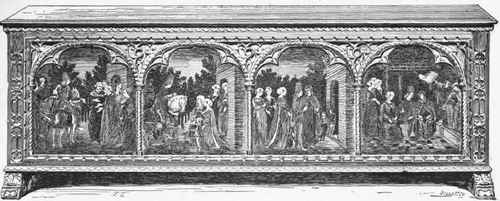
Marriage coffer or cassone ornamented with gilded reliefs and paintings; Italian work of the Fifteenth Century. [Collection of H. M. Cernusehi).
As it almost always happens, where art extends its domain, and where the wants of luxury increase, the phalanx of artists' names become rarer in our archives. We find :-
1522. Pierre Forbin, joiner, of Bourges.
1541. Martin Guillebert, huchier.
1550. Marcel Frerot, joiner.
1555. Francois Rivery, joiner of Catherine de Medicis.
1564. Francois Lheureux, employed by Catherine de Medicis.
As for Italian names, how could we collect and quote them? At the glorious period of the Renaissance, the idea of forming categories in art had not been originated; the bold geniuses of those days simultaneously applied themselves to architecture, sculpture, painting, and goldsmiths' work, and not one of them would have thought he descended from his rank by diminishing the proportion or varying the subject of whatever issued from his brain. It is, therefore, amongst the regular sculptors that we must seek for the carvers of small figures and of furniture, that is, amongst the Donatello, Bernardino Ferrante, the Canozzi, the Moranzone, Antonio and Paolo Mantoani, Fra Giovanni di Verona, Fra Sebastiano di Rovigo, Brussolon di Venezia, etc.
Already furniture becomes complicated; the credence, a simple table for making the essay or tasting provisions, as its name indicates, becomes an elegant cupboard, breast-high, often with flaps, and a small under shelf; then it is completed by a back piece, and even by a shelf, passing on thus to the form of the buffet. What was this last? At first the name was given to the room destined to contain the most valuable plate; later on it was applied to a piece of furniture serving the same purpose, and by analogy to the articles which decorated it. We will borrow from M. de Laborde the description of a buffet offered to the King of Naples for his coronation in 1495: "Au milieu de la salle avoit ung buffet qui fut donne au Roy, ou y avoit linge non pared, de degre en degre et y estoyent les richesses d'or et d'argent, qui appartiennent au buffet du Roy: aiguieres, bassins d'or, escuelles, platz, pintes, potz, flacons, grans navires, couppes d'or chargees de pierreries, grilles, broches, landies, palletes, tenailles, souffles, lanternes, tran-choirs, salieres, cousteaulx, chaudrons et chendeliers tous d'or et d'argent".
Continue to:


My Books

