


Sec. I. - Furniture Of Sculptured Wood. Part 3
Description
This section is from the book "A History Of Furniture", by Albert Jacquemart. Also available from Amazon: A History Of Furniture.
This section is from the "" book, by .
Sec. I. - Furniture Of Sculptured Wood. Part 3
The dressoir or etagere differed little from the buffet; large pieces of gold plate and other sumptuous articles were exposed there, the number of shelves was fixed by etiquette, according to the rank of the persons. The dresser was therefore the buffet of reception rooms, as the buffet was the dressoir of the banqueting hall.
We will not speak of the chairs or chaieres, some surmounted by a dais, others with an elevated back, often crowned with an escutcheon; we refer to the different models which may be seen of them at the Louvre, at Cluny, and in the collections of amateurs; it would require a long chapter to mention the folding-chairs, not less complicated than our present mechanical easy chairs, or revolving chairs (chaises a pivots), which allowed a person to turn directly round towards his interlocutor, and the gos-siping-chair (chaise caque-toire), whose not very refined name indicates an analogy with our "causeuses".
Where it is necessary for us to pause a moment, is at the word cabinet. The Marquis de Laborde considers this piece of furniture, of such general use in the sixteenth and seventeenth centuries, as a chest, or bahut, raised on four legs, which was filled with small drawers, all shut together behind a folding door, sometimes with four locks. An architectonic disposition was given to this piece, exteriorly as well as interiorly, and the cabinet was formed. The learned archaeologist has overlooked the transition which took place in the sixteenth century between the cabinet, properly so called, and the "armoire," a piece of furniture composed of two separate bodies superposed, and crowned by an elegant pediment. The fact is, that the armoire is a cabinet, of which the supporting table has been replaced by a cupboard, with folding doors, and thus utilised.
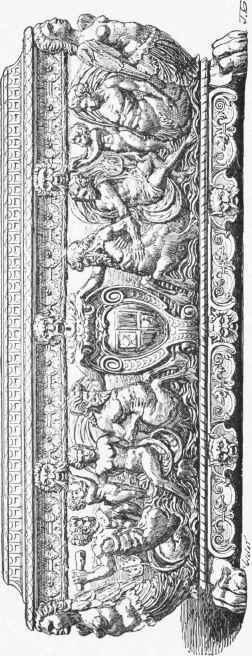
Marriage coffer of carved wood: Italian work of the Sixteenth Century. (Collection of C'omtc de Brigcs).
But it would be a hopeless task to describe these different pieces of furniture, which recommend themselves to the connoisseur by their splendid figures, medallions with busts almost in relief, and arabesques of the finest taste. This cabinet, or this credence, is a masterpiece in every respect. A series of the coffers, or "cassoni," of Italian origin, afford the most interesting subject of study as regards history and art; there is one in the Cernuschi gallery with plain mouldings, and entirely ornamented with paintings, which we should feel inclined to attribute to the beginning of the fifteenth century, if the costumes of the personages did not indicate the period of Louis XII.; those from Baron Gustave de Rothschild's collection are nearly of the same period, and yet their magnificent sculptures in relief, broken at intervals by escutcheons, the griffin supporters, the elegant arabesques which stand out boldly from the gilded and pique background, would seem to remove them nearly a century further distant. These gilded backgrounds are a remnant of the customs of the Middle Ages, for the greater part of the furniture which our museums possess, and which shine with the warm colouring of old polished oak, were once illuminated in their backgrounds as well as in their reliefs. There is still to be seen at Cluny a coffer representing the twelve apostles, which has retained its ancient paint.
It is to the Renaissance, therefore, that we owe that progress which was to substitute the simple force of relief for the artificial brilliancy of blue or of vermilion. To strengthen this force, they began to choose fine woods, more accessible to delicacy of touch than oak with its rough fibres. France especially gave the preference to walnut wood, raising on its smooth surface figures borrowed from the school of Fontainebleau. The choice of material and the style of workmanship, enable us to determine a certain number of schools; that of the north of France, faithful to its ancient traditions, retains the oak wood, and covers it with scenes in which the personages, though rather short, assume an energetic severity; the abundant ornaments remind us of those of Rouen, and of other Norman edifices. The schools of Touraine and Lyons, nearer to the sources of the Renaissance, trace on fine grained woods, rich arabesques, use winged sphinxes to support the tables, or the basements of their small edifices; and carve upon them elegant groups inspired by Jean Goujon and Germain Pilon. As for the Burgundian school, it possesses all the perfections, for it stands in the very centre of progress; since Philip the Good, it has known all the splendours of luxury, and received all the encouragement that can heighten art.
The sixteenth century, therefore, presents us a most varied and interesting series in furniture; coffers, credences, cabinets, double-bodied presses or armoires, tables, beds, seats, monumental doors, all can be obtained from it, and all in perfection. We must make a distinction, however, and not bring the simple, and light compositions of France, in contact with the redundant productions of Germany. Some amongst these, notwithstanding the science of their workmanship, sculpture exuberant garlands, and make salient brackets and caryatides, whose sturdy structure seems barely sufficient to maintain the equilibrium of the piece. This is degeneracy and it attains its final limits in what is called kunstschrank (cabinet). The cabinet-makers of Dresden, Augsburg and Nuremberg, that is Hans Schieferstein in 1568, Ulrich Baumgartner in 1605, Hans Schwanhardt, the inventor of undulated carving, do not content themselves with using various woods in its construction and appliques of stones; they call the goldsmiths to their aid, and in 1585, Keller-thaler of Nuremburg covers the smallest surfaces of the wood with repousse silver, and various gems. It is the close of the Renaissance it is true, and the threshold of the seventeenth century; but in our own country at the same period, the decline only manifested itself by the application of marble on the panels, and by the intervention of ebon)'.
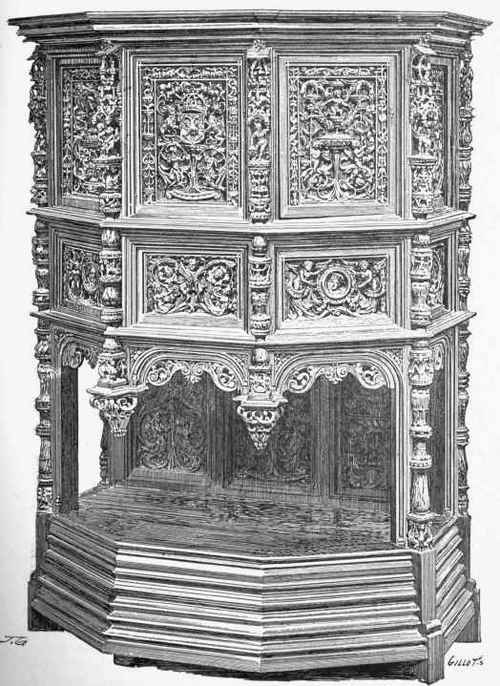
Credence of carved oak, probably executed for Maximilian I. (Collection of M. d'Yton).
We should consider as a variety of the wood sculptures of the Renaissance designs sketched out on the wood, and covered over with a preparation of stucco moulded in relief and afterwards painted and gilded, as was done in the case of frames, consoles, etc. What we meet with most frequently in this style are small jewel caskets, and other minor articles accessory to rich furniture. Some principal pieces however have existed, the disappearance of which should be attributed for the most part to their fragility alone. At the time of the sale of the Sechan collection, a cassone, or marriage coffer, was to be seen, belonging to the best period, the exterior of which, discoloured and defaced by time, scarcely conveyed any idea of its original splendour. In the form of an ancient sarcophagus, supported and divided by elegant caryatides, its reliefs represented wreaths hanging from the heads of cherubs, and borders of palmettes, separated by tritons with convoluted extremities; the upper part showed traces of a "seme" impossible to distinguish, so greatly had its details been injured. On raising the lid, all was explained; its interior, like the top, was a diaper pattern of gold rosaces, relieved by a red ground; all the fillets of the moulding, of dead gilding, and bordered by a row of beading, were ornamented with arabesques of a dull blue. The circumference of the chest being furnished with closed compartments, served as a receptacle for valuables, which were thus kept separate from the large cavity appropriated to clothes. These boxes, of a dark green colour, shone with the heightening of fine arabesques in gold. By means of these elements of ornamentation, the imagination could easily complete the restoration of the external sides, and the connoisseur could realise the degree of costliness to which a piece of furniture of this description would attain.
We pause here; not that the seventeenth and eighteenth centuries were wanting in armoires, buffets, and even commodes in carved walnut-wood; but these articles, reserved for the middle classes, were not frequent, and can scarcely be found at the present day. It is among other styles of work, therefore, that we must seek to trace out the different branches of elegant furniture.

Stool of carved wood; Italian work of the Sixteenth Century. (Collection of the Comte d'Armaille).
Continue to:


My Books

