


Carved Wood Furniture Of the East
Description
This section is from the book "A History Of Furniture", by Albert Jacquemart. Also available from Amazon: A History Of Furniture.
This section is from the "" book, by .
Carved Wood Furniture Of the East
Our labour would, however, be incomplete if we omitted to mention one important series : that of the carved wood furniture of the East - the land that has no furniture. We will begin with China, where cabinet work has, in all ages, had a considerable development, and during the last century a special centre in the town of Ning-po, which the Tai-ping insurgents have since destroyed.
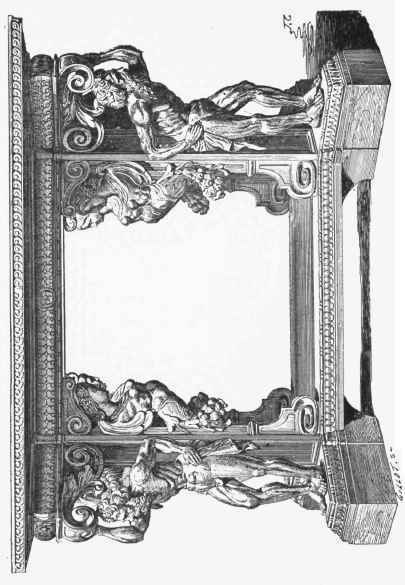
Table of carved wood; Venetian work of the Sixteenth Century. (Collection of M. Receappe )
There is nothing remarkable in the fact that the Chinese should have shown themselves skilful in working wood, as it forms the basis of their public buildings. The porticoes, the entrances of their palaces and temples, the sanctuaries of their divinities, are all of wood, and it is by the abundance of gold and by the consecrated colours that these fragile monuments are distinguished and classified according to their rank. As to the furniture, it is usually cut from the hardest woods, that especially denominated iron-wood, eagle-wood, and teak; the softer species, such as cedar, sandal, and bamboo, seldom appear, and then in smaller furniture, or occasionally in applique work.
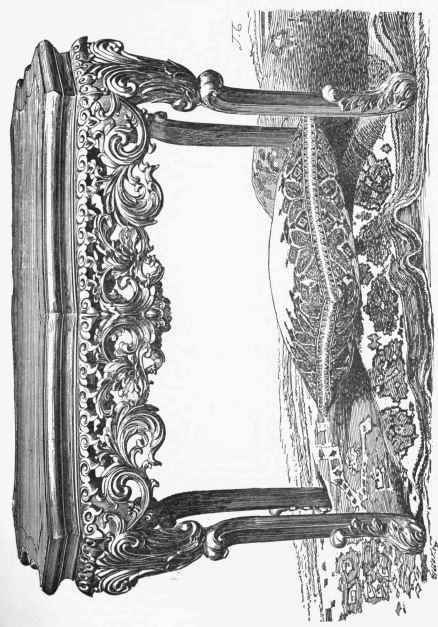
Table of carved iron-wood; Chinese work of the Eighteenth Century. (Collection of M. J. Jaequemart).
Amongst the principal pieces we have first to notice the moveable partitions used for dividing the apartments, the lower part of which are solid, and sculptured in relief with sacred and historical subjects, and surmounted by a gallery fantastically carved in open-work designs. We must also notice a piece of furniture which might almost be styled an apartment from its complicated structure; this is the bedstead. In a number of instances its pierced framework is a large circle supported on carved edges, and sometimes ornamented with frames enclosing paintings on silk. Some of these, as we before remarked, are like bedchambers; the bedstead, with a circular opening, has an outer entrance that can be closed by a sliding door, and contains a couch, facing which is a small table surmounted by a looking-glass, thus affording the means for performing the night toilette in retirement.
We have just spoken of seats; they are to be found in very varied forms. Some, rounded like the easy chairs of our bureaux, with arms, terminating in contorted dragons, are really thrones: those painted red are reserved for the emperor; those in which the wood is in its natural state may be occupied by high dignitaries giving audience. Others with square backs and carved arms are ornamented at the back and on the seat with stones, chosen with natural irregularities resembling a mountainous landscape. Round and rectangular footstools, tables and etageres complete this style of furniture, with large screens and picture frames enclosing sentences or emblems, often in relief on a lacquered ground.
The last pieces we have just mentioned are generally in black or red wood, and of very hard quality; the bedsteads, partition walls, folding screens, in a word, the ordinary manufactures of Ning-po, are in yellow wood incrusted with ivory, or in brown decorative wood incrusted with yellow pako.
Among the different pieces of Chinese furniture there are several sorts which afford a very tasteful addition to sumptuous houses : nothing is better adapted to support a handsome vase filled with flowers than the stools made of iron-wood or red lacquer. But we must carefully put aside seats and sofas executed from European models, which are rendered as disagreeable to the eye as they are inconvenient for use from a hybrid style of ornamentation, bristling with incongruous reliefs.
Japan, up to the present time, has scarcely contributed more than its etageres and carved lacquered stands, or some small pieces of furniture for special uses, such as racks for holding sabres and screens. We must, however, mention a monumental piece of sculpture which has certainly formed part of the decoration of a temple or sanctuary. It is a group of dragons surrounded by clouds and thunder. This beautiful frieze, cut out in cedar wood and relieved with light colours, adorns the tribune of the Cernuschi museum.
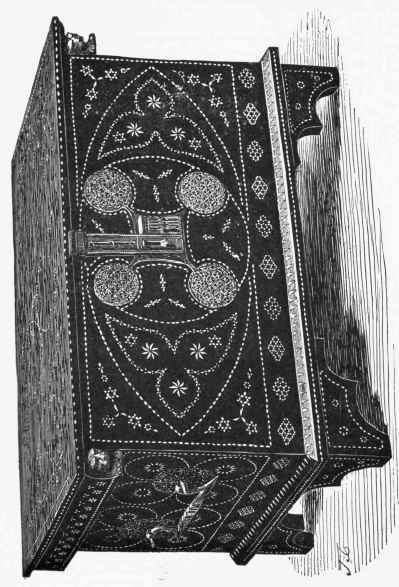
Chest in tarsia, with handles and fastenings of forged iron; Sicilian work of the Fifteenth Century. (Collection of M. Barbet de Jouy).
We may meet with some sculptured woods of India and Persia, more especially coffers and cabinets in sandal-wood; we must also be on our guard against furniture made for our own uses at the instigation of the English trade, and which are not more admissible coming from India than from China.
Neither can we pass by unnoticed the Mussulman woods which are sculptured with great elegance, and may take their place in the collection of a connoisseur under the head of "consoles-etagercs;" these are the kaou-klouk, or turban holders; they are composed of a large slab, sculptured or cut in open work serving for a base, and bearing on its lower tier, a shelf, which is either rounded or pierced along its outer rim and supported by a sort of ornamental bracket, which is often cut in open designs. The most elegant arabesques, bouquets of flowers issuing from vases, plaited or interlaced trellises are met with in these sculptures, often surmounted by the crescent and star, emblems of Islamism. Many retain the original colour of the wood, others are entirely gilded; finally some are to be found in which gilding and colours are combined; the flowers are red or white, the foliage green, and the arabesques serving as a framework or panelling are gilded. M. Sechan, who had travelled all over the East, had collected a great number of these small articles of furniture, and the sale of his collection afforded connoisseurs the opportunity of procuring this kind of sculpture.
Continue to:


My Books

