


Handles, Feet, Stuffs, Etc. Part 3
Description
This section is from the book "The Old Furniture Book", by Hannah Hudson Moore. Also available from Amazon: The Old Furniture Book.
Handles, Feet, Stuffs, Etc. Part 3
This Spanish foot retained its popularity a long time, appearing on many varieties of chairs almost as late as 1750. It was associated with cane, rush, leather, and stuff bottoms, was seen on arm and side chairs with slatted backs, and backs of cane and leather. Sometimes on the "roundabout chairs," as those having a square seat set with one angle pointed forward were called (see Figure 57), only the front foot was in Spanish style, the others being turned knobs which accorded with the turned legs and rails. Even on some of the so-called Queen Anne chairs with spoon backs, a modified form of Spanish foot was to be found, but this eventually gave way to the familiar ball-and-claw cabriole leg, or the regular Dutch foot (see Figure 11). It is curious that the cabriole leg with ball-and-claw foot was seen on pieces of furniture like both the high and low chests of drawers before it was used on chairs (see Figure 57), and the earliest of these Queen Anne chairs had the bandy leg with the plain Dutch foot.
This foot is used with the solid splat and the spoon-shaped back with rounded ends to the top.
Chippendale, in his earliest work, began to use the models then in vogue, and, with the bandy leg which was found only on the two front legs of chairs, used also a modified Dutch foot. Very soon he used instead the ball-and-claw foot, with or without the underbrace, and with the more ornamental foot the splat became pierced and carved and very ornate and rich. The later straight legged Chippendale chair (see Chapter III (Chippendale)) came into favour, with or without underbraces, and late in the eighteenth century the other great cabinet-makers came along, each with his distinctive styles and characteristics. The first of these is Hepplewhite, who never achieved the success of Chippendale, who preceded him, nor of Sheraton, who succeeded him, yet whose work is often very beautiful. He did not, of course confine himself to any one style of foot or leg, yet on many of his chairs, tables, and sideboards he used what is called the "spade foot." This was varied in many ways, but the most common form is shown in Figure 100.
Both Hepplewhite and Sheraton, as well as the other makers of the eighteenth century, used a variety of shapes of feet, for bureaus, desks, bookcases, and other pieces which were in no way distinctive. Each maker used the bracket foot as suited him best, adding curves to suit his fancy or the exigencies of the case, or inlay or even carving. A plain bracket foot is shown in Figure 100. The French foot (Fig. 100) is more ornate and slender, and comes on chests of drawers, bureaus, etc. Inlay is very often used for its decoration, and it adds a graceful line to the piece it is used on, which is always of choice wood inlaid or painted.

Flemish.

Spanish.

Dutch.

Dutch.
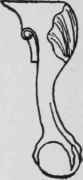
Chippendale.
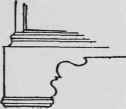
Bracket.

French Foot.

Hepplewhite or Spade.

Sheraton.

English Empire.

Pillar and Claw.
Figure 100. FEET.
The tapering fluted foot which we associate with Sheraton is also shown in Figure 100. Under his treatment it was nearly always decorated, either inlaid or carved, or sometimes both. Although we are most familiar with Sheraton style furniture in mahogany, he made much other furniture besides, as the follow-ing description of drawing-room chairs shows:
" These drawing-room chairs are finished in white and gold, or the ornaments may be japanned, but the French finish them in mahogany with gilt mouldings. The figures in the tablets above the front rails are on French printed silk or satin, sewed onto the stuffing with borders round them. The seat and back are of the same kind, as is the ornamented tablet at the top of the chair. The top rail is pannelled, a small gold bead mitred round, and the printed silk pasted on. Chairs of this kind have an effect which far exceeds any conception we can have of them from an uncol-oured engraving, or even a coloured one."
This does not seem like the furniture we know as "Sheraton ", yet in his books are many similar descriptions. After Sheraton gave up manufacturing furniture, and wrote only books of descriptions and patterns, France had passed through the throes of the Revolution, when the old regime was swept away. Napoleon had been proclaimed First Consul, and then, in 1802, confirmed for life, and took under his charge even such minor details as furniture and dress. The styles arranged to suit his whim found an echo in England. The English Empire, both at its best and worse estate, could boast of nothing better than a feeble imitation of the antique, while the French Empire was at least an expression of the conquests and successes of one man.
Thomas Hope was perhaps the best exponent of this style in England, and he industriously mingled emblems of the gods and goddesses, Phrygian caps and Roman fasces, Greek amphorae, and fabulous animals on the furniture which he designed. In Figure 100 is shown one side of a chair designed by him, as also an Empire pillar-and-claw leg, as rendered by American cabinet-makers. Less ornate and ambitious, the American treatment of this period is preferable, for the chief use to which they put brass and bronze, the too-abundant use of which was so characteristic of this style, was to tip columns or pillars, and, to some extent, the feet of tables.
Continue to:


My Books

