


American Empire. C. 1795-1830. Part 6
Description
This section is from the book "The Practical Book Of Period Furniture", by Harold Donaldson Eberlein And Abbot McClure. Also available from Amazon: The Practical Book Of Period Furniture.
American Empire. C. 1795-1830. Part 6
Materials
The almost universal material for Empire furniture was mahogany, and only the best wood was used. In some few instances furniture of the Empire period is found executed in walnut, but walnut pieces are exceptional. Rosewood was sometimes employed, but never to any great extent. Pine wood was the usual base for veneers. Curly maple was occasionally used.
Decorative Processes
The decorative processes of the American Empire period were limited in number compared with those employed in the eighteenth century. Carving and turning were the most usual. Some of the finer pieces were inlaid with brass and a few pieces were painted or else adorned with marqueterie. The application of brass or ormolu mounts, while almost universal in the French Empire furniture, was limited in extent in the American Empire furniture.
Types Of Design
The types of decorative design included bears' and lions' claw feet, wings, sphinx heads, griffins, acanthus, pineapples, melons, cornucopias with various fruits and flowers, spirals, reeding, and honeysuckle of the classic type.
Structure
In structure Empire furniture was exceedingly substantial and solid. The carcase work was almost universally rectilinear. Chairs, when not braced with stretchers, were usually so staunchly made, and of such solid proportions, that they have well withstood the wear and tear of time. As pointed out in the section on chairs, top rails were sometimes dowelled to the uprights and sometimes included between them.
Mounts
The ordinary mounts found in Empire furniture were either of brass or glass; pressed-glass knobs were extremely popular and designs of various patterns were used, the knob either being mounted in metal or held in place by a metal rod running through and bolted on the inside of the door or drawer. Brass mounts were sometimes round and chased, but more usually were of the lion-head type with a ring hanging from the mouth.
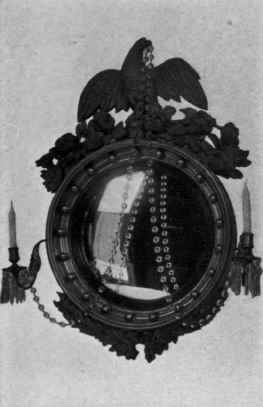
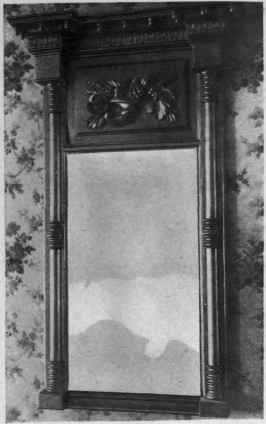

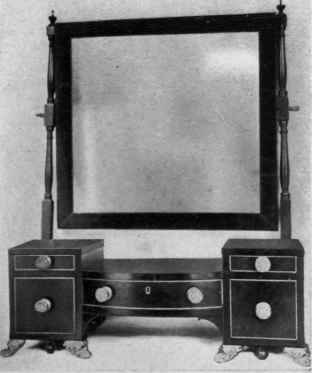
PLATE XLII. GIRANDOLE, WALL MIRROR AND TWO DRESSING STAND MIRRORS OF AMERICAN EMPIRE PERIOD By Courtesy of Miss Mary H. Northend, Salem, Mass.
Finish
What was said of finish in the chapter on the French and English styles also applies to furniture of the American Empire period. Both the old methods and the French-polishing methods were made use of. French polishing, however, was exceedingly popular and the pernicious trick of artificially reddening mahogany that came in fashion at this time, as a part of the process, is responsible for much popular misconception of the true properties of this beautiful wood.
Continue to:


My Books

