


American Empire. C. 1795-1830. Part 2
Description
This section is from the book "The Practical Book Of Period Furniture", by Harold Donaldson Eberlein And Abbot McClure. Also available from Amazon: The Practical Book Of Period Furniture.
American Empire. C. 1795-1830. Part 2
Articles
In the American Empire period the articles of furniture that chiefly concern us are chairs, stools, couches, sofas, bedsteads, tables, chests of drawers, bureaux (in the American sense of the word), workstands, sideboards, pier tables, wash-stands, bookcases, secretaries, wardrobes, cupboards, dressing tables, mirrors and clocks. The graceful knife boxes, highboys, lowboys and chests with lifting lids no longer appear. Certain articles in certain rooms centre attention upon themselves, the bedstead in the bed-room, the sideboard in the dining-room and the sofa in the parlour, and upon them the cabinet makers lavish their utmost care and elaboration.
Contour
American Empire furniture is in some respects worse than English Empire furniture and in other ways far better. The one man to whom much of its redeeming quality is due was Duncan Phyfe, a New York chair- and cabinet-maker, who may very appropriately be called the American Sheraton. He was possessed of a remarkable sense of proportion and endowed with excellent good taste, so that the furniture he designed redeemed much of the bald ugliness and clumsy ponderosity of some of the other work produced in great quantity. As in English Empire work, carcases were rectilinear and shaped or serpentine fronts were no longer in vogue. Cornices and mouldings were heavy. The supports of large pieces of cabinet-work were turned. The chairs were simpler in type and less pretentious but in the main followed the same general lines of structure. Drawers on some of the pieces of cabinet-work had heavy oval swell fronts, although the framework was perfectly straight. Bedsteads had both the old high posts (Key XVI, 5) and the shortened posts (Key XVI, 6) surmounted by carving (Fig. 1, F). In almost all cases there were higher foot-boards which presented a new feature.

A





Fig. 1. Typical American Empire Details.
Chairs
The American Empire chair is more graceful in the long run than its English cousin, upon which fantastic notions were often allowed free play. Seats were customarily square (Key XVI, 2 and 4; Fig. 2), legs were both straight (Key XVI, 4; and Fig. 2) and outward curved (Key XVI, 2) following the lines of the legs in the old classic curule chair. The top rail of the backs was almost always curved to fit the figure of the sitter (Key XVI, 2 and 4). In the best type of Empire chairs the top rail is straight, rolled over (Key XVI, 2 and 4) and sometimes the panel on it is carved (Key XVI, 2) The uprights supporting the back, when they extend above the top rail, are scrolled slightly over (Fig. 2) in the manner of the Greek curve, and there is a cross-bar between the uprights, midway between the top rail and the seat (Key XVI, 2 and 4; Fig. 2). This cross-bar is customarily turned, moulded or carved (Key XVI, 2 and 4; Fig. 2).
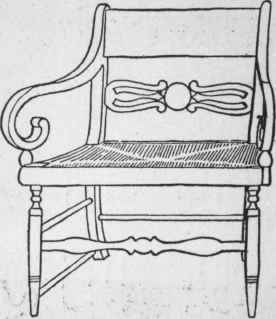
Fig. 2. Roll-Arm, Rush-Bottom Chair. By Courtesy of Mrs. Richard C. Ridgway, Philadelphia. Formerly owned by Stephen Girard.
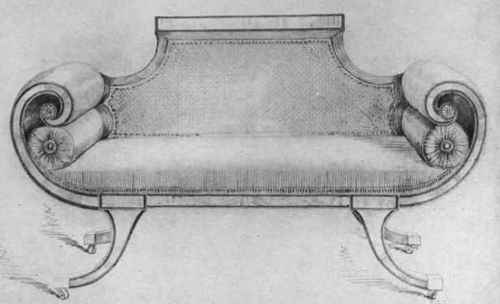
MAHOGANY AND SATINWOOD CANED-BACK PHYFE SETTEE By Courtesy of the Chapman Decorative Company, Philadelphia.

AMERICAN EMPIRE CARVED MAHOGANY SOFA SHOWING PHYFE INFLUENCE REEDED SEAT-RAIL, ARMS AND TOP-RAIL. EAGLE LEGS AND FEET.
By Courtesy of Mr. H. Burlingham, New York City.
PLATE XL.
The arm-chairs were of similar line, the arms being shaped and joining the uprights just beneath the broad top rail (Fig. 2). They came forward in a straight line and terminated in scroll ends (Fig. 2). Stretchers were often used and the front stretcher was not recessed but was raised much higher than the stretchers of the Chippendale chairs (Key XVI, 4; and Fig. 2), while there were two stretchers at the sides above and below the level of the front stretcher. The back stretcher was also raised. The top rail was sometimes included between the uprights (Fig. 2). In some patterns the top rail was dowelled on to the uprights and extended beyond them (Key XVI, 2 and 4). Rush-bottom chairs, painted and adorned with gilding (Key XVI, 4; and Fig. 2), followed the same general line. Occasionally in the chairs of less correct pattern the top rail was shaped on its upper edge. Another form of Empire chair had the uprights curving down and projecting as rudimentary arms towards the front part of the seat, giving the whole piece of furniture a peculiar hooped-back appearance (Fig. 1, B). Some of the later upholstered arm-chairs had padded arms which terminated in supports formed of swans' necks and heads or of one of the other characteristic Empire motifs,
Continue to:


My Books

