


Jacobean Period. 1603-1688. Part 6
Description
This section is from the book "The Practical Book Of Period Furniture", by Harold Donaldson Eberlein And Abbot McClure. Also available from Amazon: The Practical Book Of Period Furniture.
Jacobean Period. 1603-1688. Part 6
Cupboards
The cupboard was a very favourite piece of furniture during the Stuart period and much care and expense were lavished upon its decoration that it might worthily express the state and rank of its possessor. It occurs under divers shapes as a court cupboard (Key I, 4), a livery cupboard, a hanging cupboard - the progenitor of the wardrobe - an almery and several more.
Hanging Cupboabds were about five feet or even less in height, with openings in the doors to ventilate the clothing hanging within.
Livery Cupboards were small affairs that were hung on walls or set on tables or other conveniently elevated places, the doors frequently pierced with balustered or spindle openings, and were meant to hold food, wine and candles.
2 The word bureau is of course connected with writing, and in Great Britain a bureau is a writing-desk. In America it has come to have an entirely different signification, and it would seem to be for the following reason. Chests of drawers were frequently made with a drop lid and pigeon-holes taking the place of the upper drawers and they were then called bureaux: when these writing facilities were dropped and the chests were composed entirely of drawers and used for toilet purposes solely the name bureau still persisted, and as it3 use is so universal it seems impossible to avoid employing it.
Bread and Cheese Cupboards were bulky pieces of furniture sometimes divided into upper and lower compartments and were meant for the storage of the household larder.
Almeries were receptacles similar to livery cupboards, and were intended to put doles into for pensioners or family retainers.
Court Cupboards, literally short cupboards (Key I, 4), were originally small cupboards set on sidetables. Afterwards the two were combined into one piece and the lower part, originally but a table, was fitted sometimes with shelves, sometimes with doors, making a lower cupboard. The upper part was bedecked with pillars supporting an ornate corniced top. The other varieties of cupboards consisted of straightforward rectangular carcase work without any pretense at architectural character.
Cabinets on high stands with carved or spiral turned legs were characteristic of late Carolean times (Key I, 5).
Buffets, Dressers And Sideboards
The buffet, the dresser (Fig. 9), the sideboard (Fig. 8), and all the other prototypes of that useful and now universal article of dining-room furniture were evolved from modifications of the table or cupboard, or both, and flourished mightily in numbers and in sundry-guises all during the Stuart period.

Fig. 7. Jacobean Small Oak Cupboard, c. 1670. Total height, 5 feet 8 inches.
By Courtesy of Mr. R. W. Lehne, Philadelphia.
But little removed from the court cupboard in type was the buffet meant for the display of plate and also for convenience in serving. It was a heavy table placed against the wall with a superstructure on pillars, but without any cupboard. Akin to the buffet was the dresser (Fig. 9), with a cupboard in the lower part and a back with open shelves. This type was probably of Welsh or Yorkshire origin, known in Wales as a "cwpwedd tridarn," and persisted well into the eighteenth century. Another type was the heavy low table with deep drawers (Fig. 8), very like the sideboard that came into fashion late in the eighteenth century.
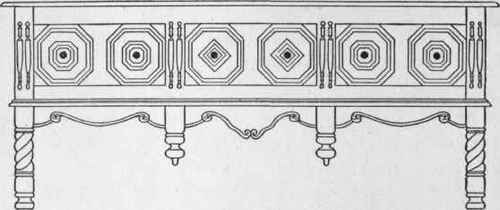
Fig. 8. Jacobean Oak Sideboard, c. 1665. Showing Flemish influence in geometrically panelled drawer fronts and applied ornament; also spirally turned legs. Length, 6 feet 6 inches; height, 34 inches.
By Courtesy of Mr. R. W. Lehne, Philadelphia.
Continue to:


My Books

