


American Empire. C. 1795-1830. Part 4
Description
This section is from the book "The Practical Book Of Period Furniture", by Harold Donaldson Eberlein And Abbot McClure. Also available from Amazon: The Practical Book Of Period Furniture.
American Empire. C. 1795-1830. Part 4
Chests Of Drawers
Chests of drawers were no longer made in two sections but were slightly higher than those of the preceding period, usually being four drawers instead of three drawers in depth. In many of these chests the deep upper drawer had a pull-down front supported on quadrants and was used as a writing desk. The fronts were always straight.
Bureaux
The modern bureau began its existence in the Empire period, when permanent mirrors supported between upright posts (Fig. 1, A) were permanently attached to what had hitherto been chests of drawers. As explained before, the name arose from the custom of having the upper drawer of these chests of drawers equipped as a secretary.
Secretaries
Secretaries were made with towering bookcase tops; the lower portion contained drawers or doors, and the large upper drawer had pull-down front and was used as a desk. The slant-top secretary was no longer made. At this time also another form of secretary appeared, of French type, being about four feet high and in form resembling an Egyptian temple or monument, or sometimes the contour of a Greek building. The front pulled down and made an ample writing desk (Key XV, 4).
Bookcases
Bookcases in the main followed the designs prevalent in the latter part of the eighteenth century, while the influence of Sheraton was still paramount. They rested on solid plinths upon the floor and were made in one or three sections laterally, and vertically they were usually divided into two sections, the upper portion being of slightly receding dimensions. The doors were glazed, sometimes both top and bottom, but always in the top, and were usually traceried. The tracery was heavier than during the preceding periods and sometimes moulded or carved.
Cupboards
In the corner cupboards of the Empire period it is possible to trace a strong lingering Sheraton feeling.
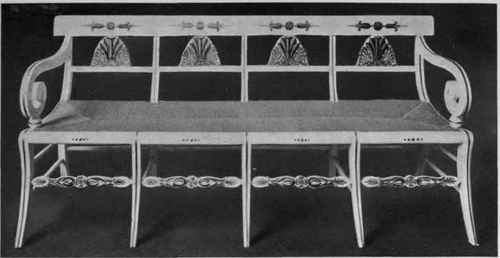
PAINTED AND PARCEL GILT AMERICAN EMPIRE RUSHBOTTOMED SETTEE.
By Courtesy of Mr. James Curran, Philadelphia.
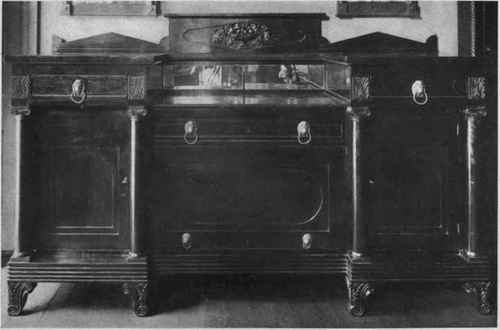
AMERICAN EMPIRE CARVED MAHOGANY SIDEBOARD, ACANTHUS CARVING AND FEET AND LION'S HEAD MOUNTS.
By Courtesy of Mr. James Curran, Philadelphia.
PLATE XLI.
While many of the tops; are straight, we nevertheless find quite a few where the top is adorned with a scroll swan-neck pediment centring in a vase. The doors taken together form a round arch and the upper parts are traceried with pointed muntins. A characteristic Empire motif was frequently introduced in the shape of spiral-turned or carved corner pillars with acanthus carving at the capitals. The corner cupboard was not an object that readily lent itself to embellishment with the characteristically heavy and robust motifs typical of the Empire period. These corner cupboards rest on bracket feet, and panels in the doors of the lower part are frequently edged with a turned or nulled moulding.
Continue to:


My Books

