


Jacobean Period. 1603-1688. Part 5
Description
This section is from the book "The Practical Book Of Period Furniture", by Harold Donaldson Eberlein And Abbot McClure. Also available from Amazon: The Practical Book Of Period Furniture.
Jacobean Period. 1603-1688. Part 5
Tables
During the Stuart period tables steadily became articles of more serious import than in preceding epochs. The change from movable boards set upon trestles to tables of permanent structure had occurred during Tudor times but it is not till the days of the Stuarts that we find them in any considerable number. Then we meet with the long tables (Fig. 5 and Key I, 6) that follow the traditional lines of the trestle boards, ingeniously devised "drawing tables," gate tables with drop leaves, small rectangular tables, three-cornered cricket tables and many others.
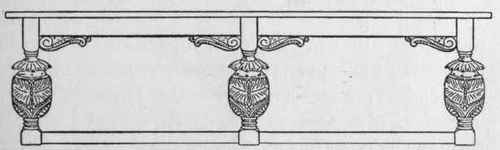
Fig. 5. Jacobean Oak Refectory Table, c. 1635. Length, 89 inches; width, 33 inches; height, 30 inches. Heavily carved bulbous legs and low stretchers characteristic of the early period.
By Courtesy of Isaac W. Roberts, Esq., Pencoyd, Bala, Pa.
The early Jacobean long or "refectory" tables were frequently of great length - some are known of even thirty feet or more - but narrow in comparison. Their structure is described in the section on "Structure." "Drawing-tables" were ingeniously contrived to double their length and seating capacity. This was accomplished "by means of two shelves, sliding under the central top, but so arranged that upon their being drawn out, the upper top falls into their place, thus forming a level surface."
The gate table (Key II, 7), which originated in this period, was found so practical and useful that, with slight variations according to the characteristics of the age, it has persisted to present days, and so, in some one of its forms, may be said to belong to each period.
About the time of the Restoration, owing largely to the prevalent habit of tea and coffee drinking, various shaped small tables began to be made in great numbers. They were also used for games. Drawers in tables became common at this date also. All the Stuart tables were substantially braced by stout stretchers near the floor. Bulbous legs (Key I, 6 and Fig. 12, b) went out of fashion by the middle of the seventeenth century. Ringed baluster and columnar legs appeared about the time of the Restoration (Fig. 12, a and c) in tables as they did also in chairs.
Chests
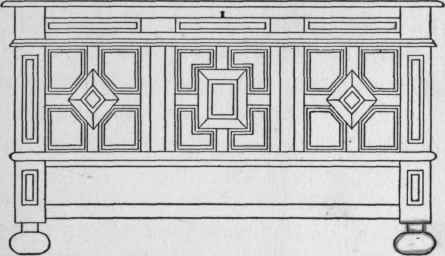
From the very dawn of history, chests (Fig. 6) of one sort or another have been factors of tremendous importance in domestic economy. Both for storage purposes and as seats they have played a conspicuous part in household equipment. They were made of various materials and wrought in every degree of workmanship from the rude box of an unskilled joiner to the masterpieces of a cunning carver or inlayer.
Several differences of structure must be noted in the divers kinds of chests. The original and commonest type of chest had a lid which opened upward. Coffers were chests of such pattern strongly made for the sate keeping of valuables. Caskets were small chests, likewise of this type, for the keeping of trinkets. Hutches were chests with stationary tops and had doors opening in front instead of lids. All these varieties were found at the beginning of the Stuart period. About the middle of the seventeenth century appeared chests with one or more drawers in the lower part, the top having a hinged lid as formerly. Later in the century more drawers were added, until by the eighteenth we have not chests with drawers but chests of drawers, the fore runners of the modern bureau.2 In Carolean times we find high chests with drawers in the lower part, while the upper opens with hutch-like cupboard doors.
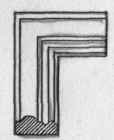
Detail of moulding.
Fig. 6. Jacobean Oak Chest, c. 1680, in Collection of Pennsylvania Historical Society. Flemish and Dutch Influence in Panels of Applied Moulding and "Bun" Feet. Height, 35 inches; length, 53 1/2 inches; breadth, 23 1/2 inches.
On nearly all the different sorts of chests of this period carving, geometrical panelling or inlay - according to the particular vogue of the day - were lavishly used for embellishment.
Continue to:


My Books

