


William And Mary. 1688-1702. Part 3
Description
This section is from the book "The Practical Book Of Period Furniture", by Harold Donaldson Eberlein And Abbot McClure. Also available from Amazon: The Practical Book Of Period Furniture.
William And Mary. 1688-1702. Part 3
Stools
Stools were still in considerable demand in lieu of chairs. What has been said of chairs regarding structure, form of legs, stretchers, upholstery and the like applies equally to stools. In addition to stools meant for one person to sit upon, there were long stools, as long as settees, that would accommodate two or three people. Joint stools with turned legs were found everywhere.
Forms And Settles
Forms and settles continued to be made in the country districts and for those in humbler circumstances and were usually of oak.
Settees
As settees were for the most part simply chairs lengthened out there is little additional to be said of them. Attention, however, must be called to the wings or flaps at the sides and the frequent shaping or double arching of the backs (Fig. 3). Settees with double arched backs usually had two squab cushions side by side instead of one long one (Fig. 3).
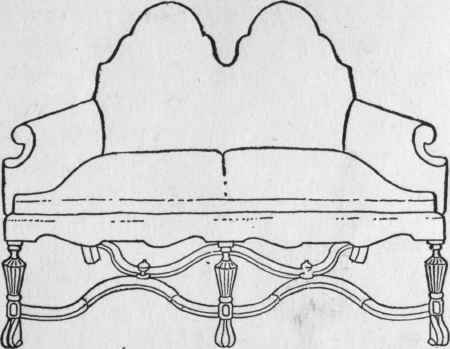
Fig. 3. Settee with Double Arched Back, Fluted Spindle Legs and Spanish Scroll Feet with Shaped Stretchers.
By Courtesy of Mr. R. W. Lehne, Philadelphia.
Day-Beds
Day-beds were made with legs and upholstery conforming to the prevalent styles as exemplified in chairs and settees. They even appeared - and this was notably the case in America - made of the less expensive woods with rudely turned legs and rush seats, and it was quite evident that they filled an important place in the households of some of the humbler members of the community.
Bedsteads
During this period many people continued to use the substantial oak bedsteads of Stuart days. For the newer houses, whose chambers were built with lofty ceilings, bedsteads were made with exceedingly tall, slender posts, round or octagonal, and testers with elaborately moulded cornices. Some of these creations towered sixteen or seventeen feet in the air. Not only were these gigantic bedsteads well curtained, but the woodwork was practically invisible, being almost wholly covered with brocades, velvets, satins or silks closely "strained" or glued on so that no detail of the contour of the intricate mouldings would be lost. Chintzes were also much used for bed-hangings.
The less important members of the household slept in truckle beds, cupboard beds, "turn-up" beds or "press beds" (which shut up against the wall) or on pallets, all of which seem to have completely disappeared.
In America the bedposts never reached such an exaggerated height as they did in England.
Tables
The typical dining table of the period was the gate which, when the leaves were extended and supported by the gates being pulled out, were generally round or oval in shape and could comfortably accommodate eight or ten persons (Key II, 7). The legs of these tables were turned.
Of common occurrence were small rectangular tables with cup or spindle turned legs, saltire stretchers and bun feet (Key III, 1, and section on Lowboys). While the gate tables were plain, these small tables were often highly decorated with marqueterie or lacquer.
It was not an age of large tables such as those that had characterised earlier Stuart days and instead of the long refectory boards we find a host of small tables for cards, writing, dressing, tea, gaming and various other uses. 6

Fig. 4. Details of Feet, Legs and Mouldings Characteristic of William and Mary Period.
Besides gate tables, there were small folding tables made upon the same principle and having turned legs and "butterfly" tables with outward splayed turned legs and movable wing brackets to uphold little leaves on each side.
At this same time were found, chiefly in America (see Chapter on "Other American Furniture"), small rectangular tables with four straight turned legs and straight turned stretchers. They were simpler than the tables with cup-turned legs and bun feet but full of grace. Joint stools of similar pattern frequently accompanied them (Key XVIII, 5).
Continue to:


My Books

