


American Empire. C. 1795-1830. Part 3
Description
This section is from the book "The Practical Book Of Period Furniture", by Harold Donaldson Eberlein And Abbot McClure. Also available from Amazon: The Practical Book Of Period Furniture.
American Empire. C. 1795-1830. Part 3
Stools
What was said of the English Empire stools may be repeated of those made in America. They were not popular pieces of furniture.
Sofas
The sofas of the Empire period for the most part are deserving of commendation. They are to be met with in various patterns. Of these the most usual are the cornucopia, so called because of the shape of the arms (Fig. 1, D), which are likewise generally carved in front with that cheerful device showering abroad its fruity blessings; the Greek curve-end sofa with rolled-over arms (Key XVI, 1; Fig. 1, C) and legs turned outward toward the side with lion feet (Key XVI, 1; Fig. 1, C) or curved sidewise in lines similar to the legs of an old Roman curule chair (Fig. 3); the sofa with winged claw feet (Fig. 1, C; Plate XL, p. 290); the sofa with turned feet and carved front supports for the arms, and various other patterns, all more or less similar, that may be recognised in general characteristics already mentioned. The Phyfe sofas have legs of the curule pattern (Fig. 3, Plate XL, p. 290), often with brass-mounted claw feet (Fig. 5). The ends are curved over in Greek manner and the top rails are straight and rolled over (Fig. 3). The proportions are much more graceful than those of the other sofas.
There were also many caned settees and couches made, the frames being painted a ground colour and adorned with gilt striping and black lining, the gilding at the ends and at scroll pieces being worked into the anthemion motif (Key XVI,4).

Fig. 3. Sofa of Characteristic Phyfe Contour.
Bedsteads
In America during the Empire period four-posted bedsteads continued to be used and pillars were of bulky dimensions and heavily carved. The bases of the posts were straight and turned (Key XVI, 5; Fig. 1, G, H, I and K), the upper parts were carved with spiral acanthus, plain spirals (Fig. 1, H), or other spiral foliations or floriations (Fig. 1, (?) or the acanthus motif alone without any spiral treatment was used (Key XVI, 5; Fig. 1, K). Then again, the criss-cross diaperings of the pineapple (Fig. 1, F) played an important part in the decorative motif for these impressive bedsteads. Such bedsteads rarely had foot-boards, but had low head-boards.

Fig. 4. Gondola or "Sleigh" Bed.
Another type of bedstead had the posts pollarded and terminated with a pineapple motif (Fig. 1, F). Then again, the beds of the gondola or sleigh type (Fig. 4) or the beds with straight head-boards and foot-boards were used.
Key Plate XVI. American Empire Period - Continued

Fig. 1. Bedstead with High Head- and Foot-board, Akin to "Gondola" or "Sleigh" Type.
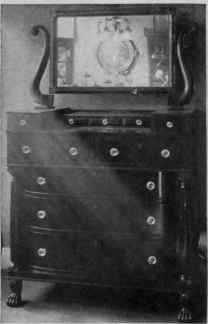
Fig. 2. Bureau, Pillar Front, Paw Feet, Swell Front Drawers and Swung Mirror.

Fig. 3. Pedestal Card Table, Flap Top, Acanthus and Claw Legs and Feet.

Fig. 4. Phyfe Lyre Pedestal Card Table, Brass Paw Feet.
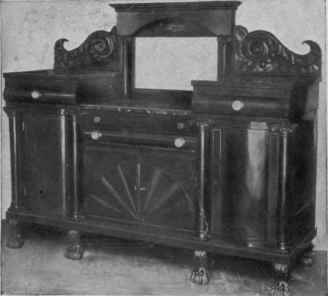
Fig. 5. Mahogany Sideboard, Pillared Front, Paw Feet, Decadent Epoch.
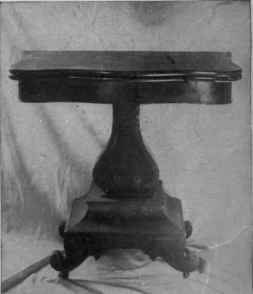
Fig. 6. Pedestal Card Table, Scrolled and Veneered, Decadent Epoch.
Tables
Dining-tables in the Empire period were usually made with square ends and were of the extension type, having drop leaves and other leaves which could be inserted on pedestal tables (Key XVII, 3, and Fig. 5). It was not an uncommon thing on the occasion of large family dinners when an unusually long table was required to have several pedestal tables put at the ends of the drop-leaf tables that formed companion pieces.
Centre tables came into vogue at this time and were ordinarily circular in shape and usually supported on highly ornate pedestals (Figs. 5 and 6; Plate XXXIX, p. 286) rising from a plinth that in turn was supported on winged claw feet (Plate XXXIX, p. 286). Many of these pedestal tables were rectangular and some had double tops which could be opened out or turned up against the wall (Fig. 5). Bases were often ornately carved and exhibited some beautiful specimens of the wood-carver's art. The sofa tables, of which beautiful specimens were made by Phyfe, were oblong and had narrow drop leaves at both sides. The ends were usually supported by some variation of the lyre motif, rising from outward-spread, curule legs with brass-mounted feet (Key XVII, 4). Phyfe, more than any of the other American makers, retained the custom of using brass mounts on his furniture. Work-stands were made both square and with polygonal ends and were supported either on pedestals or on four legs, the pedestal, as in the case of other tables, rising from a plinth or from four curule-shaped legs (Fig. 6).

Fig. 5. Pedestal Table. By Courtesy of Wilson Mitchell, Esq., Philadelphia.

Fig. 6. Pedestal Drop-Leaf Table. By Courtesy of Wilson Mitchell, Esq., Philadelphia.
Pier tables of elaborate pattern supported on pillars or dolphin-shaped supports (cf. Supports in Plate XXXIX, p. 286) were considered extremely elegant and were often adorned in the back part with mirrors.
Continue to:


My Books

