


Chapter II. Jacobean Period. 1603-1688
Description
This section is from the book "The Practical Book Of Period Furniture", by Harold Donaldson Eberlein And Abbot McClure. Also available from Amazon: The Practical Book Of Period Furniture.
Chapter II. Jacobean Period. 1603-1688
Reigns of James I and Charles I; The Commonwealth; Reigns of Charles II and James II
Jacobean Period (proper) | 1603-1649 |
Cromwellian Period | 1649-1660 |
Carolean Period | 1660-1688 |
WERE it not for the following exemption it might be hard upon the reader that this book necessarily begins with the Jacobean period, which is the most complicated of all. Jacobean furniture, however, is only and pre-eminently adapted to residences of the Tudor and Stuart type, so that if the reader's home is of a later style it would be as well for him to begin with the next chapter - that on William and Mary furniture - returning later to this section to inform himself upon its subject. Jacobean furniture is heavy and cumbersome, and therefore not well suited to modern apartments or houses other than those of the styles of architecture mentioned above.
Jacobean Period 1603-1688 Jacobean (Proper), Cromwellian, Carolean
Material Usually Oak See Text Pages 29-70

Fig. 1. Jacobean Chair Wainscot.

Fig. 2. Cromwellian Chair Upholstered.

Fig. 3. Carolean Chair Caned.

Fig. 4. Jacobean Court Cupboard Characteristic Form and Ornament.

Fig. 5. Late Jacobean Marqueterie Cabinet Showing Transition to William and Mary.
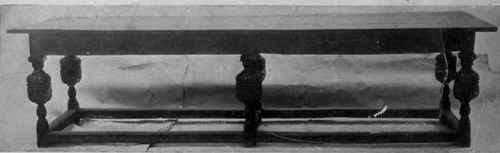
Fig. 6. Refectory Table. Bulbous Legs Characteristic of Jacobean (Proper).
Key Plate I. Jacobean Period - Continued

Fig. 7. Gate Table (wings swing out like a gate to support leaves) Of a Type Persisting from Cromwellian Times through Eighteenth Century.
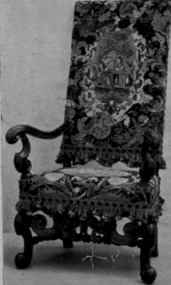

Fig. 8. Carolean Chair and Settee. Covered with Embroidery.

Fig. 9. Carolean Day-Bed.
For those whose needs embrace Jacobean furniture the authors have endeavoured to offset all difficulties and make its study as easy as possible by treating it in the most practical and systematic manner. They would also cheer the reader by assuring him that the subsequent periods are much simpler and less varied in their characteristics.
Before treating of Jacobean furniture itself it is necessary to say a few words regarding the terms used,when we speak of the Jacobean or Stuart period, with reference to furniture, we ordinarily include everything between 1603, when James I ascended the throne of England, and 1688, when the second James fled before the victorious approach of William of Orange.

Fig. 1. Jacobean Oak Cupboard, c. 1665, Characteristic Strapwork Frieze. Geometrical Panels Made of Applied Mouldings Inlaid in Centre. Detail of Frieze at Top.
By Courtesy of Mr. R. W. Lehne, Philadelphia.
By a narrower but, at the same time, more strictly accurate application, the term "-Jacobean" is restricted to the period from 1603 to 1649. The developments between 1649 and 1660 are classified as "Crom-wellian." To everything subsequent to the Restoration and prior to 1688 the term "Carolean" is applied.
While bearing in mind the more usual and comprehensive scope of the designation "Jacobean," the narrower and more exact usage is perhaps preferable as it enables us to refer readily to certain specific furniture types without incessantly quoting approximate dates. Besides, the names "Cromwellian" and "Carolean" carry with them lively historical associations that are not a little helpful in recalling the influx of varied agencies that materially affected the styles of furniture as well as everything else throughout the realm. Each of these minor epochs comprised within the general period from 1603 to 1688 was subject to its own special set of influences that all took shape in outward form. It is impossible not to accord due recognition to these differences and therefore, for the sake of greater exactitude and clearness, we shall hereafter, as far as may be, differentiate the styles according to the subdivisions just noted.
As to the extreme limits of any mobiliary 1 period at either end, it would be not only arbitrary but misleading and inaccurate as well to say that such and such a furniture type began or ended at just such a date. As a matter of fact a process of evolution, sometimes slow and sometimes rapid, was always taking place. Styles so overlapped that the best one can do is to give dates at which approximately boundary posts can be set, dates at which certain features became noticeably prominent.
To show both how unwise and unsafe it is to take too didactic or categorical an attitude, we may cite the instance of a cabinet reputed to have been made for Marie Antoinette and formerly classed by experts as unquestionably "Louis Seize" upon the evidence of its style. A few years ago it became necessary to repair it and when taken apart it disclosed the name of the maker who had died long before Marie Antoinette was born. Keeping ever before us, then, this necessary latitude in judgment, for which we are bound to make allowance, we shall pass on to an enumeration of the articles of furniture in common use within the period covered by this chapter.
1 Pertaining to movable furniture, cf. Fr. meuble, Latin mobilis.
It may be said here that, while their variety in number and form is great, their characteristics are unmistakable and different from those of any succeeding period. The illustrations in the Chronological Key and throughout the chapter have been selected with such care that they will at once familiarise the reader with the work of this period.
Continue to:


My Books

