


Queen Anne And Early Georgian. 1702-1750. Part 8
Description
This section is from the book "The Practical Book Of Period Furniture", by Harold Donaldson Eberlein And Abbot McClure. Also available from Amazon: The Practical Book Of Period Furniture.
Queen Anne And Early Georgian. 1702-1750. Part 8
Buffets And Dressers
Long buffets or dressers were made with the characteristic cabriole legs, club feet and shaped aprons. They were made both without and with an upper part containing open shallow shelves for platters and plate see Fig. 16), and the lower part contained drawers. They were not infrequently of oak banded with kingwood or rosewood. Sideboard tables (see Tables) with marble tops were largely used in dining-rooms.

PLATE X. EARLY GEORGIAN MAHOGANY BEDSTEAD.
By Courtesy of Richard A. Canfield, Esq., New York City.

Fig. 16. Dresser of Typical Queen Anne Form. By Courtesy of Mr. R. W. Lehne, Philadelphia.
Mirrors
The shape of the typical Queen Anne mirror is that illustrated in Figure 17. Both large and small had broad ovolo moulded frames shaped with the double cyma motif at the top. In the tall mirrors the glass was usually in two sections and bevelled, the upper piece overlapping the lower without wooden moulding to mark the boundary. Mirrors of this shape were often highly carved and gilt. Small mirrors of much this same shape were supported between uprights on little stands of drawers that were set on tops of dressing-tables or single chests of drawers. Another type of mirror was slightly later and showed distinct traces of architectural feeling, being surmounted with a pediment, broken or unbroken, having "dog-ear" trims at the upper outside corners and displaying much gilded ornament along with the well chosen walnut. This type was really Early Georgian rather than Queen Anne.
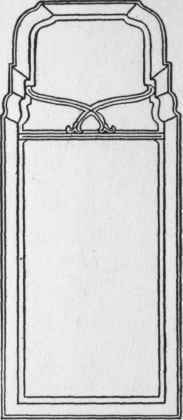
Fig. 17. Mirror in Black Frame with Gilt Lines. Brought to Philadelphia in 1711. By Courtesy of Miss Susan Matlack Carpenter, Camden, N. J.
Gueridons Or Pedestals
These pieces of furniture for holding candelabra were found in the houses of the wealthy and were elaborately carved and gilt, but occasionally examples are found of plain wood and usually in forms suggesting survivals of type from the preceding period.
Clocks
The tall-case clocks and bracket clocks of the Queen Anne period at the beginning closely resembled those of the former reign. Brass dials were still in general use. Tops were straight, rectangular, ogival domed with brass ball or vase ornaments at summit and front corners, or single arched like the old William and Mary hood.
Materials
Walnut. The wood of chief importance in this period is walnut, used both solid and as a veneer. The native English walnut of Queen Anne days is somewhat lighter in colour than the imported walnut, extensively used in earlier times, a good deal of which came from Holland and France. There was a plentiful supply of excellent walnut in America, especially in Pennsylvania, and it was used here from the first.
Oak. Notwithstanding the overwhelming popularity of walnut, oak was still used to some degree by chair and cabinet makers, particularly in rural districts in England. It was not used to any considerable extent in America.
Mahogany. Although Sir Walter Raleigh is credited with the introduction of mahogany into England, it was very rarely and sparingly employed in English furniture making till the early part of the eighteenth century. From about 1720 onward it was extensively used, though it did not wholly supersede walnut in public favour till many years afterward. Its use began in the American Colonies about the same time or perhaps slightly earlier. We have records of some Philadelphia mahogany furniture that was made a few years prior to the foregoing date. There is at least one well authenticated piece of mahogany in the State of New York, the gate dining table in the Van Cortlandt Manor House at Croton-on-Hudson, that was brought here from Holland in 1638. Doubtless there are other pieces of Dutch origin in America dating from approximately the same time.
Pine, Lime and Chestnut. These woods were used for elaborate carving that was to be covered with gilt. They were also used as groundwork to be veneered and lacquered in the same way as oak.
Pear, Beech, Elm and Yew. These woods were used in much the same way as pine and were largely employed by country joiners.
Marqueterie Woods. Various woods such as those enumerated in previous chapters were used for marqueterie and inlays.
Upholstery. Damasks, brocades, velvets and needlework in "petit-point" were used as furniture coverings for the more expensive and elegant articles. Chintz was used for less pretentious requirements.
Marble. Marble was employed for the tops of heavy gilt console or sideboard tables.
Continue to:


My Books

