


Chippendale. C. 1705 - 1779. Part 8
Description
This section is from the book "The Practical Book Of Period Furniture", by Harold Donaldson Eberlein And Abbot McClure. Also available from Amazon: The Practical Book Of Period Furniture.
Chippendale. C. 1705 - 1779. Part 8
Bookcases
Bookcases were made in one or three sections (Key IX, 3) and were often ponderous and impressive affairs. The glass doors of the upper portion were often beautifully traceried with delicate designs and cleverly-contrived astragal mouldings between the panes and glass. It is to be remembered that the mouldings really did separate the pieces of glass and were not merely put over the front of one large sheet, an unjustifiable and slovenly practice that sometimes obtains in the making of reproductions. Drawers or doors usually occupied the lower part and sometimes, in the triple-section bookcases, the middle part had drawers and the end parts doors. It is not uncommon in such bookcases for the upper drawer of the middle part to be fitted as a secretary with a pull-down front. Bookcases, owing to the weight they had to support, usually rested on a solid plinth. The top was either straight, with a well-balanced cornice and frieze, or else surmounted by a pediment. In the elaborate bookcases with pediments at top there was great play for the ingenuity of the designer and carver, opportunities of which they often fully availed themselves (Key IX, 1; Plate XV, p. 154).
Key Plate VII. Chippendale Period - Continued
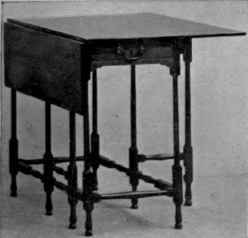
Fig. 1. "Spider Leg" Table Drop Leaves.

Fig. 2. "Piecrust," Tripod Table.

Fig. 3. Pembroke Table, Clustered Column Legs.

Fig. 4. Oval Drop-Leaf Dining Table, Straight Legs, Beaded Corners.
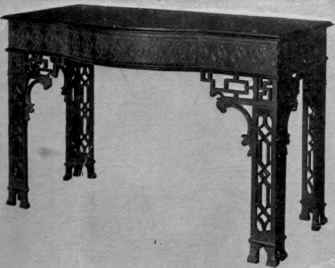
Fig. 5. Sideboard Table, Chinese Pierced Fret Legs.

Fig. 6. Serpentine Front Chest of Drawers, Fretted Canted Corners.
Cupboards
Three-cornered cupboards flourished all during the Chippendale period, the lower part had doors and the upper part was enclosed with glass. Sometimes the upper part had one large door, sometimes two narrower doors which had either straight or round arch tops. Usually there was a drawer between the lower and upper sections. The tops of these three-cornered china cupboards were straight, with a well-moulded cornice and frieze, or topped by a pediment, usually of the scroll swan-neck type.
Cupboards with closed doors in both top and bottom (Key IX, 2) sections were less common, and sometimes such cupboards had semi-circular fronts, the doors being ingeniously carved.
Sideboard Tables
Sideboards as we know them did not belong to the furniture of Chippendale style. Instead, there were elaborate, rectangular, oblong sideboard tables, supported on four, or sometimes six, legs.
The legs of these sideboard tables were more often straight (Key VIII, 5) than of the cabriole form (Plate XVIII, p. 170).
It was not unusual for the rails or underframing between the legs to be made into an elaborate frieze, either carved or fretted (Key VIII, 5; Plate XVIII, p. 170).
The tops were either of wood or marble, but wood was the more usual substance.
These were placed at the sides of the dining-room, and largely served the purpose to which the more fully-developed sideboard was in later times put.
Wardrobes And Clothes Presses
Wardrobes and clothes presses (Key IX, 4) of the Chippendale period ordinarily had two or three drawers in the lower part, and the upper part had two doors enclosing either shelves or hanging spaces for clothes. They were made of considerable height, with straight or pediment tops, and generally rested upon shaped bracket feet or cabriole supports with claw and ball, or other appropriate form of foot.
In the French period the bombe form of clothes press swelled out to portentous dimensions in the lower part.
Continue to:


My Books

