


Queen Anne And Early Georgian. 1702-1750. Part 9
Description
This section is from the book "The Practical Book Of Period Furniture", by Harold Donaldson Eberlein And Abbot McClure. Also available from Amazon: The Practical Book Of Period Furniture.
Queen Anne And Early Georgian. 1702-1750. Part 9
Decorative Processes
As in the preceding reign, the decorative processes embraced turning, carving, painting, gilding, veneering, marqueterie, inlay and lacquering.
Turning. The turning of the Queen Anne-Early Georgian period, though not obtrusively ornate, was thoroughly well done, as a look at chair and table legs and stretchers will show.
CaRving. Beyond the favourite cockle or escallop shell and the slight embellishment of knees, ear-pieces, and feet, carving was not largely practised on chairs, tables and general cabinet work of the early years of this period. Mirror frames, however, and the elaborately carved and gilt console and sideboard tables constituted a conspicuous exception. During the latter part of the period, beginning with the "Decorated Queen Anne" epoch, which came in about 1714, elaborate carving is found on chairs and tables and occasionally on cabinet work. It is notable for its bold and vigorous execution. Until the "cabochon-and-leaf" epoch, the carving is apt to be in strong relief.
Painting. Furniture was sometimes painted white or perhaps another colour and parcel gilt. Large pieces of architectural furniture so treated were often very effective.
Gilding. Gilding was applied as a coating to wood elaborately carved and carefully prepared. It was also used to pick out and embellish portions of carving or turning on walnut and mahogany furniture (Key V, 4).
Veneering. Veneering was used for its rich, warm effects on flat surfaces of cabinet work and in the splats of fiddle-back chairs until supplanted by the ascendency of mahogany. It was often effectively employed on drawer fronts and in panels while the rails and stiles were solid. It was even used in conjunction with carving on the splats of chair backs.
Marqueterie and Inlay. Though these processes were still practised to some extent in the first half of the period, the taste for them was gradually dying out.
Lacquer. Having passed the stage of being a fashionable fad, lacquer held its ground on its own intrinsic merits as a valuable decorative factor. We find many beautiful examples both in black and in colours - red, green, blue and yellow. It was sometimes, however, grievously misapplied.
Types Of Decoration
Turning displayed no particularly distinctive forms. The occasionally somewhat intricate turned forms of the preceding William and Mary period went quite out of fashion. Vase, ball and ring turning and baluster turning remained in style.
Carving in the earlier part of the period was confined largely to representations of the escallop or cockle shell ornament to be found on the cresting of chair backs, in the central part of the seat rail and on knees of highboys and lowboys as well as on the knees of many of the fiddle-back chairs. The escallop shell was also found as a central decorative motif on the drawers of highboys and on the aprons of various pieces of cabinet work. Both convex and concave forms appear. Pendent fuchsia flowers and honeysuckles are met with occasionally in conjunction with cockle shells, especially on the knees and upper portions of the legs of some of the fiddle-backed chairs. When cabriole legs did not terminate in hoof and ball, club, web or slipper feet they were ordinarily carved with claw and ball and the work was wrought with more boldness and precision than was customarily the case at a later date.
One exception to this early simplicity in the matter of carving is to be noted in the case of the ornate gilt console and side tables and some of the mirror frames upon which a wealth of painstaking detail was lavished. Animals, birds and human figures (Fig. 3), boldly carved in the round supported these tables, while the framing and other parts displayed successions of evo-lutes, drops and swags and sundry classic repetitive details.
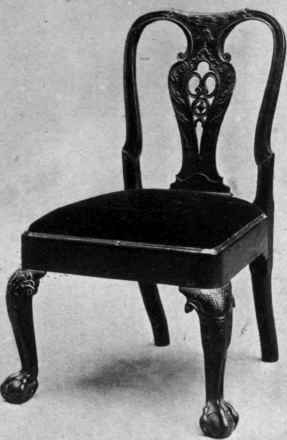
HOGARTHIAN HOOPBACK, PIERCED SPLAT MAHOGANY CHAIR.
By Courtesy of Mr. C. J. Dearden, New York City.

STRAIGHT TOP UPHOLSTERED QUEEN ANNE SETTEE By Courtesy of Messrs. E. J. Holmes & Co., Philadelphia.
PLATE XI.
With the incipience of the "decorated Queen Anne" style about 1714 we find a great elaboration of carving, particularly upon chairs and settees, whose arms were frequently terminated with eagles' heads strongly executed. Besides eagles' heads, rosettes, tassels, acanthus and sundry floriated scrolls were introduced as opportunity offered.
With the beginning of the "lion period," about 1720, vigorously wrought lions' heads and feet in the form of furred paws were added to the list of carving details and are valuable indications of approximate date.
The "satyr-masque period," beginning about 1730, intensified the grotesque element in carving and, as the name indicates, brought in the satyr masque in various forms which appeared on the knees, seat rails, backs and arms of chairs and settees, the cresting of cabinet work and the framing of tables where erstwhile had been cockles, then eagles' heads and then lions' heads, which the satyrs supplanted in great measure. During all these sub-periods the cockle shell persisted with singular vitality and varying degrees of popularity.
By 1735, when the "cabochon-and-leaf period" may be said to have begun, we find this motif, either in concave or convex form, borrowed from the cabinet makers of the court of Louise Quinze, just as the lions' heads and satyr masques had been borrowed from German designs, becoming immensely popular at the expense of motifs that had hitherto enjoyed great vogue.
Marqueterie and Inlay were both going so rapidly out of fashion that no new decorative types were developed. For what little ornamentation of this sort was practised at the very beginning of the period, William and Mary designs were made to serve.
Lacquer types of decoration experienced a change. Before the time of Queen Anne, the chief and best examples of lacquer were to be found in the cabinets which ordinarily stood upon gorgeously carved and gilt stands. These cabinets were for the most part decorated with bold sprays and branches of trees and shrubs, with here and there human forms, animals, birds or fish.
In the early years after the accession of Queen Anne, the fashion changed. Lacquer was applied to everything - chairs, tables, cabinets, highboys, secretaries and cupboards. The patterns became more strongly pictorial and often closely resembled the designs of landscapes, houses, gardens, people and bridges to be seen on old platters and plates.
Continue to:


My Books

