


Chippendale. C. 1705 - 1779. Part 6
Description
This section is from the book "The Practical Book Of Period Furniture", by Harold Donaldson Eberlein And Abbot McClure. Also available from Amazon: The Practical Book Of Period Furniture.
Chippendale. C. 1705 - 1779. Part 6
Chests Of Drawers And Chests
Chests of drawers were of two varieties, low and high. The low chests of drawers were supported on short cabriole legs with claw and ball feet or upon shaped bracket (Key VIII, 6) feet. The base of the plinth was generally straight, sometimes with a splayed gadroon edge. There were ordinarily four drawers. The fronts of the drawers either overlapped the rails slightly and were edged with a small ovolo moulding or else were cock beaded. The fronts were straight (Plate XIV, p. 148) or shaped. The shaped fronts were generally of the (Key VIII, 6) serpentine type, but in the late French phase were sometimes bombe.
Corners were either straight or else canted or chamfered (Key VIII, 6).
In some instances the top drawer was arranged with a small mirror and other toilet accessories. These chests of drawers varied from extreme plainness to all degrees of elaborate carving and mountings (Plate XIV, p. 148).
High chests of drawers were similar to the low chests, except that the upper section of four drawers in depth was superadded. In the upper section of these high chests the corners often contained quarter-round section fluted pillars (Key XVIII, 6; Plate XLIII, p. 304) applied which terminated in a capital at the frieze. The cornices of these high chests were carefully moulded and the frieze often contained elaborate ornamentation of either carving or fretwork.

Fig. 7. Double Chest of Drawers, Bracket Feet.
Tops were sometimes straight, sometimes surmounted with a pediment either straight, broken or of the scroll swan-neck type.
Fronts of the high chests were commonly straight.
A third type of chest was occasionally found consisting of three separate divisions placed one upon the other. Oblong chests with lifting lids were still occasionally made and were sometimes supported on four-legged stands (Key IX, 6).
Key Plate V. Chippendale Period, 1740-1780
Material Usually Mahogany See Text Pages 144-183

Fig. 1. Swept Whorl Top-rail, Vertically PiercedSplat,Carved Cresting of Knees Early.

Fig. 2. Upholstered Arm-Chair, French Style, Shaped Seat-rail.

Fig. 3. Ribband Back, Carved Seat-rail, Leaf Foot.

Fig. 4. Interlacing Ladder-back, "Stitched-up" Seat.
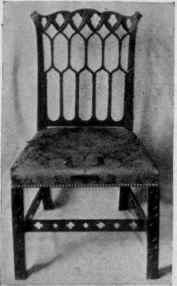
Fig.5. Gothic Fret Back, Fretted Legs, Pierced Stretcher.

Fig. 6. Ladder-back Arm-Chair, Drop Seat, Fretted Legs and Stretchers.
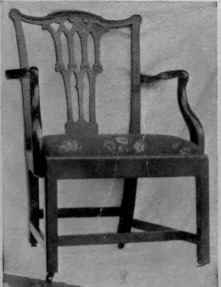
Fig. 7. Gothic Fret Splat, Shaped Arm.

Fig. 8. Square Back, Chinese Fret, Canted Arm.

Fig. 9. Back, Showing French Influence in Detail.
Highboys
Highboys were made of a similar character to those in vogue in the preceding period. As stated in that chapter, the highboy was not a popular piece of furniture in England after the early part of the eighteenth century, and to America we must look for its fullest development and enrichment (see Chapter XIV (Other American Furniture)).
The highboys of Chippendale type have cabriole legs and claw and ball feet.
The upper portion is of slightly narrower dimensions than the lower, and the top, often carried to a great height, is, more often than not, surmounted by a swan-neck pediment. There are frequent instances, however, of straight tops. A common form of adornment with the corners was the quarter-round section, fluted pillar (Key XVIII, 6).
Some variation of the scallop shell ornament usually occupied the front of the small middle upper drawer.
The legs were carved with all degrees of elaboration.
Continue to:


My Books

