


Chippendale. C. 1705 - 1779. Part 5
Description
This section is from the book "The Practical Book Of Period Furniture", by Harold Donaldson Eberlein And Abbot McClure. Also available from Amazon: The Practical Book Of Period Furniture.
Chippendale. C. 1705 - 1779. Part 5
Stools
Stools were of infrequent occurrence, but when made corresponded with chairs.
Sofas And Settees
Chair back settees and sofas followed precisely same structural and decorative principles as chairs (Key VII, 3). Some of the large sofas have arched backs and stuffed or rolled over (Fig. 6) arms.
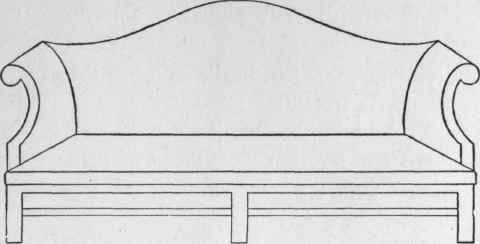
Fig. 6. Sofa with Arched Back and Stuffed over Arms. By Courtesy of John T. Morris, Esq., Compton, Chestnut Hill, Philadelphia.
Window Seats
Window seats usually followed same lines as chairs. Some window seat arms are curved over and the backs bowed or arched.
Daybeds
Daybeds, when found, were of the same structure and type as chairs.
Bedsteads
Chippendale bedsteads were less pretentious than those of the earlier part of the preceding period. They were, however, sufficiently imposing to justify the statement that the eighteenth century was the age of four posters. The posts had either cabriole or square bases, the foot of the cabriole base being usually of a claw and ball type, although other types were also found. The square bases had block feet.
The shaft of the post from the framing upward was rounded or octagonal and fluted or reeded. In addition, it was frequently embellished with ornate carving, the acanthus ornament being a favourite motif, although other types of decoration were also used.
The tester was adorned with fretwork and carving and made a considerable showing above the valances and curtains.
Headboards were gradually coming into use during the Chippendale period.
Though bedsteads were occasionally designed according to the French Gothic or Chinese taste, they were ordinarily of a type which, for convenience sake, we shall classify as English.
Tables
What was said in connexion with chairs respecting the four phases of Chippendale styles, the modes of embellishment and types of legs, holds good also of tables. It remains, therefore, to enumerate the typical varieties of tables and to note their general contour and structure.
Dining Tables largely followed the general type used in the preceding period. That is to say, the tables were oblong, had drop leaves (Key VIII, 4), and cabriole legs (Key VII, 5). The points of difference were that the drop leaves were often semi-circular or oval in shaping, the apron or under framing was not shaped and there were often three cabriole legs at each end instead of two, the middle leg being stationary and two legs at each end being hinged to pull out and support the leaves, which, being of mahogany, were apt to be heavy.
Square-legged tables of the same general type were also used, the underframing at the ends being straight. A third type of dining table is of rarer occurrence. It has eight square legs, the top is a long oval (Key VIII, 4) when the drop-leaves are extended, and these drop-leaves are supported on each side by two of the legs which are hinged and pull out, leaving the other four legs to support the ends.
Card Tables were (Key VII, 6) made in great numbers and occurred in several forms, one of the most common of which had cabriole legs and a double top. One of the legs was hinged to pull out and support the flap top when opened. These cabriole card tables were either plain, or highly ornamented, the ornaments being applied on the edges of the top, the rails which became, for the time being, a frieze, the lower edging of the rails often consisting of splayed gadroons, and the knees and feet.
The tables were sometimes exactly rectangular, sometimes with projecting corners, either squared (Key VII, 6) or circular.
Oftentimes the corners were "dished" to hold candlesticks, and there were four oval-shaped cups for money or counters. The tops when opened frequently displayed cloth covering strained over the wood.
Rectangular card tables were also made with square legs and turn over tops, one leg being hinged. These were either plain or highly carved.
A third kind of card table was semi-circular, with square legs and triple top.
Drawing Tables were in great demand and made in numbers. In general appearance they were similar to the square-legged card tables, just described, but had adjustable tops to accommodate the drawing board and instruments. Frequently the drawer pulled out, supported by two sliding legs.
Side Tables. Oblong rectangular side tables for use against the wall were made in large numbers and were either of the cabriole variety (Plate XVIII, p. 170), square-legged or made according to some of the Gothic or Chinese (Key VIII, 5) conceits. Tables of this sort were both plain and decorated. They were really the sideboard tables to which a special section is devoted later.
Tea Tables occurred in a variety of shapes. The four-legged variety had either cabriole or square legs and the top was surrounded with a gallery or rim, either moulded, carved, or fretted (Plate XIX, p. 174). The tops were sometimes detachable and meant to serve as trays. These tables were both plain and decorated, and usually of dainty proportions. In use they were closely akin to the tripod tables. In some of the more delicate tables rising saltire stretchers were used (Plate XIX, p. 174).
Tripod Tables. The introduction of tripod furniture is to be ascribed to Chippendale more probably than to any of his contemporaries. The tripod table had either a round or rectangular top, which was oftentimes hinged so as to turn up when not in use. Some of the tops were plain but more frequently were "sunk," that is to say, they had rims or galleries, moulded, carved or fretted. The familiar pie-crust rim (Key VIII, 2) belonged to this type of table, and was carved, as its extreme irregularity of outline could not conveniently be turned.
The shaft was frequently fluted, reeded or carved and often sprang from a turned or carved vase or bulb which rested upon three cabriole legs.

PLATE XVII. CHIPPENDALE CABINET IN CHINESE MODE (Of authentic Chippendale origin).
By Courtesy of Richard A. Canfield, Esq., New York City.
The cabriole legs were usually carved more or less elaborately and terminated in feet of various shape, the claw and ball or slipper feet being the most common, although other forms also occurred. The slipper feet are more common where the legs and the shaft are plain. All the plainer American tripod tables are to be classed as belonging to the Chippendale period.
Continue to:


My Books

