


Chippendale. C. 1705 - 1779. Part 4
Description
This section is from the book "The Practical Book Of Period Furniture", by Harold Donaldson Eberlein And Abbot McClure. Also available from Amazon: The Practical Book Of Period Furniture.
Chippendale. C. 1705 - 1779. Part 4
Uprights were flat, moulded, fluted, carved or embellished with applied frets according to style and degree of elaboration.

A

Fig. 3. A, Ladder Back with Hooped Top Rail; B, Cupid's-bow Top Rail, Gothic motifs in Splat.
In Possession of H. D. Eberlein, Esq.
Seats were almost invariably of square type with slight taper towards back. Occasionally the front seat rail was slightly bowed or serpentine. Shaping was more frequent in later chairs of French type.
Flat seats were the rule but "dropped" or dipped" (Key VI, 6) seats are also found. Both dropped-in seats that could be set into the framing (Key VI, 7 and 9; Fig. 5, C; Plate XVI, p. 160) and "stitched-up" (Key VI, 4 and 5) seats were used. In "stitched-up" seats the upholstery came down to the lower edge of and concealed the seat frame.
Seat rails were rarely shaped except in later French forms but were often carved or enriched with applied frets. In some very early (Key VI, 1) chairs and some late French chairs cresting of forelegs extended above lower edge of seat frame.
In more ornate chairs, lower edge of seat rail often had projecting edge of splayed gadroons (Fig. 4) or a fine rope moulding. In very early types lower edge of seat rail sometimes bulged and was carved.
A few instances are found among American chairs where cabriole legs, club feet and pierced splat backs exist in conjunction with rounded seat corners.
Arms joined uprights at angle (Key VI, 2, 6, 7, 8 and 9; VII, 1, 2, 3, and 4; Plate XVI, p.160); in wooden chairs were shaped outward and inner edge pared down (Key VI, 7 and 9; Plate XVI, p. 160); in upholstered chairs were usually straight and parallel with side rails of seat (Key VII, 4).
In wooden chairs, arms (1) joined supports of unbroken curve and support was shaped forward to join top of front leg, or side rail slightly back of same (Key VI, 6 and 9, and VII, 1,2,3 and 4); (2) projected beyond supports and terminated in slightly flaring scroll (Key VII, 2); support shaped forward and dowelled to side rail back of foreleg; (3) junction of arm and support similar to either of two preceding. Support shaped slightly backward, joining side rail farther back.
In upholstered chairs support joined arm at angle and was shaped forward in single curve (Key VII, 4) to top of foreleg or seat rail.
In chairs of Chinese pattern arms were canted (Key VI, 8) and usually filled with fretwork (Key VI, 8; and Fig. 4).

CHIPPENDALE MAHOGANY CHAIR WITH CHINESE MOTIFS (Of authentic Chippendale origin) By Courtesy of Richard A. Canfield, Esq., New York City.
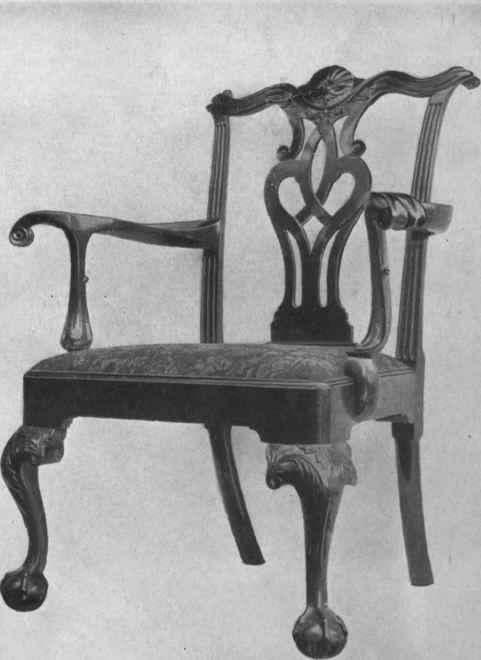
CHIPPENDALE MAHOGANY ARM-CHAIR OF PHILADELPHIA ORIGIN.
By Courtesy of John T. Morris, Esq., Compton, Chestnut Hill, Philadelphia.
PLATE XVI.
Legs were (1) cabriole (Key VI, 1, 2, 3 and 9; and Fig. 4); (2) straight (Key VI, 4, 5, 6, 7 and 8) or (3) fretted (Key VI, 5 and 8; VII, 1 and 2; Plate XVI, p. 160).
1. Cabriole legs were used exclusively in the early period and concurrently with straight legs after the latter appeared. Cabriole legs are found in conjunction with backs of the following pattern (Key VI, 1, 3, 7 and 9; Plate XVI, p. 160).


Fig. 4. Chinese Fret Back, Arm Detail, Gadroon Carving at Lower Edge of Seat Rail and Acanthus Carved Knee.
2. Straight legs appeared synchronously with Gothic and Chinese designs. They were (a) square or chamfered on inner edges; (b) composed of slender clustered columns, and (c) in a few instances tapered. Square legs were grooved, carved, or adorned with applied frets. Clustered column legs were turned and ringed. Tapered legs were either turned and ringed or carved. 11
3. Fretted legs were straight and sometimes pierced. The pierced sort are rarely met with.
Fretted brackets are often used at junction of square legs and seat rails (Key VII, 1; and Fig. 5, B).
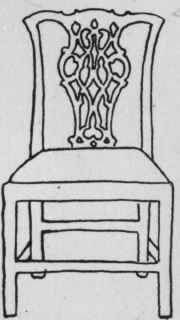
Stretchers reappeared with the straight leg. Front stretcher was almost invariably recessed. In the more ornate chairs stretchers were often carved, fretted, pierced, or moulded (Key VI, 5; Plate XVI, p. 160).

A

B
C
Fig. 5. A, Pierced and Fretted Stretchers; B, Fretted Bracket between Legs and Seat; C, Strap Pierced Splat.
Feet
With cabriole legs the following types of feet occur: (a) Club, very early; (b) web, early; (c) scroll, early and late; (d) leaf, early; (e) paw, early; (/) dolphin, early; (g) slipper, middle; (h) claw and ball, all the time.
With square legs, when there is a distinct foot, it is of block type.
Clustered column legs have round moulded feet.
Continue to:


My Books

