


Chippendale. C. 1705 - 1779. Part 3
Description
This section is from the book "The Practical Book Of Period Furniture", by Harold Donaldson Eberlein And Abbot McClure. Also available from Amazon: The Practical Book Of Period Furniture.
Chippendale. C. 1705 - 1779. Part 3
Chairs
Of all pieces of furniture, chairs are the most sensitive to new influences, and the quickest to indicate a change of style. How this was true in a general way has been previously mentioned. How it was true in a particular way, namely in the case of Thomas Chippendale or the school of furniture designing called by his name, we shall presently see.
Chippendale's versatility in adapting styles and combining types of ornament, or the faculty of so doing, common to the chair- and cabinet-makers of his period - which ever way one chooses to put it - expressed itself in four distinct phases, which may be classified as follows: (1) the early or distinctly English phase, which grew out of, and was adapted from, the types in vogue (Plate XIV, p. 148) in the latter part of the Queen Anne-Early Georgian period (Key VI, 1); (2) the Gothic and fretted phase (Key VI, 5 and 7); (3) the Chinese phase (Key VI, 8, and VII, 1), and (4) the phase "in the French taste" (Key VI, 9). These phases appeared successively at short intervals and practically in the order indicated. The appearance of a new phase, however, did not mean that the types distinctive of the preceding phase or phases were abandoned. On the contrary, they continued in use and were employed concurrently. In this connexion it should be noted that the distinctly Gothic phase did not continue long in independent form but merged, by a process of evolution and selection, into the fretted phase (Key VI, 5 and 7) and was perpetuated by the use of details of ornament which were incorporated and adapted as fancy dictated.
Much of the so-called Chinese Chippendale is Chinese only by faint suggestion of detail (Key VI, 8) and might more accurately be classified as belonging to the fretted phase. While chairs "in the French taste" are put in the fourth chronological classification, much of the earlier work is full of French detail and feeling.
What was true of chairs in the expression of the several phases was true also of other pieces of furniture, though sometimes in a less degree.
In the catalogue of sundry patterns of Chippendale chairs, the great flaring wing chairs must not be overlooked. They were wholly upholstered, the legs and stretchers being the only wood visible.
Backs. The back is the most distinctive feature of a chair and the part that usually supplies the key for its proper classification. Chippendale chairs may be classified as follows:
1. Splat back (Key VI, 1).
2. "Square-hoop" backed (Key VI, 4 and 9 and, even more pronouncedly typical, (Plate XIV, p. 148).
3. Ribband-backed (Key VI, 3).
4. Grothic-pillar, bar, or tracery-backed (Key VI, 5).
5. Fret-backed (Key VI, 7 and 8).
6. Ladder-backed (Key VI, 4 and 6).
7. Square-backed (Key VI, 8, and VII, 4).
Top Rails must also be carefully considered in con-nexion with backs and may be classified as:
I. "Cupid's-bow" (Key VI, 6 and 7; Fig. 2, B, and Plate XVI, p. 160).
II. Swept whorl (Key VI, 1).
III. An intermediate form between "Cupid's-bow" and serpentine found only on the early square or flat-hooped backs (Plate XIV, p. 148).
IV. Straight, found on square upholstered, Chinese, and fretted backs (Key VI, 8, and VII, 4).
V. Arched, found on square upholstered backs (Key VI, 2, and VII, 2).
VI. Serpentine, found on ladder backs (Key VI, 4).
VII. High arched or triple arched, found on Gothic and a few fretted backs.
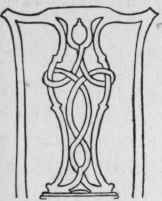
1. In the splat-backed chairs, splats are (a) of interlaced strapping (Fig. 2, A), either flat (Fig. 3, B) or beaded and carved (Fig. 2, C, and Fig 4; Plate XVI, p.
A
P
C
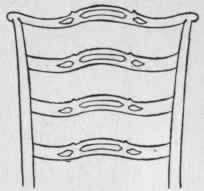
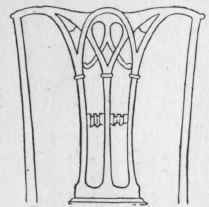
Fig. 2. A, Interlaced Strap Splat; B, Ladder Back Pierced; C, Pillared Splat.
160); (b) vertically pierced (Key VI, 1); (c) pierced in sundry patterns in which C scroll, singly or in combination (Plate XIV, p. 148), and various Gothic motifs played a prominent part (Key VI, 5, 7, 9; VII, 3; Plate XVI, p. 160); (d) fretted (Key VI, 7 and 8); (e) pillared or barred (Fig. 2, C).
In all their subdivisions splat backs occur both flat and carved.
2. Square or flat-hooped backs (Plate XIV, p. 148) are found only in early chairs of "pre-Director" style, and present a transitional form between the Queen Anne-Early Georgian hooped back, and the back with "Cupid's-bow" top rail. The upper part of the back is usually broader than in the hooped backs of preceding period. Barely made after 1750. In some instances the uprights of the flat-hooped backs retain the Queen Anne stepped curve (Plate XIV, p. 148) just above the seat. Central splat often composed of circles (Key V, 5).
3. Ribband backs (Key VI, 3) were intricately designed and elaborately carved, usually introducing cords and tassels and also flowers, as well as interlaced and knotted ribbons. They were made almost exclusively in the earlier period when Chippendale gave his personal supervision or his actual labour to the work and before the product of his shops became fully commercialised.
4. Gothic-pillar, bar, or tracery (Key VI, 5) backs enjoyed only a short vogue. The back was divided by slender clustered pillars supporting the arches of the top rail or was filled with moulded or fretted Gothic traceries.
5. Fretted backs were often completely filled with fret work of Gothic (Key VI, 5 and 7; VII, 4, and Fig. 5, A), Chinese (Key VI, 8; VII, 1, and Fig. 4) or conglomerate character. Simple geometrical repeats without any particular nationality attaching to them were also used (Fig. 5, B). Fret work was both flat and enriched with carving.
6. Ladder backs (Key VI, 4 and 6; Fig. 2, B, and Fig. 3, A) had horizontal bars or slats springing from the uprights and echoing the pattern of the top rail. They were pierced and often interlaced (Fig. 3, A) as well. They occur flat, moulded or carved.
7. Square backs are found in padded-back chairs (Key VII, 4), both arm and side, and in some fretted and Chinese patterned (Key VI, 8, and Fig. 4) chairs. Upholstered chairs were often called "French chairs" (Key VI, 2) regardless of design, and are not to be confounded with chairs "in the French taste."
Continue to:


My Books

