


Chapter IV. Queen Anne And Early Georgian. 1702-1750
Description
This section is from the book "The Practical Book Of Period Furniture", by Harold Donaldson Eberlein And Abbot McClure. Also available from Amazon: The Practical Book Of Period Furniture.
Chapter IV. Queen Anne And Early Georgian. 1702-1750
Anne 1702-1714
George I 1714-1727
George II 1727-1760
THE period now to be treated is a long one but definite in its characteristics and easily grasped. The reigns of Queen Anne's two immediate successors are naturally and sensibly best treated with here for the reason that during a large portion of the early Georgian epoch the forms of furniture experienced little change and the process of mobiliary evolution was to be detected in ornamentation rather than in contour.
As we follow the history of furniture according to chronological sequence, the reign of Queen Anne seems always to have a sturdy, wide-awake character about it. We feel that modern England has indeed begun when we reach that point. The last vestige of romantic mediaevalism vanished when James II, sung out of Ireland to the infectious tune of "Lilliburlero bullen allah!" fled across the Channel to France and left the way to the throne open to his little Dutch kinsman and rival. With the advent of the Stadtholder and his amiable consort, to whose apron strings, however, her positive spouse declined point blank to be attached, although she had far more right to the throne than he, new forces began to work and a period of transition set in.
By the time of Anne's accession the new modern spirit had had a chance to grow and assert itself. One of the ways in which it did assert itself was in the evident desire and determination in all quarters to improve conditions of domestic comfort. The amenities of household equipment were more heeded and, furthermore, the spirit of improvement was more widely diffused than ever before. It was not only in the houses of the very wealthy that a general betterment was noticeable but in the dwellings of those in less affluent case the change could be discerned as well. This increase in the demand for creature comforts and conveniences, for finer houses and more furniture, meant, of course, that chair and cabinet makers throve apace.
Key Plate III. Queen Anne-Early Georgian Period, 1702-1750
Materials Usually Walnut and Mahogany See Text Pages 97-130

Fig. 1. Q. A. Cabriole Leg and Club Foot Highboy. Ogee Apron and Drop Ornament Persisting from William and Mary Period.
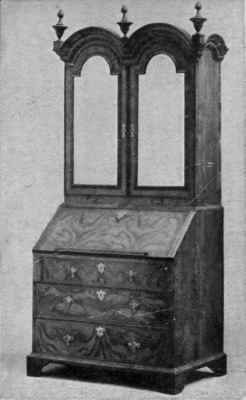
Fig. 2. Q. A. Walnut Veneer Bureau Bookcase. Double Hood Top Persisting from William and Mary Period.

Fig. 3. Q. A. Lacquered Lowboy, Mirror and Chairs.
Note Sun Ray Motif on Apron and Shell Carving on Knees of Cabriole Legs of Lowboy.
Queen Anne furniture has certain clearly defined characteristics of form that enable one to distinguish it at once from antecedent types. In the chapter immediately preceding were rehearsed the peculiarly distinctive traits of William and Mary furniture. "While there was the usual overlapping of styles we can say, however, with perfect assurance, that the forms we consider as typical of the William and Mary epoch were wholly discontinued in the early years of the eighteenth century and that the distinctively Queen Anne type developed and flourished for a long period of years, so that the furniture affinities of Queen Anne's day belong rather with those of her successors' reigns than with those of her predecessors' - hence the division adopted at the head of this chapter.
The typical forms of Queen Anne furniture are shown in the Chronological Key and the illustrations to this chapter, and are carefully described under the individual pieces. During her own reign the surfaces were for the most part plain, ornamentation being largely confined to the familiar and favourite shell (Fig. 1).
For the thirty or thirty-five years succeeding the death of Queen Anne, furniture exhibited no radical change in form but rather, as stated before, an elaboration of patterns, already well recognised, together with certain gradual minor developments in divers channels.
Mr. Herbert Cescinsky, in his admirable work, English Furniture of the Eighteenth Century, has suggested a very lucid and comprehensive classification for the decorative types evolved during this era which we cannot do better than quote at this point. He says: "In dealing with the furniture of the years from 1714 to 1745, that is, from the accession of George the First to the middle of the reign of George the Second, it is inevitable that some system of classification is required. It is possible either to arrange examples in the order of their date, or to adopt the five-fold division of decorated Queen Anne furniture, carved with lion-heads, satyr-masques, or cabochon-and-leaf ornament and architects' furniture. The latter system is the more advisable, as although examples of the five classes necessarily exhibit, in their details, a tendency to overlap, the former would result in a mere jumble of specimens of every conceivable design and form, without any constructional or evolutionary relation whatever."
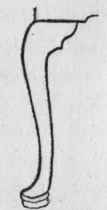
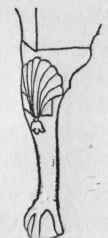
Fig. 1. Typical Chair Legs, Queen Anne Period.
These fashions, for the sake of convenience, he roughly summarises as follows: Decorated Queen Anne, 1714 to 1725; the "lion period," 1720 to 1735; the "satyr-masque period," 1730 to 1740; the "cabo-chon-and-leaf period," 1735 to the rise of Chippendale to recognition as "almost the sole arbiter of the furniture fashions of England." The "architects' furniture period" is concurrent with all the four first mentioned.
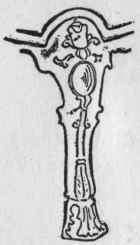
The distinguishing characteristic of the decorated Queen Anne style is greater elaboration of carving than was formerly the fashion, the chief motifs being more cockle shells, occasionally with pendent husks below them (Key V, 4 and 6), distributed on the knees of chairs, settees and tables and the backs and seat rails of chairs and settees; vigorously carved claw-and-ball feet (Key V, 4) and boldly executed eagles' heads (Key V, 5) to terminate the arms of chairs and settees, the same design occurring also at times in the backs. The "lion period" brought lions' heads on the knees, backs and seat rails of furniture in place of the details mentioned with the foregoing vogue (Fig. 2, A). The feet were oftentimes lions' paws. "Satyr-masque" furniture had grotesque heads where before were lions' heads (Fig. 2, C). The grotesques, in turn, gave way to the "cabochon-and-leaf" motif which Chippendale used as an important factor in "the design-basis of his earliest manner" (Fig. 2, B). Georgian "architects' furniture" comprised the larger pieces of cabinet work which were usually designed upon more or less architectural lines with pilasters and surmounting pediments (Plate IX, p. 112). From time to time during this early Georgian era we can discern rudimentary-forms cropping out here and there that afterwards crystallised into distinct features under Chippendale's hand.
One of the most significant incidents of the Queen Anne-Early Georgian period was the popularisation of mahogany for chairs and cabinet work. Its entrance into popular favour from about 1720 onward was rapid. Fuller reference will be made subsequently to the circumstances of its introduction. Suffice it to say here that its use produced important modifications in both structure and form of decoration. Furniture patterns, however, that were in fashion prior to 1720 do not seem to have changed materially because of the prevalence of the new wood, except that they became lighter and more graceful, and we also find far greater elaboration of carving, to which mahogany lent itself particularly well. The time, barren of any striking originality, saw the craftsman bending his energies to the refinement and embellishment of accepted forms rather than the designing of new ones. Barring a few variations in chair back types, the most they apparently did in the way of invention was to devise or borrow new details of decoration to meet the constant demand of their patrons for a measure of novelty.

A.
B.

C.
Fig. 2. Knees of (A) Lion, (B) Cabochon, and (C) Satyr-masque, Phases of Early Georgian Furniture.
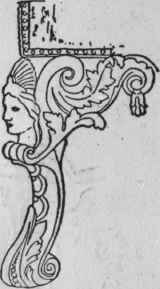
Fig. 3. Highly Carved and Gilt Leg.
Continue to:


My Books

