


George Hepplewhite. 1786. Part 3
Description
This section is from the book "The Practical Book Of Period Furniture", by Harold Donaldson Eberlein And Abbot McClure. Also available from Amazon: The Practical Book Of Period Furniture.
George Hepplewhite. 1786. Part 3
Chairs
However much Hepplewhite may have been indebted to Adam in his other designs, he is decidedly original in his chair patterns and distinctly practical as well. The legs of Hepplewhite chairs are prevailingly square, tapered and either with or without the "collared" toe or spade foot, and either flat or grooved. In a number of chairs, stretchers are used to brace the legs, and the front stretcher is recessed. Seats are ordinarily square, with a slight taper towards the rear uprights, or else are slightly rounded in front, and the seat frame is either visible or covered with upholstery. Rounded seats and also rounded legs occur (Plate XXVI, p. 210), but the first-mentioned types are more characteristic. The square seats are sometimes "dropped" (Key XI, 2). In the earlier arm-chairs the arms run out horizontally from the backs to a sharp angle and then drop with a sweeping curve to join the tops of the front legs (Plate XXVI, p. 210). In the later chairs the same contour of arm is preserved but the supports join outside the seat rails (Key XI, 3) and are dowelled into the side of the seat frame a little behind the line of the front legs.
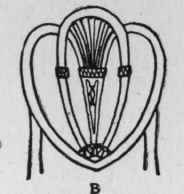
The backs form the most distinctive feature of the chairs, and exhibit a broad variety of shape and detail. The typical forms, however, are the shield (Key XI, 1, and Fig. 2, A, C, E, G, H and I), the oval (Fig. 1, 2, and Fig. 2, F), the interlacing heart (Key XI, 3, and Fig. 2, B), and the hoop (Key XI, 2 and Fig. 1, and Fig. 2, D) and all other types, with the exception of an occasional essay at a square back (Fig. 1, 3), are but modifications of these. The tops of the shield-back chairs are of two shapes - either serpentine (Key XI, 1) or with a slight unbroken bowed curve like the top of a crusader's shield (Fig. 2, E). The latter form is not common. "Honeysuckle" backs are found in both the oval and hoop forms (Plate XXVI, p. 210).
Hepplewhite backs do not usually join the rear seat rail but are supported by the extension of the back legs rising above the seat and curved slightly inward (Key XI, 1, 2 and 3; Fig. 1; 2 and 3; and Fig. 2, all except D). Shield-back chairs are either balustered (Fig. 1, 3; and Fig. 2, E) or barred (Key XI, 1), having usually five carved and curving balusters or bars converging to a semi-circular rise in the bottom of the shield or else have some form of central pierced splat (Fig. 2, A, G, H and I). In some instances the shield back has only three bars (Fig. 2, C) and in the bow-topped shields the bars do not curve but are vertical (Fig. 2,E).



V

E


Fig. 2. Characteristic Hepplewhite Chair-back Shapes.
In the splatted shield backs the central splat usually follows the outline of a vase or lyre (Fig. 2, A, G and /). There are, of course, other variations in the treatment of shield backs (Fig. 2, H) but they may easily be recognised by their general resemblance to the types just noted.
The oval-backed chairs (Fig. 1, 2, and Fig. 2, F) may have been inspired by Adam designs, but they were developed in a thoroughly characteristic and individual manner. The three feathers of the Prince of Wales (Fig. 2, F) were frequently worked into these backs as a decorative motif, sometimes altogether replacing the splat, and at other times we have a modification of the interlacing heart patterns, used as tracery and sometimes a modified lyre form of splat.
In the interlacing heart backs (Key XI, 3, and Fig. 2, B), the inner sides of the hearts, springing from a circular segment at the base of the back, take the place of a splat, and the upper portion, just under the crest, is often given a fan treatment (Key XI, 3).
The hooped-back chairs are the only ones whose central splat joins the seat rail at the rear (Fig. 1, and Fig. 2, D). The back legs project above the seats and continue in one unbroken line with the cresting. In the hoop backs the central splat usually follows a vase or lyre outline. Hoop-back chairs also sometimes have a wheel motif instead of a splat (Key XI, 2). Ladder-back chairs were common to the cabinet- and chair-maker's trade from 1760 to 1790, and Hepplewhite, as well as others, doubtless made them. Forms are met with that show characteristic Hepplewhite touches and details of ornament.
Continue to:


My Books

