


George Hepplewhite. 1786. Part 2
Description
This section is from the book "The Practical Book Of Period Furniture", by Harold Donaldson Eberlein And Abbot McClure. Also available from Amazon: The Practical Book Of Period Furniture.
George Hepplewhite. 1786. Part 2
Articles
There is always, necessarily,much similarity between the list of articles in each chapter, because no sudden revolutionary changes took place in the habits of our forefathers to bring the vogue of one piece of furniture abruptly to an end and replace it immediately by another. A comparison, however, between the different chapters will reveal the gradual discontinuance of certain types from period to period, or from style to style when the popularity of one maker's handiwork shall be said to constitute a period division. For instance, if we look first at the inventory of chair- and cabinetwork in the Chippendale period and then at the list of articles designed by the Brothers Adam or made by Hepplewhite, we shall see that the highboys and lowboys have disappeared in the newer mode and tall chests of drawers, chests on chests< and presses or wardrobes have taken the place of one, while more pretentious and fully appointed dressing tables have supplanted the other. Tripod furniture, likewise, has practically disappeared with the trifling exception of such things as flower stands and gueridons. Bookcases, sideboards and cabinets, on the other hand, have become objects of much more consideration.
The several articles will be treated in their usual order so that it will be unnecessary to append here an itemised list.
1Clouston: Chippendale.
Contour
What was said of contour in the Adam chapter is substantially true for this. With the advent of the Adam influence, we are come to a straight-legged period and a period when curves are subservient to straight horizontal and vertical lines. There were plenty of curved surfaces such as the serpentine fronts of chests of drawers, tables and sideboards, or the semi-circular or semi-oval fronts of cabinets, but the top and bottom lines of these pieces were horizontally straight and their side lines were vertically straight, so that all the curving had to be done in one direction. A point of contrast to be observed between Hepplewhite and Sheraton contour is that in the former the element of concavity, especially in the fronts of sideboards and chests of drawers, is emphasised, while in the latter the element of convexity is found instead. There are, to be sure, sporadic instances where an Adam table was designed with scroll legs or a Hepplewhite chair with cabriole legs, but they are rare exceptions and need not concern us.
The foregoing observation, of course, does not apply to Hepplewhite's French furniture, which very accurately followed all the curves of the later Louis Quinze fashion. It is so French in character that it is scarcely entitled to consideration in this chapter.
The most distinctive note to be observed in Hepplewhite contour, a particular in which neither Adam nor Sheraton designs share, is the shape of the shield back (Key XI, 1), hoop back (Key XI, 2) and interlacing heart (Key XI, 3) back chairs. Hepplewhite made round and oval (Fig. 1, 2) chair backs, too, but these are also found in Adam designs.

Fig. 1. Examples of Hepplewhite Splat, Oval and Bar Backs.
As much alike as Hepplewhite and Sheraton patterns are in many respects, one sharp contrast must be drawn between the styles. Though both men held to straight structural lines in their designs of cabinetwork, and to a very large extent in chair- and tablework, Hepplewhite is regarded as the exponent of the curve and Sheraton as the exponent of the straight line. Hepplewhite introduced his curving lines in chair backs, seat frames, sofas and settees, the serpentine fronts of sideboards and cabinet-work and the shapes of table-tops. How Sheraton, on the contrary, emphasised the straight line, we shall see in the Sheraton chapter. Strange as it may seem in the tracery of the glazed doors of bookcases and cabinets (Key XII, 2) the preference was apparently reversed, for Hepplewhite was disposed to use straight lines, while Sheraton turned to graceful curves and incidentally showed what a master of proportion he was. The same is true of panel shapes in cabinet-work. Sheraton seems to have fallen heir to the Adam oval and used it to excellent effect, while Hepplewhite, with his strong predilection for curving lines, kept, in the main, to rectangular panel shapes.

A
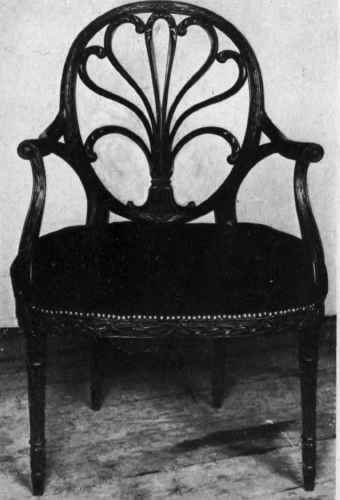
B
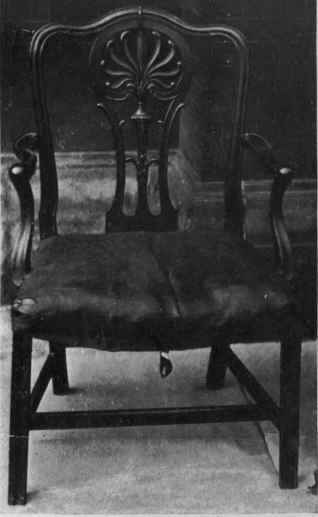
C
HEPPLEWHITE CHAIRS: (A) PAINTED, BARRED SHIELD BACK, SQUARE TAPERED LEGS; (B) OVAL HONEYSUCKLE BACK, ROUND FLUTED LEGS; (C)
By Courtesy of Messrs. Hale and Kilburn, Philadelphia.
PLATE XXVI.
To Hepplewhite must be credited the popularisation of the tall French foot (Key XI, 4) for cabinet-work, with its refined proportions and graceful outward curve of both sides and angle. Though both men used square legs and round legs in their table and chair designs, the square leg (Key XI, 5) may be considered more typical of Hepplewhite. In the majority of cases, square or round, and in the designs of both men, legs are tapered.
Continue to:


My Books

