


Louis Quatorze And Louis Quinze. Part 5
Description
This section is from the book "The Practical Book Of Period Furniture", by Harold Donaldson Eberlein And Abbot McClure. Also available from Amazon: The Practical Book Of Period Furniture.
Louis Quatorze And Louis Quinze. Part 5
Types Of Decoration
Of all the manifold types of decoration employed in these two periods, the one we most frequently hear of is Rococo ornament, though its excess of sinuosity was by no means of universal application to the exclusion of all else.
Rococo Ornament. The word "rococo" comes from the French "roc" and "coquille" which could be literally translated into English by the expression "rock cockle" and be very accurate. The term arose from the passion that existed during a portion of the Louis Quinze period for employing rocks and shells along with wisps of nondescript foliage carved with bewildering scrolls in every conceivable place and in every conceivable variety of shape, as the prevailing details of ornamentation. It was a formalised expression of a Renaissance conception of rusticity.
"Abcadian Properties." This happy phrase of Mr. Foley's denoted the miscellaneous collection of wreaths, cupids, female busts, satyrs, fountains and doves with which so much of the Louis Quatorze and Louis Quinze furniture was plentifully bedecked.
Diaperwork was largely used to fill plain surfaces of panels and the like during a part of the Louis XIV period and was applied with excellent and varied decorative effect.
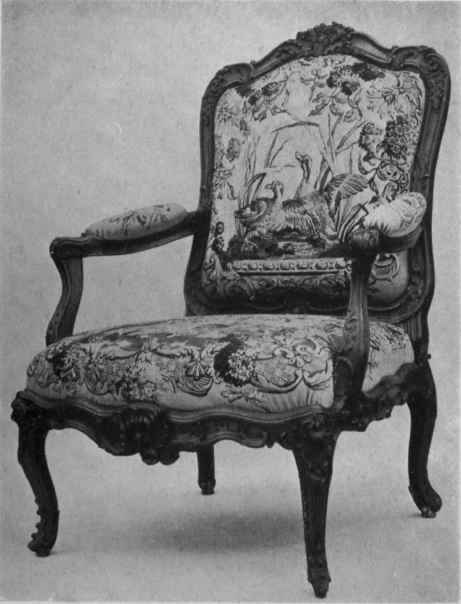

PLATE XIII. LOUIS QUINZE ARM-CHAIRS WITH ROCOCO MOTIFS.
By Courtesy of Metropolitan Museum of Art, New York City.
Acanthus leaves, as they seem to have been in nearly every age, were a decorative necessity and were employed for foliage effects.
Fruits and Flowers also formed important items in the cataloguing of available motifs of embellishment.
Pendent Husks and Ribbons likewise filled a useful place in the scheme of adornment, as did also, to some extent, trophies of various sorts, and musical instruments.
Structure
In the time of Louis XIV the royal workshops, as we have said, were in the Louvre, and no pains were spared to turn out the best possible work. The joinery was of a high degree of excellence, and we find the same tradition prevailing in the succeeding period.
Mounts
In the furniture of these periods metal mounts were used not merely for necessary purposes of utility such as knobs, drawer pulls, hinges, key-plates, scutcheons and the like, but were employed extensively for purely decorative purposes. Brass ormolu and other metal mounts were designed with the greatest care, and their execution formed an important craft. There was endless variety in their design, so that it is not feasible to illustrate any special type. The designs were made to accord with the general scheme of decorative motifs used for the special piece, and much dependence was placed on the mounts to produce the charm of the object to which they were attached.
Continue to:


My Books

