


Parallel Bars
Description
This section is from the book "Woodworking For Beginners: A Manual for Amateurs", by Charles G. Wheeler. Also available from Amazon: Woodworking For Beginners.
Parallel Bars
A useful form (and not beyond the skill of an amateur) is shown in Fig. 261. The height must, of course, depend upon the gymnast, and can range from 3' 6" to 5' 6", the width inside (between the bars) from 14" to 19", and the length from 6' to 8'.

Fig. 261.
Before beginning work read carefully Marking, Rule, Square, Saw, Plane, in Part V., and look up any other references.
The base of the apparatus can be simply made of 2" x 6" planks, as shown in Fig. 261, and fastened by screws (see Screws), or, as shown in Fig. 262, the pieces can be halved at their intersections (see Halving), in which case thicker stock may be used. For a small pair of bars the planks for the base can be somewhat lighter.
The upright posts should be of strong wood not less than 2" x 4" (unless for a very small pair of bars) and should be mortised at top and bottom, as shown in Figs. 263 and 264 (see Mortising). These joints should be pinned.
The bars themselves should be of the best white ash (hickory, oak, hard pine can be used), not less than 2" x 3" (unless for a small pair of bars). The arrangement and object of the iron braces is plain.
After the apparatus is all fitted together, take off the bars and carefully round the top edges for the entire length (see Rounding Sticks). The ends which project beyond the posts can also be rounded on the under side (i. e., made elliptical in section, as shown), if desired.
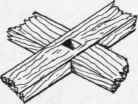
Fig. 262.

Fig. 263.

Fig. 264.
Machine-planing is sufficient for this apparatus, except for the bars themselves, which should be carefully smoothed by hand (see Plane, Scraper, Sandpaper), although, of course, the whole will appear more nicely finished if smoothed by hand. The square edges should be "broken " (i. e., slightly bevelled or rounded) so as not to be too sharp in case of contact with them.
The whole apparatus can be simply oiled thoroughly, or can be given in addition one or more coats of shellac or varnish (see Finishing), but a coat of oil is sufficient for the bars themselves, as they will be polished by use.
This arrangement has the advantage of being portable, but of course the base can be omitted, if desired, and the posts fastened directly to the floor. If mortises cannot be cut in the floor, blocks can be screwed to the floor around the base of each post so as to form a socket into which the post will fit.
Parallel bars can be readily made for outdoor use by simply setting four upright posts (not less than 3" x 4") firmly in the ground, at the same distances apart as specified for the movable bars described above, and fastening the bars to the tops of the posts by mortise and tenon, as already shown (Fig. 263). The posts should reach 3' or more below ground, both on account of the frost and to give increased steadiness, and the earth should be thoroughly tamped down around them with a sharp-pointed bar or stick. This apparatus should be thoroughly oiled and can be varnished (see Finishing). The posts should be of good thickness at the ground, but can be tapered toward the top, on the outside, to the thickness of the bars.
Continue to:


My Books

