


Sharpening. Part 2
Description
This section is from the book "Woodworking For Beginners: A Manual for Amateurs", by Charles G. Wheeler. Also available from Amazon: Woodworking For Beginners.
Sharpening. Part 2
The tool must be moved back and forth very steadily or instead of a second bevel the whole edge will be rounded (Fig. 672) and will not have the requisite keenness. The angle of this second bevel is usually about ten degrees greater than the long bevel, or thirty-five degrees, although the angles of sharpening should be varied slightly according to the hardness of the wood and the kind of work to be done; but where you have only few tools and must use them for all kinds of work you cannot always, as a practical matter, pay much regard to such variations, as of course you cannot keep regrinding your tools every time you begin on a new piece of wood. Just how acute to make the edge you must learn by experience, according to the conditions of your work.
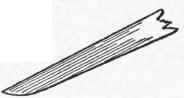
Fig. 672.
An edge suitable for delicate work in white-pine would be immediately ruined if used upon lignum-vitse.
Any little wire edge which is produced on the flat side by the process of rubbing on the oilstone can be removed by drawing the flat side of the iron over the stone once, but be sure that you do not raise the handle at all, as the slightest bevel on the fiat side of the edge will spoil it. After the tool has been sharpened a good many times on the oilstone this smaller bevel (the oilstone bevel, so to speak) will become so wide that it is a waste of time and strength to rub it down. The chisel must then be reground and a new bevel made on the oilstone.
It is a good plan to have a separate stone or " slip " for the outside bevel of gouges, because it is so hard to avoid rubbing hollows in the stone, which injures it for the other tools. Care must be taken also with very narrow or pointed tools lest the stone be grooved or nicked. Gouges can be rubbed at right angles with the stone, rolling the tool with the left hand, or by the use of a slip they can be rubbed as described below. For rubbing gouges on the inside, i. e., on the concave surface, rounded pieces of stone, called "slips," are used. These can be bought of various sizes and shapes to fit the various curves. Do not think, however, that you must try to find a slip that will fit each gouge as exactly as if it had been shaped by the gouge itself. The curve of the slip may be a little " quicker " or sharper than that of the tool, but must not be flatter or of course it cannot be made to bear on all parts of the curve.
In rubbing with the slip, hold the tool upright in the hand and rub the slip up and down, moving the slip and not the tool. If you rest the tool against the bench, it will steady it and also avoid any probability of your finger slipping on to the edge. The more common " outside " gouges are not rubbed on the inside, except the merest touch of the slip to remove any wire edge or burr. The draw-knife is also rubbed with a flat slip, in the same manner, resting it on the bench.
In rubbing the knife on the oilstone give it a circular motion rather than simply back and forth, particularly for the point. The straight part can be allowed to bear a little more heavily near the edge of the stone as it is passed back and forth.
It is much the best way to sharpen tools frequently, as soon as they begin to get dull, when they will require but little rubbing on the stone, rather than to let them get into such condition that it is a long and hard job to whet them; and of course the more careful you are to keep them sharp, the better work you will do.
To test the sharpness of your tools, cut across the grain of a piece of soft pine wood. If the cut is clean and smooth, the tools are sharp, but if the cut is rough or the wood torn, further sharpening is needed. The reason for using soft wood, which at first thought might not seem to require as keen an edge as hard wood, is because the fibrous structure of the soft wood, being more yielding, offers less resistance to the tool and so is torn or crushed apart except by a very keen edge, while the firmer structure of the hard wood can be cut smoothly by a tool which would tear the soft wood. The difference is somewhat like that between cutting a fresh loaf of bread or cake and a stale one.
The edge left by the oilstone can be improved by stropping on a piece of leather on which a little paste of lard and emery or some similar composition has been spread. This is better than to strop knives and other tools on your boots. Any piece of leather such as barbers use, or even a piece from an old boot, will answer. For fiat edges see that the strop rests on a flat surface, so as not to tend to round the edge, as it may do if held carelessly in the hand. See Oilstone and Strop.
Saw Filing is particularly hard for boys and amateurs to do satisfactorily and you are advised not to undertake it until you have become quite familiar with the use of tools, for it does not need to be done very often, costs but little, and there are very few places where you cannot get it done.
It is not difficult to understand the theory of setting and filing saw teeth, but to fix a saw in really good shape is hard for an amateur, - and for that matter you will find but a small proportion of good workmen who are experts in saw filing. Even in very small villages there is almost always some mechanic who has the knack of putting saws in order better than anyone else and who therefore makes quite a business of such work and people bring their saws to him from all the country round, even though they may be able to fix them tolerably well themselves, so great is the advantage in the quality of the work and the saving of time in having a saw in perfect condition. You had best do the same, and have your saws fixed whenever they get dull. The expense is but slight, and there is nothing that will conduce more to good work, and to your own success and satisfaction, than to have your tools in first-rate working order.
Continue to:


My Books

