


Spring-Board
Description
This section is from the book "Woodworking For Beginners: A Manual for Amateurs", by Charles G. Wheeler. Also available from Amazon: Woodworking For Beginners.
Spring-Board
A form not difficult to make is shown in Fig. 272. The framework can be made of any strong wood, but the spring-board itself should be of the best quality of clear, straight-grained white ash.
Before beginning work read carefully Marking, Rule, Square, Saw, Plane, in Part V., and look up any other references.
First make the base or framework. Get out two pieces of 2" x 3" plank for the outside pieces (to stand on edge) and screw blocks of the same plank at each end to raise the pieces from the ground as shown. Place these pieces so that they spread apart slightly at the forward end (Fig. 272), being about 22" apart at the rear end. Fit a cross-tie to connect these stringers at about 2' from the forward end.
Another cross-bar, resting on the stringers, is placed nearer the rear end, and about 1' from the rear end a piece of 3" x 4" joist is fitted between the stringers and held in place by a bolt passed through it and the stringers. This should be loose enough to allow the block to turn.
The spring-board can be made of five strips of 7/8" stock, 4" wide and 6' long, screwed to a cleat at the forward end, and securely bolted to the block at the rear end.
This apparatus can be finished as in the cases described above.
Vaulting-Horse,-A simple affair (Fig. 273) can be easily arranged by making a box, perhaps 5' long and 8" or 10" square, which can be supported by flaring legs of joist as shown in the illustrations.
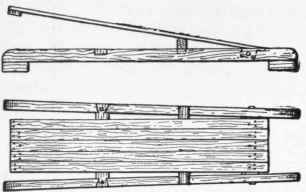
Fig. 272.
First make the box (see Box-making, in Part II.). The corners and edges should be rounded (Fig. 274), and the whole padded and covered with such materials as you may have at hand or can afford for the purpose. Laying out and sawing the bevels for the tops of the legs is the hardest part of the job. Transfer the bevels carefully from your working drawing tothewood, and saw as ex-actlytothelines as you can. See also Scribing. Unless you have had much experience some paring will probably be required to make all the legs fit. To make the horse stand evenly see Scribing, Winding-sticks, etc. The other general directions given for the apparatus described above will suffice for this horse.

Fig. 273.
A horse for outdoors (Fig. 275) can be simply made of a log, perhaps 1' in diameter, smoothed and with the ends rounded, and mounted (by mortising) upon posts set in the ground (see Mortising). The top can be covered with rubber, as indicated in the illustration.
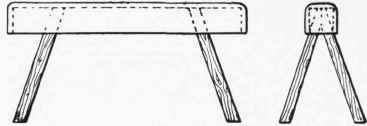
Fig. 274.
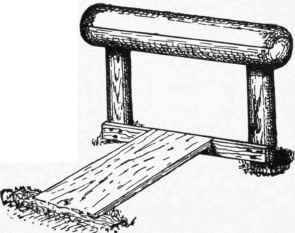
Fig. 275.
The posts should be set at least 3' in the ground, and the earth well tamped around them with a pointed bar or stick.
The apparatus can be finished as in the cases given above.
Continue to:


My Books

