


An Analysis Of Tenoning, Mortising, Rabbeting And Beading. Part 2
Description
This section is from the book "Carpentry for Boys", by J. S. Zerbe. Also available from Amazon: Carpentry for Boys.
An Analysis Of Tenoning, Mortising, Rabbeting And Beading. Part 2
Things To Avoid In Mortising
You must be careful to refrain from undercutting as your chisel goes down at the lines a, b, because if you commit this error you will make a bad joint.
As much care should be exercised in producing the tenon, although the most common error is apt to occur in making the shoulder. This should be a trifle undercut.
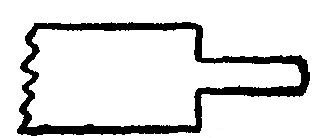 Fig. 209.
See the lines (A, Fig. 209), which illustrate this.
Lap-And-Butt Joint
The lap-and-butt is the form of uniting members which is most generally used to splice together timbers, where they join each other end to end.
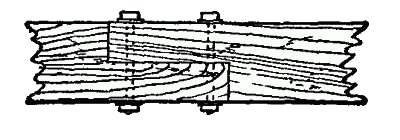 Fig. 210.
Bolts are used to secure the laps.
But the lap-and-butt form is also used in doors and in other cabinet work. It is of great service in paneling.
A rabbet is formed to receive the edge of the panel, and a molding is then secured to the other side on the panel, to hold the latter in place.
Scarfing
This method of securing members together is the most rigid, and when properly performed makes the joint the strongest part of the timber. Each member (A, Fig. 212) has a step diagonally cut (B), the two steps being on different planes, so they form a hook joint, as at C, and as each point or terminal has a blunt end, the members are so constructed as to withstand a longitudinal strain in either direction. The overlapping plates (D) and the bolts (E) hold the joint rigidly.
 Fig. 211.
 Fig. 212.
The Tongue And Groove
This form of uniting members has only a limited application. It is serviceable for floors, table tops, paneling, etc. In Fig. 213, a door panel is shown, and the door mullions (B) are also so secured to the rail (C). The tongue-and-groove method is never used by itself. It must always have some support or reinforcing means.
 Fig. 213.
 |  |
Fig. 214. | Fig. 215. |
Beading
This part of the work pertains to surface finishings, and may or may not be used in connection with rabbeting.
Figs. 214 and 215 show the simplest and most generally adopted forms in which it is made and used in connection with rabbeting, or with the tongue and groove. The bead is placed on one or both sides of that margin of the board (Fig. 214) which has the tongue, and the adjoining board has the usual flooring groove to butt against and receive the tongue. It is frequently the case that a blind bead, as in Fig. 215, runs through the middle of the board, so as to give the appearance of narrow strips when used for wainscoting, or for ceilings. The beads also serve to hide the joints of the boards.
 |  | 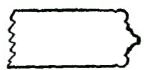 |
Fig. 216. | Fig. 217. | Fig. 218. |
Continue to:


My Books

