


Bread Or Meat Board
Description
This section is from the book "Shop Projects Based On Community Problems", by Myron G. Burton. Also available from Amazon: Shop Projects Based on Community Problems.
Bread Or Meat Board
Materials
Black Walnut (Chap. III., Par. 44) or Gum (Chap. III., Par. 37) or any dark wood.
2 pcs. l"x2 3/4"x14 1/2" S 2 S
Oak (Chap. III., Par. 29) or
Maple (Chap. III., Par. 41) or any light-colored wood.
l pc. 1"x5"x14 1/2" S2S 1 pc. 1/4"x10" dowel rod.
Introductory Statement
The cutting of bread or meat, which must take place in every home, calls for some sort of cutting board. The size and shape of the board are not important features, but there are a few points which should be carefully observed. The boards should be made of some kind of hard wood, preferably maple or birch, but there are a number of other kinds of wood that will be very satisfactory. Wood used for this purpose should be free from any natural odor and as close-grained as possible so as to be non-absorbent. The board should have no cracks or decoration which would make it hard to keep clean. A board made of several pieces glued together is most satisfactory because it is less likely to warp.
References:
Maple, Maple Sugar and Syrup, U. S. Bulletin No. 252. Familiar Trees, Mathews. Appleton Pub. Co., New York. Timber and Timber Trees, Laslett. Macmillan Co. Wood Finishing, Staining, Varnishing and Polishing, Hasluck.
Bread Or Meat Cutting Board

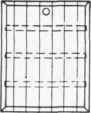
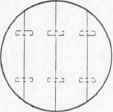
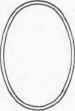
Suggestions For Original Design
No. 1
No.2
No. 3
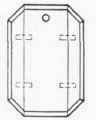
No. 4
Steak Or Fish Plank
Bread Or Meat-Cutting Board Specifications
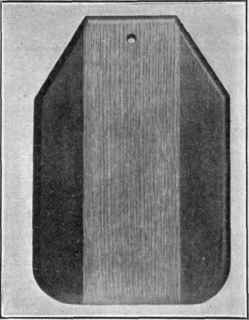
This board is to be made by gluing together the three boards, as you will note from the illustration the light-colored piece is to be used in the middle with a dark piece on each edge.
The Light-Colored Piece
As this material is furnished S 2 S, and as you will have to resurface it after it is glued up, it is not necessary to plane the surface now. Select the best surface and mark it the working face (Chapter II., Paragraph 2). Carefully plane one edge perfectly straight and square with the working face (Chapter II., Paragraph 4). With the marking gauge or pencil and ruler gauge the width of the board (shown in the drawing), (Chapter II., Paragraphs 6 or 7). Carefully plane to the gauge line. It is not necessary to cut the length of this board at this time. That can be done after the work is assembled.
The Dark-Colored Pieces
Plane one edge of each of the dark strips perfectly straight and square (Chapter II., Paragraph 4). Lay the boards in position on your bench top, and press them closely together to make sure that the joints will fit perfectly. If they do not fit perfectly, determine what the difficulty is, and with a sharp plane, set to take a very thin shaving, plane them until they will make a very tight joint. These boards are to be joined with dowels, as indicated in the drawing. Locate the points where the dowels are to be and lay out for them (Chapter II., Paragraph 18); carefully bore for the dowel (Chapter II., Paragraph 13). Cut the dowels the right length (make sure they are not too long or the work will not assemble properly).
Continue to:


My Books

