


Construction Problems. Part 2
Description
This section is from the book "Shop Projects Based On Community Problems", by Myron G. Burton. Also available from Amazon: Shop Projects Based on Community Problems.
Construction Problems. Part 2
Supplementary Problems
Problem A - To Erect a Perpendicular and the End of a Given Line.
Draw a line AB. Assume a point P, any convenient position outside this line. With P as a center, and a radius equal the distance from P to B, draw a circle passing through B and cutting the line AB at the point C. Draw a line from C to P and extend it to intersect the circumference at F. Draw the line FB. This will be the required perpendicular at the end of the line.
In regular shop practice the perpendicular at the end of the line will be drawn with the triangle.
Problem B - To Bi-Sect Any Given Arc.
With the compasses draw any arc AB. Connect points A and B with a straight line. This straight line is called a chord. Bi-sect this chord with a perpendicular line (Problem 1). This perpendicular line will also bi-sect the arc.
Problem C - (Test Problem).
With your T-square draw a horizontal line AB. From any point P in this line erect a perpendicular with one of the triangles. Test the accuracy of this perpendicular by the method given in Problem 2.
Problem D - (Test Problem).
With your T-square draw two parallel horizontal lines and with your triangle draw two vertical parallel lines. Test both pairs of lines (Problem 4) to determine whether or not they are accurate.
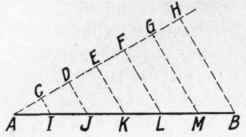
Problem No. 5 - To Divide a Given Line Into Any Number of Equal Parts.
Let AB be the given line, which, for illustration, we will divide into six equal parts. Draw the line AH at any convenient angle to line AB. Lay off six equal parts on line AH. This may be done by setting the dividers at any convenient distance and beginning at A mark off the required number of parts. Letter these points C, D, E, F, G, H; from H draw the line HB. From the other points in line AH draw lines parallel to line HB, cutting line AB; letter the points of intersection M, L, K, J, I. These lines will divide AB into the required six equal parts.
In shop practice these parallel lines would be drawn by the use of triangles.
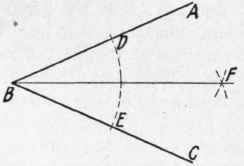
Problem No. 6 - To Bi-Sect Any Angle.
Let Abc be the given angle. With B as a center, at any convenient radius draw an arc cutting AB and CB and letter these points D and E respectively. With any convenient radius greater than one-half of DE, using D as a center, draw an arc. With the same radius, using E as a center, draw an arc intersecting the first. Letter this point of intersection F. Draw a line connecting points F and B. This is the required bi-section; that is, it divides the angle into two equal parts.
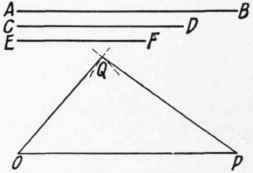
Problem No. 7 - To Construct a Triangle Having Its Three Sides Given.
Let lines AB, CD and EF, respectively, be the given sides with which to construct a triangle. Draw a line OP equal to the line AB. Set the compasses to a radius equal to CD; using point P as a center, draw an arc above the line OP. Set the compasses to a radius equal the line EF. Using the point O as a center, describe an arc, cutting the first arc at point Q. Connect point Q to points O and P. This will be the required triangle.
Problem No. 8 - To Transfer An Angle.
Let Abc be the given angle. Draw any line EF. On the given angle, using B as a center, and any radius, draw an arc cutting the sides of the angle at M and N. With the same radius, using E as a center, draw an indefinite arc, cutting the line EF at P. Now on the given angle set the compasses to a radius equal NM. Using P as a center, draw an arc cutting the first indefinite arc at point Q. Draw the line ED through the point Q. Def will be the required transferred angle.
Problem 5
Problem 6
Problem 7
Problem 8
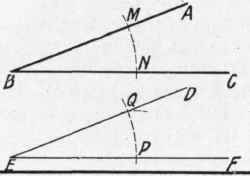
Plate II.
Continue to:


My Books

