


Construction Problems
Description
This section is from the book "Shop Projects Based On Community Problems", by Myron G. Burton. Also available from Amazon: Shop Projects Based on Community Problems.
Construction Problems
(See Plate L, Page 299.)
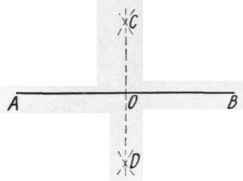
Problem No. 1 - To Bi-Sect a Given Line.
Let line AB be the given line. With a pencil compass set at a distance greater than one-half the length of line AB, using A as a center, draw an arc below and one above the line; using B as a center, with the same radius, draw arcs above and below the line, intersecting in points C and D respectively. Rule a line to connect points C and D. Point O, where this line intersects line AB, will be the point of bi-section (half way between points A and B).
In shop practice a line is usually bi-sected by measurements made with the scale, or dividers.
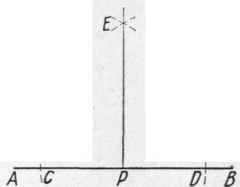
Problem No. 2 - To Erect a Line Perpendicular to a Given Line at a Given Point.
Let AB be the given line and P a point within the line to which the perpendicular is to be erected. With the compasses set at any convenient radius, using P as a center, draw an arc cutting the line AB on each side of point P. Mark these points C and D respectively. With the compasses set at any radius somewhat greater than PD, using D as a center, draw an arc above the line AB; with the same radius, using C as a center, draw an arc intersecting the first arc. Rule a line E to P. This is the required perpendicular.
In shop practice this perpendicular would be erected by placing a triangle on the T-square and drawing the perpendicular line through the required point.
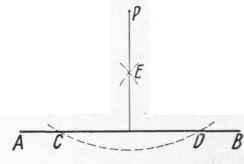
Problem No. 3 - From a Given Point Outside a Line to Drop a Perpendicular to the Line.
Let AB be the given line and P the point outside the line. With the compasses set at any convenient radius, using P as a center, draw an arc cutting the line AB at points C and D. With the compass set at any convenient radius greater than one-half of CD, using D as a center, draw an arc above the line AB. Using C as a center, with the same radius, draw another arc, intersecting the first arc at point E. Rule a line passing through points P and E to the line AB. This will be the required perpendicular.
In shop practice this perpendicular would be drawn by the use of a triangle resting on the T-square.
Problem No. 4 - Through a Given Point to Draw a Line Parallel to a Given Line.
Let AB be the given line and P the given point. With P as a center and the compasses set at any convenient radius great enough to cut the line AB, draw an arc cutting line AB at point Q. With Q as a center, and the same radius, draw an arc cutting the line AB at R (it will pass through the point P). Set the compasses with a radius equal to RP, using Q as a center, draw an arc cutting the first arc at point S. Rule a line through points P and S. This is the required line.
In shop practice this parallel line, if horizontal, would be drawn with the T-square; if vertical, with the triangle resting on the T-square.
Problem 1
Problem 2
Problem 3
Problem 4
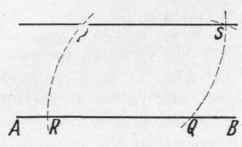
Plate I.
Continue to:


My Books

