


Construction Problems. Part 4
Description
This section is from the book "Shop Projects Based On Community Problems", by Myron G. Burton. Also available from Amazon: Shop Projects Based on Community Problems.
Construction Problems. Part 4
Supplementary Problems
Problem I - The Sum of the Three Angles of Any Triangle Is Equal to 180 Degrees (the Total Angles on One Side of a Straight Line), Having Two Angles Given, to Find the Third Angle of Any Triangle.
Let Mno be one of the angles, Qrs the second, to find the third angle of the triangle; draw a straight line AB. At any point P in this line transfer the angle Mno, making the vertex fall on P. Let the line AP form one side of the angle. In like manner transfer the angle Qrs, letting the vertex R fall on point P; letting PB form one side of the angle. The remaining angle would be the required angle.
Problem J - To Construct a Triangle Having Two Sides and the Included Angle Given.
Let MN and PQ be the two sides, and Rst the given angle. Draw the line AB equal to the side PQ; transfer the angle Rst making its vertex on point B. Prolong the side of the angle the length of the side MN, mark this point C; connect C with A. This will be the required triangle.
Problem K -
(Test problem in actual measurement). To find the largest circle that can be drawn in an equilateral triangle with one side given.
Draw the equilateral triangle of given size (Problem 7); inscribe the circle (Problem 10). Measure the diameter with the scale.
Problem L - To Inscribe a Square in a Given Circle.
In the given circle draw two diameters at right angles to each other (T square and triangles). Connect the points where these diameters cut the circumference; this rectangle will be the required square.
By drawing and actual measurements find the largest square that can be cut from a circular board 9 inches in diameter.
Problem 12
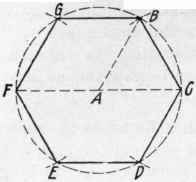
Problem 13 - To Inscribe a Regular Hexagon in a Given Circle.
With A as a center, draw any circle. With the T-square draw the diameter of the given circle, cutting the circumference in points F and C. With the compasses set to the same radius with which the circle was drawn, using C as a center, draw arcs B and D above and below the diameter, respectively. With F as the center, and the same radius, draw arcs G and E. Connect these six points with straight lines, thus forming the required hexagon.
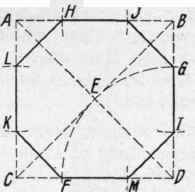
Problem 14 - To Construct an Octagon in a Given Square.
Let Abcd be the given square. Draw the diagonals AD and BC intersecting at point E. With the compasses set to a radius equal to DE (one-half the diagonal), using D as a center, draw an arc intersecting the square at points G and F. Using B as a center, and the same radius, draw an arc intersecting the square at points H and I; using A as a center, draw an arc intersecting at J and K. Using C as a center, draw an arc intersecting at L and M. Draw lines from M to I, from G to J, from H to L and K to
F, thus forming the required octagon.
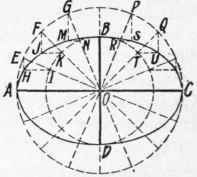
Problem No. 15 - To Draw an Ellipse When the Two Axes (Diameters) Are Given.
Draw the major axis AC; draw the minor axis BD perpendicular to AC at its middle point. Make BO equal to OD. With O as the center and a radius equal to OC, draw the circle A, E, F,
G, P, C. With O as a center and a radius equal to OB, draw the Circle Iknrt. Draw a number of radii from 0, cutting both the circumferences. These radii may be drawn with the use of the 60 and 45-degree triangles. From the point where these radii intersect the inner circle draw horizontal lines (with the T-square). From the point where these radii intersect the larger circle draw vertical lines (with the triangle). Where these vertical and horizontal lines intersect will be points in the required ellipse. Locate a number of such points. Usually about four or five will be sufficient in each quarter of the circle. Draw a freehand curve touching all these points.
Problem 16 - To Construct an Ellipse With the Use of a Trammel.
Draw the major and the minor axis as explained in Problem 15, letting AC be the major axis and BD the minor axis. Prepare a strip of cardboard, or paper, having a straight edge, and mark off EG equal to one-half the major axis and FG equal to one-half the minor axis. Place this slip of paper in a number of positions, keeping point E on the minor axis and F on the major axis. Point G will thus locate a number of points in the desired ellipse. Connect these points by means of a freehand curve.
Problem 13
Problem 14
Problem I5
Problem 16
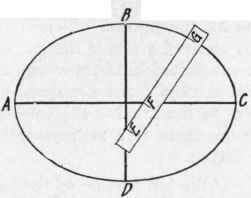
Plate IV.
Continue to:


My Books

