


Medicine Or Shaving Cabinet
Description
This section is from the book "Shop Projects Based On Community Problems", by Myron G. Burton. Also available from Amazon: Shop Projects Based on Community Problems.
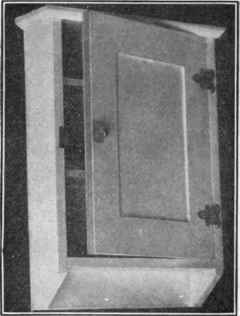
Medicine Or Shaving Cabinet
Materials
Poplar (Chap. III., Par. 42) or any-soft wood.
1 pc. 7/8"x5 1/2"xl8" S 2 S Top.
2 pcs. 7/8"x4 3/4"x24" S 2 S Sides.
1 pc. 7/8"x4 3/4"xl5" S 2 S Bottom.
1 pc. 7/8"x3 1/4"xl5" S 2 S Apron.
2 pcs. 1/2"x334"xl5" S 2 S Shelves.
1 pc. 1/4"(3-ply)xl5"x20" S 2 S Back. lpc. 1/4"(3-ply)xlO"xl5" S 2 S Door panel.
2 pcs. 7/8"x3 1/4"x20" S 2 S Door side styles. 2 pcs. 7/8"x3 1/4"xl4" S 2 S Door cross rails.
l 1/2 doz. 6d finishing nails.
2 doz. 1 1/4" brads.
8 screw eyes, No. 114.
1 pair 1 1/2" hinges.
1 small cupboard catch.
Introductory Statement
In every home it is very important that some place be provided for the care of medicines and various home remedies; a small, neat cabinet with a close-fitting door is most suitable for this purpose.
There is no standard size for a medicine cabinet; for it is often desirable to make it to fit a certain space in the bathroom or wherever it is to be used. It would be well for you to measure your space at home and then make your cabinet to fit.
This lesson presents the principles of a mortised and tenoned door, and since this is such an important piece of construction, you should give it special attention. A door made of one wide board or with battens is not so good nor so neat for small cabinet work.
There are so many uses for various kinds of wall cabinets, such as shaving cabinets, china cabinets, built-in bookcases and the like that you should master these principles.
References:
Cabinet Work and Joinery, Hasluck.
Elementary Cabinet Work, F. H. Selden. Rand-McNally Co., Chicago,
Ill. Inside Finishing, King. American Book Co., Chicago, Ill.

Medicine Cabinet
Suggestions For Original Design
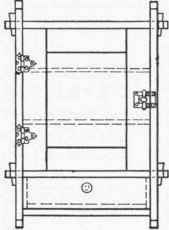
No. 1
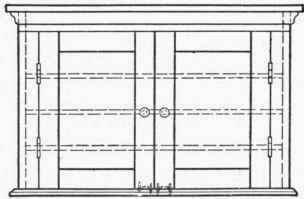
No.2
Medicine Or Shaving Cabinet Specifications
The Top
Square the stock, lay out and make it the proper dimensions.
The Sides
Square the stock, lay out and make the side pieces the size shown in the drawing. Although the material is furnished S 2 S, these pieces should be carefully surfaced, and finished with a steel scraper.
The Rabbet
The side pieces and the top are to be rabbeted to receive the back. If you rabbet them with a plane this will cut away the material to the end of each piece, and when the work is assembled will leave holes, which will have to be neatly filled. If you desire, you can cut these rabbets only as far as required, by laying them out with a marking gauge, and carefully cutting them with a pocket knife, first scribing deeply on one gauge line, and then on the other until the rabbets are completely cut out.
Continue to:


My Books

