


50. The Common Rafter
Description
This section is from the book "Constructive Carpentry", by Charles A. King. Also available from Amazon: .
50. The Common Rafter
The Common Rafter. (Fig. 71). (A.) The length of a common rafter is not from the apex of the roof to the eaves, but from the apex of the roof to a point directly over the plate, upon the top edge of the rafter, as in the figure. If a ridge is used, one half of its thickness must be taken off parallel with the plumb cut at the top end of the rafter, as will be described later in this topic. If there is a lookout upon the rafter, the stick must be long enough for it to be added, though upon an open cornice roof the lookouts are usually sawed to some design, and nailed upon the sides of the rafters.
The following is a key to the formulas for finding the length of a common rafter: -

Fig. 71. - Common Rafters.
H = length of rafter.
R = run of rafter.
A = rise of rafter.
T = pitch line of ½ of the thickness of the ridge.
X = bridge measure.
T1 = thickness of ridge.
P = plumb cut (ridge, or face cut).
C = constant of rise of roof - 6, 8, or 12.
S = seat (plate cut).
The length of any kind of rafter of any pitch may be found mathematically by using the following formula :
Formula 10. H =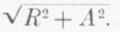
The length of any rafter may be found upon the steel square thus: -
Formula 11. H = X of R on Bl., A on To.
If the square is laid upon the rafter with A on the tongue, and R on the blade, To. will give P, and Bl. will give S; these figures are rarely used in marking angles, as their principal use is in ascertaining the length of the rafters, though they are frequently used when irregular roofs are being framed. The length of any straight rafter, of any pitch, anywhere in the roof, may be found by applying the above method, though in certain instances there are better methods of finding it. Upon intricate work, it is best to use the mathematical formulas, as well as the steel square, to insure accuracy, as one proves the other.
(B.) The cuts of any of the three common pitches may be found by using formulas 10 and 11, working from the actual dimensions of the roof; but in practice it is the custom to use constants which will always give the cuts for the standard pitches, since, if the rafters are square with the plate, neither the pitch nor the angle of the cuts changes, whatever the length of the rafter, or the size of the house.
These constants are obtained by using the dimensions of a house 24' wide, as 12' is the run, and the rise of all of the standard pitches will be even feet with no fractions. Thus working from an inch scale, 12 Bl. will be the constant for the run of all pitches.
The constant for the rise of a half pitch roof, on the above house, is therefore : 24/2 = 12; for a third pitch roof: 24/3 = 8; for a quarter pitch roof: 24/4 = 6; either 12, 8, or 6 To.
If a two thirds or a three fourths or any other pitch is wanted, its constant may be found in the same way.
In Fig. 72 is illustrated the method of laying off the angles of common rafters, giving the constants to be used for the common pitches, - the edge ab of the bevel board being the pitch, or rafter line, the line of Bl. being the run, and the line of To. being the rise. This seems an awkward position, but after a little practice the student will have no trouble. Thus, 12 Bl, 12 To. = ½ pitch; 12 Bl, 8 To.=1/3 pitch; and 12 Bl, 6 To. = ¼ pitch. In every case To. gives the plumb or ridge cut, and Bl. gives the seat or the plate cut.
It should be remembered that in all of the following problems in the use of the steel square, those which deal with rafters, the runs of which are square with the plate, have in every instance 12 Bl. as the constant for the run. The student should be careful not to use the constant for the length of the rafters, unless a house 24' wide is being framed, and the rafters are square with the plate. A house of that width, or one with a run of 12', is the only one for which the constants will give the correct results. Instead, use the actual dimensions of the rise and the run to obtain the length, as in formulas 10 and 11. In laying out rafters of all kinds, always work from the top of the stick, which should be the crowning or rounding edge.

Fig. 72. - Laying out the Plumb or Ridge Cuts of a Common Rafter.
In laying out the common rafters, or any pieces which should be just alike, it is the custom to lay out one, and mark the others by it. For an example, we will lay out the first common rafter for a third pitch roof.
Lay the square upon the stick, as shown by the full lines of Fig. 72, and mark To., the angle of the plumb cut. Calculate the length of the rafter by either or both, formulas 10 or 11; measure this distance from the ridge cut toward the other end of the stick, and mark the seat cut. In laying out the length of common rafters, for instance, for a third pitch house with a run of 12' 8", the length of the rafter, working to the nearest 16th of an inch, would be 15' 3".
The method of using the square in laying out the seat or plate cut is shown in Fig. 73 in which the apparently awkward position of Fig. 72 is repeated. The end of the rafter at the plate is indicated by point k, which is made upon the top edge of the rafter, and is identical with point k of Fig. 71. It will be directly over the outside of the plate when the rafter is in position. Fig. 73 shows the method of working from point k, to lay out the "bird's mouth" joint which fits over the plate. A line is drawn from k to the under edge of the rafter, as at kc, and the plumb height, kd, about 3", is measured from k upon this line. Keeping the square at the same figures, 12 Bl. and 8 To., slide it along until the Bl. coincides with d; draw this line from d to e. The triangular piece, cde, must be cut out to allow the rafter to fit the plate. The seat or plate cut, de, will rest upon the top of the plate; while dc fits against the outside of the plate when the rafter is in position, as in Fig. 71. A plumb height of from 3" to 4" according to the pitch and size of the stick is left from the plate to the top of the rafter, as at dk, Fig. 73, to give room for fastening the lookout on its side.
If a ridge is to be used, the mathematical formula for finding the length of the rafter is as follows : -
Formula 12. H =
In using a steel square to lay out a common rafter, which is to rest against a ridge, the first rafter should be laid out as though it were to be cut full length. Measure the distance c (Fig. 72), which equals one half of the thickness of the ridge, square from the plumb cut of the rafter, and draw a line as indicated by To. of the dotted square. Square across the edges of the rafter at the plumb and seat cuts, and saw accurately to the marks. Using this rafter as a pattern, lay out and cut as many as may be desired.

Fig. 73. - Laying out the Seat or Plate Cut of a Common Rafter.
(C.) The sizes of the common rafters generally used upon ordinary work are as follows: 10' 0" or less in length. 2" X 4"; if longer, a purlin should be used or a 2" X 5" or a 2" X 6" rafter. If a rafter more than 16' long is needed, it is common practice to use a purlin if possible, rather than very heavy rafters.
(D.) Upon the better class of buildings it is customary to space the rafters 16" to centers, thus allowing both the covering boards and laths to be cut economically, and giving four nailings for the latter. Many architects and builders consider that this spacing adds to the weight and expense of the roof more than is necessary upon ordinary buildings, and therefore space the rafters 20" or 24" to centers. The former distance requires that 10' or 12' covering boards should be used to prevent too much waste if a plain roof is being built, but if the roof is broken by dormer windows, hips, and valleys, this is not an important consideration. If the ceiling of the attic is to be plastered, the 20" spacing will not allow the laths to be cut economically.
The 24" spacing will allow both the covering boards and the laths to be cut with the minimum of waste, though the distance between the rafters is greater than it should be for nailings, more especially in nailing the laths, though many reputable builders consider that as there is not the vibration to the roof that there is to a floor, the 24" spacing gives satisfactory results if thick laths are used and the mortar is well clinched.
Continue to:


My Books

