


Decorative Processes. In Wood And Metal Work. Continued
Description
This section is from the book "Handcraft In Wood And Metal", by John Hooper, Alfred J. Shirley. Also available from Amazon: Handcraft In Wood And Metal.
Decorative Processes. In Wood And Metal Work. Continued
Wax Inlaying
This is another traditional type of decoration, rather unjustly abused in some quarters. Theoretically the application of wax inlaying may be wrong, it being contended that its composition is liable to shrink and fall out. In actual practice, however, a better state of things occurs, as is evinced by a fine French cabinet (period sixteenth century) in the Edinburgh Museum. For this example a free treatment of design is possible, there being practically no limitation to the use of the material, as is the case when inlaying wood. The design is cut out with a vee tool and gouges, and the cavities filled with a composition of wax, dry colour, and resin. The latter acts as a hardening element. The three media are melted and well mixed together, and the mixture is then put into the grooves with a piece of stick. Previous to the insertion of the wax, the wood should be given a coating of ordinary French polish which prevents discoloration of the groundwork and a ragged effect in the fine lines owing to the composition soaking into the end grain. A design can be executed in one or more colours, care being taken not to allow them to merge one in the other where they join. The composition is dry half an hour or so after its application, and the superfluous composition can be removed with a steel scraper. Colour combinations for this process include reds, blues, blacks, and greens for oak; yellows, blues, or greens for mahogany. Stronger contrasts of colour can be effected with wax inlaying, and generally speaking, the tone of natural wood accentuated can be utilized as colour schemes. Various applications of this process are shown on pp. 33 and 27. A combination of wax and veneer inlaying is also an effective treatment (see Fig. 6 on p. 50). Punch work filled with this preparation is particularly suitable for young pupils, giving a deal of scope for ingenuity in design, and it is particularly easy to manipulate.
Recessing
This type of decoration, a familiar feature of Jacobean work, is not now used to the extent it deserves. There has been no noteworthy example of this art in England since the seventeenth century, nor abroad, where it flourished about the same time. Switzerland, Germany, and Scandinavia all excelled in the practice of this art, and the museums show some excellent examples of furniture decorated with this process. The details of a fine Tyrolean cabinet in the Victoria and Albert Museum are illustrated in Fig. 9, from which it will be seen that the whole outline is simply vee tooled and then recessed. The veins of the leaves are executed with one cut of the vee tool. Simple geometrical designs and outlines based upon natural motives as on p. 144 can very well be introduced, and if the recessed part is painted in oil colour rich effects are produced. Decorated in this way is the fine Scandinavian chair shown opposite, exhibited at the last Paris Exhibition. It is a rich example of work, following the traditional lines of Scandinavian ornament, and provides much useful detail for lessons, introducing simple carving and recessing. In executing this work, a good plan is to transfer the design on to the groundwork and then to cut or outline the design with gouges, not necessarily removing all traces of the tooling, for a texture is thus imparted to the background which has a very pleasing effect when coloured. The background can be painted with an admixture of painter's gold size and dry artist's colour which dries quickly. The surface or relief part of the decoration can be treated with another colour, or simply cleaned up and waxed. Mediaeval German artists produced some very beautiful specimens of this work, imitating a "gesso"effect, and gilding the background with fine gold leaf; the raised portions were also gilded and burnished bright to effect a contrast of tone. The writer has also seen specimens with a painted background of a red colour with the relief part gilded.

Fig. 9.
The drawings on p. 39 illustrate simple designs for recessed work which lend themselves also to decorative colour treatment.
Punch Work is a simple process eminently suited to handcraft work. The designing is easy, and has advantages in the development of taste and observation of proportion by the disposition of units in a much greater range than the degree of executive skill demanded. Good designs can be effected with such a simple tool as the leather washer punch, obtainable at ironmongers. This is used for circular holes, whilst square and diamond shapes can be cut with chisel?. Borders are especially effective when decorated in this way, and panels for doors and constructional models can be decorated with advantage. Fig. 10 shows three designs for borders. The circular punch should be held in a vertical position, and struck smartly with a hammer, cutting the wood about 1/19 in. deep. A slight movement of the tool usually suffices to separate the core, and the next spot can then be proceeded with. The punch has an elongated conical attachment which causes the loose circular pieces to become loose when several cuts are made. They may then be easily removed by reversing the punch. Square and diamond shaped holes are made with four chisel cuts, removing the core with a small chisel. Composition can be used to fill in the spaces, or they may be painted in contrasting colours. The play of light and shade also has a pleasing effect in this type of work.
Carving, like its sister art inlaying, is also of very ancient origin, as is evidenced by the examples illustrated in the chapter on decorative examples of handcraft. Nearly all nations have had a period in their history when carving was the pre-eminent craft. Not only has wood been chosen for carved decoration, but metal, stone, and marble, gems, ivory, and pearls, have from the earliest times all been utilized in the practice of this art. Mediaeval France and Italy produced most elaborate specimens of carving, especially during the Gothic and Renaissance periods. These masterpieces are unsurpassed from the point of view of technique, with the exception perhaps of work belonging to the Grinling

Fig. 10.-Simple patterns tor punched work.
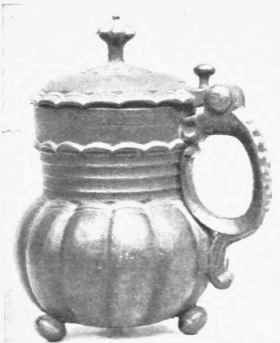
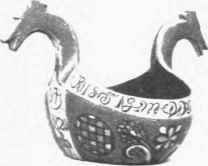
-Norwegian bowls, examples of peasant art, carved wood, the bowl being painted.
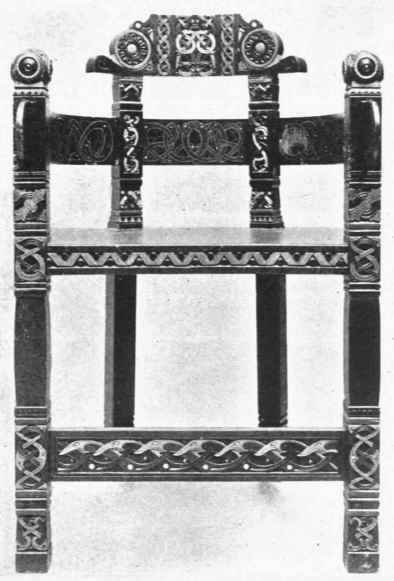
Fig. 11.-A modern Scandinavian chair shown at the Paris Exhibition.
Gibbons school in England. Educationally, they should be regarded as the peculiar products of a period, interesting as studies, but devoid of true aesthetic feeling.
Continue to:


My Books

