


Hanging Knees
Description
This section is from the "The Elements Of Wood Ship Construction" book, by W. H. Curtis. Also see Amazon: The Elements Of Wood Ship Construction.
Hanging Knees
Where heavy shelves are not fitted, it is the rule to place a hanging knee under each end of each beam. This practice is confined principally to the Western Coast where there is a great supply of natural crook fir knees available.
They are cut from the roots of fir trees and are remarkably strong.
Heretofore there have been no rules for proportioning these knees beyond the rough rules devised by the ship carpenters in the yards. The author has, therefore, after giving the subject some study, devised the proportioning rules shown in Figs. 111 to 114 inclusive. These rules should of course be used with some discretion, but for the great majority of knees of the ordinary proportions they will produce strong knees having a pleasing appearance.
The short leg of the knee is generally called "the root" and the long leg "the trunk" as this is the position in which the knee is cut from the stump of the tree.
There is no very definite relation between the thickness of knees and the length of root and trunk. The following table gives the range of proportions most generally used.
Thickness | Length of Root "A" |
12 inches | 48 to 60 inches |
10 inches | 40 to 48 inches |
8 inches | 30 to 45 inches |
6 inches | 24 to 36 inches |
4 inches | 16 to 24 inches |
Typical knee fastenings and the method of scribing them in are shown in Figs. 115 to 117 inclusive. In Fig. 115 some of the bolts are driven from the inside while the balance are button-headed bolts driven from the outside and clinched inside. In Fig. 116 all of the bolts where possible except the throat bolt are driven from the outside and clinched inside..
The scribing and fitting of a knee is in reality a very simple operation, the principal part of which is shown in Fig. 117. The knee is first roughed out so that when shored up against the beam and ceiling it will stand close enough everywhere to permit scribing, or more properly speaking, pricking. Then with dividers held in the positions indicated in the figure prick points are made at frequent intervals on both sides of the knee, which when joined with a line give the cutting limit for a fit. In the figure short lines have been drawn to indicate the relative position of the two points of the divider. Care must be taken to hold the divider at the same angle at all points. If this is done the knee can be pricked and cut in at one operation no matter what the shape of the ceiling, or clamps. Care must also be taken to so adjust the knee for pricking that the proper amount of material will still remain in the knee after it has been cut to the prick points.
Ceiling and clamp fastenings should be kept clear of knees, but where they happen to land in the way, the faying face of the knee must be spot bored to clear them.
All hanging knees set square with the centerline of the ship, but the inboard face of the knee should be so dressed off that it will parallel the ceiling in the fore and aft direction. This is done by first determining the amount of bevel the hanging leg of the knee is to have and sawing a corresponding bevel on the inner face. This is not done for the purpose of securing strength, but mainly to give a pleasing and workmanlike appearance to the knee after it has been placed in the ship.
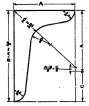
Figure 111.

Figure 112.

Figure 113.
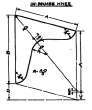
Figure 114.
Proportions Of Knees - Square Knees.
Continue to:


My Books

