


Plumbing And Squaring The First Square Frame
Description
This section is from the "The Elements Of Wood Ship Construction" book, by W. H. Curtis. Also see Amazon: The Elements Of Wood Ship Construction.
Plumbing And Squaring The First Square Frame
The first square frame set up must be squared with the keel. Since the keel has a declivity, and in addition is laid with a spring, this cannot be done by the ordinary method of squaring. While there are several methods of going about this problem, the following, as shown in Figs. 51,52 and 53, is the best that has come to the author's attention. Figure 51 is a view looking down on top of the frame, square with the keel. Figure 52 is an elevation looking along the keel, and Fig. 53 is an elevation looking across the keel. For the purpose of illustration a definite example has been taken, the problem being to erect and square the first square frame on a keel having a slope of ⅝" to the foot, the keel having a spring and a taper. It is, therefore, impossible to square off either the sides or the top of this keel. We then proceed as follows:
With the frame set up in approximate position and at its proper location on the keel, set a straight edge having a length greater then the span of the frame across the keel and 24 inches away from the center of the frame. Square this straight edge with- the center-fine on the keel and level it by any of the methods well known to carpenters. Place a nail at center of frame, on each side, 16 feet above the top of the keel, care being taken to have the nail on each side exactly the same distance down from the deck line and 16 feet above the top of the keel. From each of these nails hang a plumb-bob with a line long enough to pass the ends of the straight edge. From the center of the cross-pawl hang another plumb-bob with plumb just short of the inside of the frame over the keel. Now, the nails at the sides of the frame are 16 feet above the straight edge and the slope of the keel is ⅝" to the foot. The slope in 16 feet will be 10 inches, and the side plumb-lines should be 10 inches nearer, or further away from the straight edge than the distance from the straight edge to the center of the frame at the keel, according to the position of the straight edge above or below the frame. In this case the straight edge has been placed below the frame, and the distance from the plumb-line to the straight edge will be 10 inches less than that at the keel, between the center of the frame and the straight edge, or 14 inches. Then all that is necessary to properly square the frame is to adjust the shores holding the frame in position until each of the side plumb-lines is 14 inches away from the straight edge, and the center plumb-bob hangs directly on the center-line of the keel.
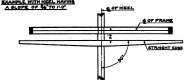
Figure 51.

Figure 52.
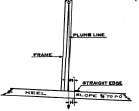
Figure 53.
Plumbing And Squaring - First Square Frame.
This frame must be very rigidly shored in position. Then the balance of the frames are spaced from it with a space-stick reaching from center to center. If the spacing is carefully done it may not be necessary to make further checks for plumbing and squaring, but it is usually advisable to plumb and square by the above method at least three frames having some distance between them; that is, the last square-frame at each end and one at the midship.
All frames, as soon as erected on the keel, are plumbed and spaced from the last frame and fitted with bilge shores and cleats to hold them plumb and at proper space. Sometimes two sets of bilge shores are fitted. As soon as a number of the square-frames are up the ribbanding should be begun. Ribbands should be heavy enough and close enough together to properly bring the frames into alignment. Of course no amount of ribbanding can bring a poorly molded and assembled frame into alignment, but with a frame well built good ribbands will greatly reduce the amount of dubbing. Ribbands should be fastened with ship spikes driven through washers or clinch rings, so that when the ribbands are pulled off the spikes will come with them.
Continue to:


My Books

