


Cutting Pipe Threads
Description
This section is from the book "Machine Shop Work", by Frederick W. Turner, Oscar E. Perrigo, Howard P. Fairfield. Also available from Amazon: Machine shop work.
Cutting Pipe Threads
Another common form of thread cutting is that on wrought-iron pipe. The pipe thread is rounded slightly at top and bottom and is made tapering at the rate of three-quarters of an inch per foot. The dies are usually solid, square in form, and the die stocks are provided with a ring which fits over the pipe and serves to hold it square with the die. This avoids the danger of cutting the thread at an angle with the pipe axis.
Cutting Bolt Threads
Bolt cutting is seldom done by hand, such work being usually performed on bolt-cutters. This is ordinarily the roughest and cheapest class of work, and the running of the bolt-cutter is often the first work to which the apprentice is assigned.

Fig. 84. Split Die.
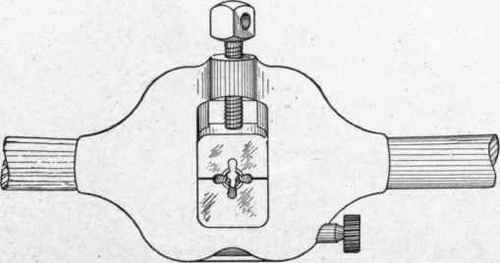
Fig. 85. Threading Die Holder.
An ordinary bolt-cutter is shown in Fig. 86; its operation is as follows: The dies are held in the head A. Instead of being solid, as in Fig. 82, they are made in sections and can be opened or closed by the movement of the lever B. A chuck C is placed on a traveling head, and this can be moved back and forth by the handwheel D. The method of working is very simple. The dies in the head are closed in order to be in the working position. The bolt to be cut is gripped in the chuck by turning the handle E and forced against the dies by the handle D. As soon as the dies have taken hold, they draw the bolt ahead. When a sufficient length of thread has been cut, the dies are opened and the bolt withdrawn. This avoids the necessity of backing out, as would be required if the dies were solid. While the thread is being cut, the dies are kept flooded with oil.

Fig. 86. Bolt Cutter.

HISTORICAL DEVELOPMENT OF HARTNESS FLAT TURRET LATHE.
Courtesy of Jones and Lamson Machine Company, Springfield, Vermont.
Continue to:


My Books

