


Patents. Part 20
Description
This section is from the book "Turning And Mechanical Manipulation", by Charles Holtzapffel. Also available from Amazon: Turning and Mechanical Manipulation.
Patents. Part 20
Note AV, page 554, to follow the paragraph ending, "without figures."
(Freeman's Registered Brill Tool.)
This is a very useful substitute for the drill bow, it consists simply of a flat strip of wood, from about 8 to 16 inches long, by 3/4 to 1 1/2 wide, with an appropriate handle, and on one side of the wood is cemented a strip of sheet india rubber or caoutchouc. The pulley of the drill or drillstock is made of wood and cylindrical, the diameter and length being about equal, and the extreme angles slightly rounded. The contact between the wooden pulley and the caoutchouc will be found quite sufflcient for the working of email drills, and as the tool is simply need as a violin bow, the tedious procees of coiling on the string of the ordinary bow is entirely avoided.
Note AZ, page 557, to follow the paragraph ending "for reciprocating drills." (Mr. MacDowall's Archimedean Screw Drillstock.)
Mr. MacDowall's improved drillstock, fig. 1011, is a very useful instrument, noting by reciprocating motion, and which was rewarded in 1845 by the Society of Arts. It consists of a rod of the so-called pinion wire (the formation of which is noticed on page 426 and fig 294 of vol 1. The one end of the wire is bored up to serve as a socket for receiving the drills, the other end is formed into a center point and contained within a handle or socket, by which the instrument sa guided towards and pressed into the work; the remainder of the instrument consists of a slider or nut fitted to the ribs of the pinion wire, and possessing a handle having on universal joint.
If the grooves of the pinion wire wore straight like the flutes of a column, the nut might be slid up and down without giving any motion to the drill, but as the wire is twisted to the extent of two or three turns in its length, like a very oblique screw, every ascent or descent of the handle causes a circular reciprocating motion of the drillstock, to the extent of two or three revolutions to and fro, and fulfils the office that would otherwise require the drill bow of the breast drill, or the cross staff of the upright or pump drill.
The instrument as above described answers beautifully for very small holes, but the ingenious inventor was again rewarded in the following year, for additions by which the power of this drill tool is much increased. He first added a transverse or diametrical arm at the foot, carrying two balls to serve as a fly and give momentum; but inconvenience then occurred from the weight having to be suddenly started and stopped. This defect was judiciously remedied by introducing a little catch wheel or ratchet in the nut by which, as in the Brequet watch key, and also in the ratchet drill, page 561, the catch slips over the teeth of the ratchet wheel in the ascent, and only moves the drill in the descent; thus allowing the fly to act uninterruptedly and impel the drill with continuous motion in the one direction only, and with increased force. With the improved instrument registered under the name of the "Continued RevolvingArckimedean Drill." holes can be pierced of fully twice the diameter of those which could be made with the former and more simple Archimedean drill having a reciprocating action.
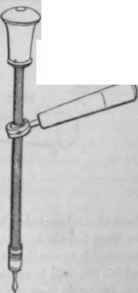
Fig. 1011
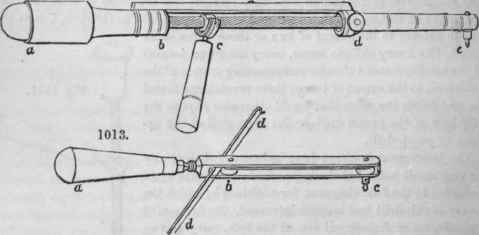
Note BA. - To follow the Note AZ, on page 557. (Mr. MacDowall's Rectangular Archimedean Drillstock for Dental Surgery.) This tool, which is represented in fig. 1012, is an offshoot of the reciprocating Archimedean drillstock. The parts a,b, c to d, of the succeeding figure are precisely analogous to the corresponding parts in fig. 1011, except that from i, to d, extends a straight bar that firmly unites these two parts. From d, to e, is a socket or tube carrying at e, a small drill socket or hollow mandrel, at right angles to the length of the instrument, and within the tube are concealed two very small bevel pinions, the one fixed on the drill socket, the other on the end of the reciprocating drill shaft, b d, which is continued within the tube so far as e, the bevel pinions therefore transfer the motion of the reciprocating shaft to the drill.
The tube which extends from d, to e, may be moved round in the collar at d, and fixed in any required position by the thumb-screw, so that the drill may bo directed upwards, downwards, to the right, or to the left, according to the portion of the hole the dentist has to drill in the tooth of his patient.
Note BB. - To follow the Note BA, on page 557.
(Capt. G. D. Davison's Rectangular Drilstock for Dental Surgery.)
Fig. 1013 represents an instrument for the same purpose as the foregoing, and which was invented at about the same time fig. 1012, by an officer of the British
Army, engaged in the Ahmednurggur Survey in India. It consists of two slender bars of steel united at both extremities, and inserted by the one end into a wooden or ivory handle a; at c, is a small spindle for the drills with an appropriate pulley situated between the two side bars, and at b is a similar pulley. The catgut line by which the drill is moved passes entirely round the pulley of the drill-socket at c, the two ends then run parallel with the stem of the tool, make each a quarter turn in opposite directions over the guide pulley b, and then proceed to the extremities of the drill bow, d, d, which passes through the space between the side bars of the instrument. If the pulley c, is situated close to the end of the instrument, and the drill bow nearly fills out the space between b and the steel frame, the cord will then be retained in the grooves of the pullies with little or no risk of its being accidentally detached. This instrument, like the last, may bo used in all the required positions.
Figs. 1012.
Note BC, page 563. - To precede Section IV. (Mr. George Scott's Apparatus for Boring and Tapping Cast-iron Main Pipes for Water and Gas.) Fig. 1014 represents Mr. George Scott's apparatus for drilling gas and water pipes, rod which was rewarded in June, 1846, by the Society of Arts. The parts are all grouped together as if in use, bat the pipe itelf is represented in dotted lines, in order that the point of the drill and the apparatus generally may be better seen: a, is a semicircular iron strap thai embraces the pipe b b, c c. is a cross piece with a screwed central bole attached to the curved strap by the nuts d d, and c, is a tube screwed into e e, and which tube carries the revolving socket f, terminating in the drill g. When the parts are all united and fixed to the pipe as in the figure, the drill socket f g, is handed round by means of a spanner about two feet long, Applied to the square at f, and whilst the hole is being pierced, the drill is set gradually deeper, by a screwed nut which in extended so as to constitute the handles h h, by the movement of which at intervals, the drill is gradually forced deeper into the hole it is in the act of boring.
Continue to:


My Books

