


Advaita According To The Saiva Siddhanta. Part 7
Description
This section is from the book "Studies In Saiva-Siddhanta", by J. M. Nallasvami Pillai. Also available from Amazon: Studies In Saiva-Siddhanta.
Advaita According To The Saiva Siddhanta. Part 7
These two principles in fact underlie our Mantra and Tantra, our Upasana and Sadana, Bhavana, and Yoga, and our books instance the case of the snake-charmer chanting the Garuda Mantra in illustration of this second principle of assimilation or identification. The Professor instances from Darwin, how in the working out of this principle of association and assimilation or identity in the human and animal evolution, persons ever associated with pigs get piggy faces, and with horses, horsey faces. In the case of husband and wife when they have been perfectly loving, it has been found to effect a complete assimilation of their features. Such is the power of the human mind, both a demerit and a merit; it can lower itself to the very depths of the brute, or it can rise to the very height of Godhood. This law is spoken of in our text books as the law of 'Garudadhyanam.' The writer of the book "Spiritual Law in the Natural World" (Purdy Publishing Company, Chicago) observes that all "who have made a study of the cause of all things have become so at one with it, as to have causing power, for it is an invariable rule, that we become like what we study or are closely associated with.
We become so like people with whom we live constantly, that the expression of face and sound of voice grow similar, and even features grow alike. Sometimes a child will look more like its nurse than its mother." And the whole book is an exposition of this principle, and it holds out as a Sadana for spiritual elevation, that a man should firmly believe that there is no world, no untruth, no sin, no sickness, no death, and he is a child of God, that there is only 'Truth, Power, Love, and Presence in this universe and nothing but this, that he is the reflection of God, the image and likeness of God, and then he can truly conquer sickness and death, and become truly the son of God. This is exactly the Sohambha-vana or Sivohambhavana. And the following verse of St. Aru-nandi Sivacharya sums up the whole teaching: -
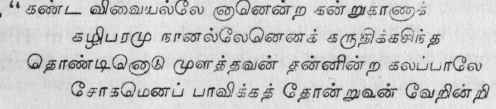
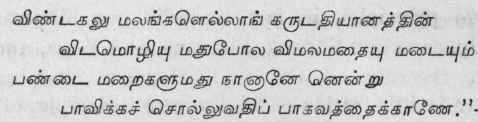
-(ix. 7).
"Say 'I am not the world, and am separate from it.' Say also' I am not the Unknowable Supreme One.' Then unite with Him indissolubly by loving Him in all humility, and practise Soham ('I am He'). Then will He appear to you as yourself. Your mala will all cease, just as the poison is removed by Garudadhyana, and you will become pure. So, it is, the old Vedas teach us to practise this mantra 'Aham Brahmasmi,' 'I am Brahman'."
As this right knowledge of non-difference and difference of ourselves from God and the universe is essential for our salvation, Srikantha discusses these questions in his Bhashya on the Sutras, II, i, 21-3, and we quote the whole of these passages, and he quotes and beautifully reconciles the numerous Bheda Srutis with the Mahavakya texts: -
"The Sutrakara raises and refutes an objection to the foregoing theory: -
(Jiva) being mentioned (to be one with) the other, there follows an incongruity such as neglecting what is good. (II. i. 21)..
(Objection): Because in the words "That thou art," and "this Atman is Brahman," Jiva. the effect, is mentioned as one with Brahman, because, it has been shown that they are not distinct from each other. In that case it would follow that the all-knowing and all-pervading Parames-vara dissolves the Universe for his own [good] and creates it for his own [evil]. Then it may be asked, how is it that Isvara, who is all-knowing and of unfailing will, and who knows that the pain of Jiva, who is no other than Himself, is His own pain, engages Himself in the creation of the Universe, which as leading to Samsara is an evil, and does not abstain from creation for His own good. Accordingly, once it is proved that Jiva and Paramesvara are one, there follows this incongruity that Paramesvara, though all-knowing, is guilty of a want of sense in so far as he abstains from what is good to Himself and engages in what conduces to His own evil. Wherefore it does not stand to reason that Jiva and Isvara, the cause and the effect, are one.
(Answer): In reply we say as follows: -
But the Cause is superior, because of the mention of a distinction. (II. 1. 22).
Though the cause and effect are one, the cause is declared in the Sruti to be superior to the effect, to the sentient and insentient universe, in such passages as the following : -
"Superior to the universe is Rudra, the Mighty Sage." So, a distinction is also made between Jiva and Paramesvara in the following passages: -
"But he who controls both - Vidya and Avidya is - another." "The one God rules the perishable (Pradhana) and Atman." "Thinking that the Atman is different from the Mover (the Lord)." "Two birds, inseparable friends, cling to the same tree." "Two Brahmans ought to be known, the superior and the inferior." "There are two, one knowing, the other not knowing : both unborn; one strong and the other weak."
"He is the eternal among eternals, the sentient among the sentient." "Having entered within, He is the ruler of the creatures." "Know then Prakriti is Maya, and the great Lord the Mayin." "From that, the Mayin sends forth all this; in that, the other is bound up through that Maya."
"When he sees the other, the Lord is contented...then his grief passes away."
"He is the master of nature and of man, the Lord of the three qualities."
"Of these creatures, pasus, the Pasupati is the Lord." Wherefore quite superior to the universe is Brahman, otherwise called Siva.
'Objection): By establishing non-duality in II. i. 15, and duality in II. i. 22, you have only proved duality and non-duality of Brahman and the universe.
(Answer): No : we do not establish that sort of Visishtadvaita which takes the form of duality and non-duality. We are not the advocates of an absolute distinction between Brahman and the universe as between a pot and a cloth, because of its opposition to the Sruti declaring that they are not quite distinct from each other. Neither are we the advocates of an absolute identity as of the mother-o'-pearl and silver, one of them being illusory; for, it is opposed to the Sruti which points to a difference in the inherent attributes of Brahman and the universe. Nor do we hold to duality and non-duality, which is opposed to the nature of things. On the other hand, we maintain that the unity of Brahman - as the cause and the effect - is like that of the body and of the embodied, or like that of the substance and its attribute. By unity of Brahman and the universe, we mean their inseparability like that of clay and the pot as cause and effect, or like that of the substance and its attribute. A pot, indeed, is not seen apart from clay, nor is the blue lotus seen apart from the colour blue.
Continue to:


My Books

