


Bath
Description
This section is from "The American Cyclopaedia", by George Ripley And Charles A. Dana. Also available from Amazon: The New American Cyclopædia. 16 volumes complete..
Bath
Bath, a place or vessel for washing the body. Besides the employment of natural streams and bodies of water, the artificial bath has been used from the earliest times of which we have any record. It is mentioned in Homer, the vessel for bathing being described as of polished marble, like many of the basins which have been found in the Roman baths. Even the warm bath is referred to in the Iliad and Odyssey, but it is spoken of as effeminate. In the historical periods of Greece there were numerous baths in Athens and the other large cities; but we know little of their arrangement, and they appear never to have attained the magnificence afterward reached in Rome. At Rome, in the time of the second Punic war and of the vigor of the republic, the baths, according to Seneca, were dark, small, and inconvenient. It was only with the beginning of the empire that they began to be among the most magnificent buildings of the city, the immense ruins which still exist testifying to the almost unparalleled luxury of their arrangements. The public bath at Pompeii (uncovered in 1824), though inferior in size and appointments to those of the capital, was similar probably to them in its internal arrangements.
It occupied an area of about 10,-000 sq. ft., and contained two distinct bathing establishments, of which the smaller is believed to have been appropriated exclusively to the women. In the men's baths is first a court, about 60 ft. long, bounded on two sides by a Doric portico, in which those who were waiting their turn for admission to the thermae might walk or repose upon the benches placed along the wall. From this court there was a communication by means of a corridor with a smaller room, frigidarium, in the walls of which holes are observed, which served for the insertion of pegs on which the clothes of the bathers might be hung. This room was the apodyte-rium (the place where the clothes were left) for those who intended to take the natatio, or cold bath. From it another door opened into an apartment in which was placed the natato-rium, or the piscina, a basin for the cold bath. The piscina itself occupies the centre of the room; it is of white marble, circular, 12 ft. 10 in. in diameter, and a little more than 3 ft. in depth; 10 in. below the lip, and 2 ft. 4 in. from the bottom, it is surrounded by a marble seat, 11 in. in width. The water was conducted into the basin by a bronze spout, the remains of which can still he discerned in the wall of the chamber.
In the bottom was an outlet, by which the water could be let out and the piscina cleaned, while the rim is furnished with a waste pipe. From the frigidarium a door opened into a similar room, which appears to have been warmed by a large portable fireplace, and was furnished with bronze seats placed along the wall. This room served as an apodyterium for those who were to use the warm baths, and here the bathers, previous to entering the caldarium, were rubbed and anointed with some of the immense number of fragrant oils and ointments which were employed by the ancients. Having left his dress in the tepidarium, the bather passed directly into the caldarium. The flooring of this apartment, which, in accordance with the directions of Vitruvius, is twice as long as it is broad, is placed upon small pillars (suspensurae), so that the heat from the furnaces had ready and free admission beneath it. The walls, too, were hollow, the inner being connected with the outer wall by strong clamps of iron and brick, and they thus formed one large flue for the circulation of the heated air. At one end of this room was placed the hot bath.
This was a shallow cistern (alveus), 15 ft. in length by about 4 ft. in breadth, and 2 ft. and half an inch in depth; it was elevated above the level of the floor, and the bathers ascended to it by means of two steps, the top one serving for a seat; on the inside another seat surrounded the whole of the cistern at about half its depth. The hot water was furnished by caldrons placed upon the other side of the wall. At the end of the room, opposite the alveus, was the labrum, a huge vase or tazza of white marble, 8 ft. in diameter, and having a depth internally of not more than 8 in. From the centre projected a brass tube, probably throwing up cold water. This was perhaps received upon the head of the bather, before he quitted the heated atmosphere of the caldarium. Adjoining the caldarium was placed the furnace over which was set the caldron for supplying hot water to the baths. The arrangement will be explained by the annexed copy of a fresco discovered in the baths of Titus at Rome. The women's baths resembled those of the men, except that the different apartments were much smaller, and the arrangements less complete. - The great thermaa erected by the emperors at Rome were much more extensive and magnificent structures. The baths of Caracalla were 1,500 ft. long by 1,250 ft. broad.
At each end of the building is a large oblong hall, a, having on one of its sides a semicircular tribune, b. The halls were probably designed for exercise, as was also the large open space f before the baths. From the tribunes orators and poets spoke to those assembled at this favorite place of resort. The large central apartment c is called the pinacotheca, but excellent authorities believe it to have been the cella calidaria. The circular apartment e was the laconicum, or room for the vapor bath; while the apartment d, at the other side, was the cella frigidaria. The water for all the building came from the elevated reservoir h, passing under the rows of seats g, from which spectators witnessed the athletic exercises below. All the apartments of the bath were magnificently ornamented with mosaic, and profusely adorned with painting, stucco work, and statuary. In these immense establishments, the apartments were not only more numerous, but some of them on a very much larger scale. Thus the na-tatorium, or swimming bath, in the baths of Diocletian, was 200 ft. long by 100 ft. broad, and it is calculated that in the whole establishment more than 18,000 persons could bathe at the same time. - In the times of the republic the cold bath alone was ordinarily employed, but later the hot air and warm bath were likewise generally used.
The order in which they were taken varied according to the directions of the physicians or the inclination of the bather. Previous to bathing, gentle, exercise was generally taken; then it was recommended that the bather should remain in the tepidarium, or warm chamber, for a time previous to undressing; after undressing he proceeded commonly to the caldarium, and after sweating some time in its heated atmosphere, he either gradually immersed himself in the hot water bath, or had hot water simply poured over the head and shoulders; then cold water was poured over the head, or the bather plunged into the cold piscina. He was now scraped with strigiles (small curved instruments, made generally of bronze), dried and rubbed with linen cloths, and finally anointed. When one bath alone was desired, it was taken just before the principal meal; but the Romans bathed after as well as previous to their eaena, and Commodus is said to have indulged in seven or eight baths a day. - The Turks and Arabs have, since the decline of Roman civilization, more particularly cherished the custom of bathing than any other nations. The laws of Mohammed ordain five prayers daily, and an ablution of the face, hands, and feet before each of them.
There are many other occasions for bathing, and the public bath is as sure to be found in every village as the mosque. With these eastern nations, as well as in Egypt, public bathing is a very complicated art. The bather, having left his dress in the reception room, proceeds through a long gradually warmed passage into the spacious bathing room, in which the steam of boiling water and the perfumes of burning essences are combined. He there reclines upon a kind of hammock, and when he has perspired sufficiently, the process of shampooing and bending the joints is performed upon him. He then passes into an adjoining apartment, where his head is profusely covered with the foam of soap, and his body with a kind of pomatum. In two other rooms he is washed with both warm and cold water, and he returns to the open air as he entered, through a long passage the temperature of which is graduated. - In India, also, there are public baths, which are associated with the practice of shampooing. The bather is extended upon a plank, and a vigorous attendant pours hot water over him, presses and bends the various parts of the body, cracks all the joints, and continues this operation of pouring, pulling, and pressing for about half an hour.
He then rubs him briskly with a hair brush, with soap and perfumes, after which the subject is obliged by his fatigue to sleep a few hours, but wakes extremely refreshed. The women in India take a lively pleasure in being shampooed by their slaves, and Europeans who enter upon the process with a sort of fear describe the sensation which results as delightful and peculiar. - The northern nations have also their peculiar usages in respect to bathing. The Russian lord has his bathing room in his own house, and the people in the villages frequent the public bath at a small expense. The entire operation consists, first, of a perspiration, then of friction, and of successive ablutions in hot and cold water. The poorer people, however, adopt a simpler method. They remain in the bathing room only till they begin to perspire freely, and then rush out and throw themselves, perhaps through a crust of ice, into the nearest stream or pond, thus exposing themselves suddenly to the extremes of temperature, and tempering themselves as steel is tempered. Among the Russians of Siberia, the bath is especially in use as a means of driving off the effects of a violent cold and preventing fever. The subject is taken into the bath room and placed upon a shelf within an inch or two of a steaming furnace.
After he is well parboiled in this position, he is drubbed and flogged for about half an hour with a bundle of birch twigs, leaf and all. A pailful of cold water is then dashed over him from head to foot, the effect of which is described as electrifying. He is next put in an exhausted condition to bed, and physic is administered. It is rare that a fever does not beat a retreat after a few repetitions of the bath and the physic.
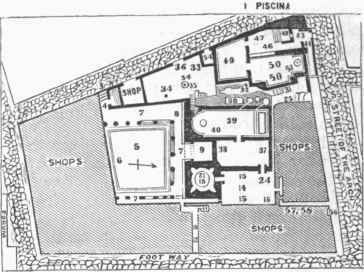
Plan of Pompeian Bath.

Frigidarium in a Bath at Rome.

Apodyterium at Pompeii.

Tepidarium at Pompeii.

Baths of Titus.

Plan of Baths of Caracalla.

Turkish Bath.
Bayard Taylor, in his winter travels in Lapland, gives an account of similar baths. There the bather is placed on an elevated platform, and vapor is produced by throwing water on heated stones beneath. - In Mexico, a peculiar form of vapor or steam bath is in use. The steam, generated below the floor of a small apartment, is admitted around the bather, who reclines on a low bench. - The Japanese are constant frequenters of the bath, though bathing is with them a simple process. A large tank or pond occupies the centre of their bath house, and men and women bathe together. The warm bath, in its more elaborate forms, is seldom found in Japan. - The use of the bath has not marked the manners of the most civilized modern nations, as it did those of the polite nations of antiquity. Yet it is less neglected now than formerly, and public baths, though they are not centres of resort for the people, are found in all large cities, and private baths are common in dwelling houses. Turkish baths, with some peculiarities adopted from the baths of other eastern nations, have also become popular of late years in western Europe and America, and are now to be found in almost every large city; and Russian baths are also numerous. - Hygiene of Bathing. To bathe, in the widest sense of the word, is to surround the body, or a portion of it, for a temporary period, by a medium different from that in which it usually exists.
The medium may consist of air or vapor, of water, either pure or holding various substances in solution, or finally even of sand or mud. The body may be wholly or partially immersed in the medium, as in the ordinary plunge bath, the foot bath, hip bath, etc.; or the medium may be poured with greater or less force upon the body, as in the shower and douche bath. The temperature of the medium, as it is warm, hot, or cold, modifies powerfully the effect of the bath. In the present article we shall confine our attention to the effects of the ordinary water bath, and of the hot air and vapor baths. The temperature at which the water bath may be taken varies from 32° to 112° or even 120° F., and baths are ordinarily divided into cold, warm, and hot, according to the sensation they communicate to the bather. These sensations, it must be recollected, are no very accurate measure of the true temperature; the water which to one person seems warm, to another feeling cool. Systematic writers have further multiplied these divisions; perhaps the most convenient among them is that proposed by Dr. John Forbes. He divides the water baths into the cold bath, from 32° to 60° F.; the cool, 60° to 75°; the temperate, 75° to 85°; the tepid, 85° to 92°; the warm, 92° to 98°; the hot, 98° to 112°. On plunging into cold water the bather experiences a shock attended with a sensation of cold that may amount to rigor, and with a sudden catching of the breath, caused by the contact of the cold fluid with the surface of the face and trunk; in some persons this spasmodic anhelation is so great as entirely to prevent speech.
The surface appears contracted and shrunken, the superficial veins become smaller or disappear, the color assumes a bluish tint. After a short time, the duration of which depends partly upon the coldness of the water, partly upon the constitutional vigor of the bather, reaction takes place; the chilliness and rigor disappear, and are succeeded by a sensation of warmth, which diffuses itself over the whole surface; the respiration becomes tranquil, and there is a general feeling of lightness and vigor. After a variable period the bather again begins to suffer from the cold, trembling and rigor supervene, the movements become impaired and feeble, the pulse is smaller and less frequent, the breathing is oppressed, and the whole body is languid and powerless. If he leave the water before the occurrence of the second period of chill, there is a renewal of the reaction, a glow-pervades the surface, the color returns and is heightened, the pulse is fuller and stronger than before the immersion, and there is a general feeling of buoyancy and vigor.
M. Begin, experimenting upon the cold bath, took nine baths in the Moselle under the ramparts of Metz, toward the end of October, the thermometer in the open air standing at from 2° to 6° Reaumur (36 1/2 to 45 1/2 F.). At the moment of immersion there was a sensation as if the blood were all driven to the interior of the body, particularly to the chest; the breath was rasping, interrupted, quickened, almost to suffocation; the pulse concentrated, small, and hard; there was rigidity of the tissues, but without trembling. At the end of two or three minutes a feeling of calm followed, the respiration became deep, the skin warm, and all the movements were free and easy. "All the muscular movements are quick, easy, and precise; one feels as if the skin and aponeuroses were applied more closely to the muscles, and that these thus held down acted with greater force an 1 energy than in their ordinary state. Soon a lively redness covers the surface, a marked and pleasant feeling of warmth spreads over the skin; it seems as if one swam in a liquid raised to 86° or 98°; the body appears to seek to expand in order to multiply the surface of contact; the pulse is large, full, strong, regular. Few sensations are so delicious as those felt at such a moment.
All the springs of the animal machine acquire greater flexibility, strength, and firmness than they had previously; the limbs cleave with ease a fluid which no longer offers any resistance; one moves without effort, with quickness, and above all with an incredible lightness." In from 15 to 20 minutes there was a gradual return of cold and discomfort; it was then time to leave the water. If the bather still remained, he was seized with chills, and the difficulty of moving became 80 great that he was in danger of drowning. On (putting the water, continues M. Begin, before the reaction has ceased, the transition to the cold air gives no unpleasant sensation. In despite of the wind and the moisture which covers the body, the latter remains warm, and the skin is so insensible that the friction of the towel is not perceived; indeed, M. Begin sometimes rubbed off the cuticle without being aware of it. To endure a bath of such a temperature with safety, to say nothing of enjoyment and benefit, requires a vigorous constitution and great promptness of reaction.
M. Ros-tan, another French physician, was unable to remain longer than six minutes in the Seine at a time when the water was 43° F., and then reaction only fully occurred on the following night after many hours of discomfort, accompanied by a painful feeling of weight about the head. Reaction takes place most promptly, and a lower temperature can safely be borne, when exercise is conjoined with bathing, as in swimming, than when the body is at rest. Salt water is more stimulating than fresh, and renders the reaction more marked and of longer duration; the shock of the waves too, by rendering muscular action necessary to resist it, has a similar influence. The effects of the cold bath, where it agrees, are tonic and bracing; it stimulates the skin, improves the appetite, and renders the circulation more active and vigorous. It hardens the system, and causes it to be much less sensitive to vicissitudes of temperature. The regular employment of the cold bath is the best protective against the liability to take cold on moderate exposure. Its beneficial effects depend mainly on the promptness and completeness of the stage of reaction; if full reaction does not take place, if the bather remains cold and shivering, with a sense of weight about the head, the bath is injurious.
It should not be taken when the body is fatigued and exhausted, or when it is overheated by exertion in hot weather; on the other hand, a moderate degree of warmth, or even a gentle perspiration, provided there is no exhaustion, does not contra-indicate its employment. When first employed, it should be used but a few minutes until the bather has tested his powers of resistance and reaction, and the interval can then be gradually increased. When the shower or cold bath is taken in the house, it may be used immediately on rising while the body is still warm from bed; but the sea bath suits best about noon, or some three hours after the morning meal. The presence of disease of the heart or of the great blood vessels renders the use of the cold bath dangerous. The cool and temperate baths produce effects similar in kind to those of the cold bath, but less in degree; they are the cold bath of the invalid and feeble. Infants and old persons, as a rule, bear the cold bath badly. Young infants in particular do not react promptly, but remain cold and blue for some time after taking a bath; yet in feeble and strumous children the bath is one of our best means of hardening and invigorating the constitution.
With them it is best to commence with the tepid bath, and the temperature should gradually, day by day, be lowered; when the cold bath is arrived at, it should be given in a properly warmed apartment; the immersion should be sudden, complete, and continued but for a few moments, and the child should immediately afterward be well and thoroughly rubbed with dry flannels. - The effect of the warm bath is very different from that of the cold bath. There is no shock; on the contrary, the temperature is grateful to the bather. The blood is solicited to the surface, which becomes full and rounded. The cuticle absorbs water and is softened, and the epithelial debris are readily removed. The pulse is unaffected, irritability of the nervous system is soothed, pain dependent on spasmodic action or neuralgia is allayed, and the relaxation of the skin extends to the deeper-seated parts. Its beneficial effects are especially recognizable after excessive muscular exercise or after the fatigue and excitement of a long journey, in refreshing and tranquillizing the system.
On the other hand, the warm bath exercises none of the tonic and astringent influence which is produced by the cold; its frequent use tends to relax and debilitate, while it renders the system more sensible to the variations of external temperature. - The hot bath, 98° to 112° F., produces at first an inconvenient and even painful sensation of heat; from the determination of blood to the surface, it soon becomes reddened and swollen, the face is turgid, the eyes are injected; the action of the heart is increased, the pulse becomes fuller and more frequent, the carotid arteries in particular beat with violence; the breathing is oppressed, and there is a painful sensation of weight about the head; soon the parts not covered by the water break out into a profuse perspiration, which only partially relieves the discomfort of the patient. On leaving the bath the excitement does not immediately subside; the pulse continues to beat with force and frequency, the extremities, particularly the lower, remain swollen, and the patient perspires abundantly, while the secretion of urine is diminished; there is a sense of muscular fatigue, and the whole system is relaxed and weakened.
These symptoms, however, when present, are to be attributed to a too sudden or too long continued action of the hot bath. The best mode of obtaining its beneficial effects, in ordinary cases, is to begin with water at the temperature of the tepid bath, and gradually raise it to that of the hot bath. "When the full effect of this is produced, and before any signs of exhaustion manifest themselves, the bather should leave the hot water and take a momentary shower or douche of cold water, to be followed immediately by rubbing with the towel. In healthy persons this will usually produce a moderate and agreeable reaction. The continued warm or hot bath, however, is sometimes employed intentionally to produce temporary muscular relaxation in cases of dislocation or strangulated hernia. - Besides the cold and warm water bath, the body may be exposed to the action of air artificially heated or to the vapor of boiling water. The former, the laconicum, was habitually employed by the Romans and is now used by the Turks and the Egyptians, and the latter by the Russians. The effects of both, when the temperature is much elevated, are at first highly stimulating.
The beat of the heart is increased in force and frequency; the pulse rises to 90, 100, 120, and even 150 or 160 beats in a minute; the blood is driven powerfully to the surface, the face becomes flushed, the eyes injected and suffused, the skin turgid, and the bather soon breaks out into a profuse sweat; if the temperature is very high and too long continued, after a time the whole mass of the blood becomes heated above its normal standard, and this may be attended with dangerous or fatal consequences. Owing to the free evaporation from the surface, the hot-air bath can be borne of a much higher temperature than the vapor bath. The ordinary heat of the Russian or oriental bagnio is from 120° to 140° F., though it is occasionally raised as high as 180° or 190°; while, when the air is moderately dry, a temperature of from 250° to 280° F. has been borne for some time with impunity. Medicated baths are used in the treatment of diseases, generally those of a chronic character, and may be either liquid or vapor baths, the vehicle being water, watery vapor, or air.

Mexican Steam Bath.

Japanese Bath.
Continue to:


My Books

