


Bath (2)
Description
This section is from "The American Cyclopaedia", by George Ripley And Charles A. Dana. Also available from Amazon: The New American Cyclopædia. 16 volumes complete..
Bath (2)
Bath. I. A W. county of Virginia, lying among the Alleghanies and bordering on West Virginia; area, 725 sq. m.; pop. in 1870, 3,795, of whom 889 were colored. The surface is hilly, and well watered by the sources of the James, Cowpasture, and Jackson rivers. The soil is very fertile in the valleys. There are many medicinal springs. The Chesapeake and Ohio railroad traverses the county. The chief productions in 1870 were 30,093 bushels of wheat, 49,252 of Indian corn, 23,552 of oats, and 2,790 tons of hay. There were 1,081 horses, 1,357 milch cows, 3,534 other cattle, 3,029 sheep, and 2,380 swine. Capital, Warren Springs. II. A N.E. county of Kentucky, watered by Licking river and Slate creek; area, 290 sq. m.; pop. in 1870, 10,125, of whom 1,702 were colored. The N. W. portion is remarkably fertile. Coal and iron are found in great abundance, and there are numerous medicinal springs. The chief productions in 1870 were 46,113 bushels of wheat, 23,092 of rye, 860,631 of Indian corn, 108,945 of oats, 2,175 tons of hay, and 25,480 lbs. of wool. There were 4,178 horses, 2,199 mules and asses, 2,879 milch cows, 7,209 other cattle, 8,343 sheep, and 22,405 swine.
Capital, Owingsville.
Bath #1
Bath, a city, port of entry, and the capital of Sagadahock co., Maine, situated on the W. bank of the Kennebec river, 4 m. below its junction with the Androscoggin at Merrymeet-ing bay, 12 m. from the ocean, and 35 m. by rail S. of Augusta; pop. in 1860, 8,076; in 1870, 7,371. The river here is a mile wide, with abundant anchorage and docks, the tide rising about 12 ft. The city extends 2 1/2 m. along the bank, and 1 m. back. It is irregularly laid out, contains 5 national banks, 2 savings banks, 2 Congregational churches, 1 Baptist, 2 Freewill Baptist, 2 Methodist, 1 Universal-ist, 1 Episcopal, 1 Roman Catholic, and 1 Swe-denborgian. There are 19 public schools, attended by 1,795 pupils. The valuation of property in 1860 was $5,876,993, and in 1870, $6,393,876. One daily and one weekly newspaper are published. The principal business is ship building, in which Bath ranks next after New York, Philadelphia, and Baltimore. During the year ending June 30, 1871, there were built here 48 vessels, of 9,825 tons.
A large number of vessels engaged in commerce in all parts of the world are owned in Bath. The number of vessels registered, enrolled, and licensed in 1871 was 195, with an aggregate tonnage of 81,951. As the river never freezes here and is of great depth, Bath has great advantages as a commercial port. During the year ending June 30, 1871, the imports amounted to $182,512, and the exports to $24,985; 4 American vessels of 2,691 and 27 foreign vessels of 1,864 tons entered from foreign ports; the clearances for foreign ports were 12 American vessels, tonnage 4,777, and 27 foreign vessels, tonnage 2,435. The entrances in the coastwise trade were 70, with an aggregate tonnage of 42,232, and the clearances 52, of 1 7,018 tons. There were 32 vessels of 681 tons engaged in the cod and mackerel fishery. The custom house is a granite edifice built at a cost of about $50,000. A branch of the Maine Central railroad connects the city with Brunswick, 9 m. distant; and there is steamboat communication with Boston and Portland. Bath was incorporated as a town in 1780, and as a city in 1850.
Bath #2
Bath, a township and village, capital of Steuben co., N. Y., on Conhocton creek, 20 m. N. W. of Corning; pop. of the township in 1870, 6,23(5. The village has several churches, a bank, two weekly newspapers, and some mills and factories. The Buffalo division of the Erie railway passes through the village.
Bath #3
Bath (anc. Aquae Solis), a city of Somersetshire, England, 106 m. W. of London by the Great Western railway, on the river Avon, 12 m. above Bristol; pop. in 1871, 52,542. Built chiefly of freestone and upon the sides of high hills, the city rises in a succession of terraces, circuses, and gardens. It is a place of resort for invalids on account of the hot springs from which the city derives its name, and which are beneficial in palsy, rheumatism, gout, and scrofulous and cutaneous affections. Their character is alkaline sulphureous, with a slight proportion of iron. There are three springs of a constant temperature of 109°, 114°, and 117° F. The last named yields 128 gallons a minute. Bath was formerly a place of great fashion and gayety. In the last century and the beginning of the present it was at the height of its celebrity, but the opening of the continent after the war diverted the stream of visitors toward the German spas. The city is one of the most ancient in Britain, and was reputed to have been founded before the Roman invasion. It was a station on the old Roman road leading from London to Wales. There have been found at and near the site of the present town Roman coins, vases, altars, baths, and the remains of a Corinthian temple.
Joined with the city of Wells, it is a bishop's see. The city has an abbey church, a relic of an ancient monastery. There are well supported hospitals for general purposes, and for the uses of those poor who resort to the city for the sake of the baths. Bath has been the residence of several men of political distinction, in particular of Pitt and Sheridan. William Beckford, the author of "Vathck," resided and died in Bath.
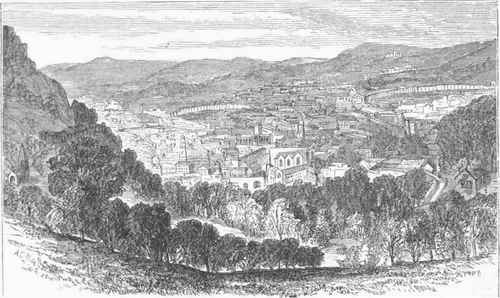
Bath, England.
Continue to:


My Books

