


Brest
Description
This section is from "The American Cyclopaedia", by George Ripley And Charles A. Dana. Also available from Amazon: The New American Cyclopædia. 16 volumes complete..
Brest
Brest, a fortified town of France, in Brittany, department of Finistere, on a bay of the Atlantic, 310 m. W. of Paris; pop. in 1866, 79,847. It is the chief station of the French marine, and one of the first military and naval ports in Europe. It stands on the N. side of a landlocked haven, accessible only by the Goulet, a narrow fortified entrance about a mile wide, divided in the middle by a rocky island. The town is built on the summit and sides of a projecting ridge, some of the streets being so steep that they can be traversed only on foot. A deep narrow creek runs up from the harbor behind this ridge, separating the town on its left bank from the suburb of Recouvrance on its right, communication being kept up by an iron bridge 65 ft. above high-water mark, with a swing opening to allow ships of war to pass. Just above the mouth of the creek, which is defended by several tiers of batteries, is an old castle. This creek, which forms the inner port, is so narrow that there is barely space for the merchant vessels, and for 30 or 40 ships of war moored side by side. Above the castle the shores on both sides are enclosed by a high wall, separating the dockyard from the town.
Around the harbor run long quays at which the largest vessels can lie, and five artificial basins are excavated out of the rock. There is also a commercial harbor, with a breakwater, extending far into the roadstead. The dockyard is situated on both sides of a narrow creek winding between steep rocks, which have been pared down so as to afford space for the buildings, quays, and yards. Three large dry docks have been cut out of the solid rock. On one side of the creek are the magazine, sail loft, rope yard, and hospital; on the other the foundery and sailors' barracks. Slips for building vessels occupy the level space at the water's edge; and above these are the steam-engine factory, from which machinery is lowered into the vessels. On the Recouvrance side of the harbor are the forges, furnaces, and workshops necessary for the construction and repair of steam engines. The galleys or hulks for convicts no longer exist, the prisoners confined in them having been removed in 1860 to the penal colony of Cayenne. Outside the dockyard is the marine hospital, admirably arranged, containing 26 wards, each having 53 beds, attended by a large body of religieuses called sceurs fideles de la sagesse, who are lodged within the building.
The roadstead of Brest lies between the promontory of Finistere on the N. and the peninsula of Quelern on the S., which have a space of only 1,749 yards between them, and this is still further contracted by a rock in the centre, which compels vessels to pass directly under the batteries on each side. The roads, consisting of several bays, are about 15 m. long, and in some places 3 m. broad; and although there are many shoals and sand banks, several hundred vessels can anchor there. The harbor is so fortified as to be apparently impregnable against any naval attack. Fully 400 heavy guns can be brought to bear from the batteries outside the Goulet, while 60 more sweep the anchorage within. Besides these the fortifications of the town itself mount more than 400 cannon, and behind is an intrenched camp defended by heavy guns. Brest has a considerable trade'in wheat, oats, wine, brandy, beer, sardines, mackerel, and water-proof goods. It is connected with America by a submarine cable, terminating near Duxbury, Mass. It has a city hall, chamber of commerce, observatory, naval school, cabinet of natural history, botanical garden, communal college, public library, and marine library, with 27,000 volumes. - Brest was of some importance during the middle ages.
The old castle belonging to the dukes of Brittany fell into the possession of the English, and sustained a long siege by the French under Duguesclin and Olisson. In 1395 it was surrendered by Richard IL in consideration of 12,000 crowns. It was made a fortified port by Richelieu in 1631, and the fortifications were modernized by Vauban in 1680-88. In 1694 a combined English and Dutch fleet appeared in the roadstead and disembarked a strong force, hoping to take the fortifications by surprise; but a storm dispersed the fleet, and most of the land force were killed. In 1757 an English fleet of 19 vessels approached the mouth of the Goulet, and 20,000 men were landed, but made no attack. Since that time Brest has never been seriously threatened by an enemy; but it was blockaded in 1794 by Admiral Howe, who won a great naval victory in its neighborhood (June 1).
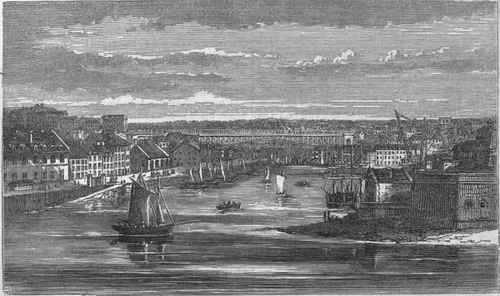
Brest - Swing Bridge.
Continue to:


My Books

