


Aqueduct. Continued
Description
This section is from "The American Cyclopaedia", by George Ripley And Charles A. Dana. Also available from Amazon: The New American Cyclopædia. 16 volumes complete..
Aqueduct. Continued
It is estimated that the lead alone used in these three inverted syphons would now be worth $2,500,000. In modern aqueducts the system of gradual descent is only partially followed, the use of cast-iron pipes admitting of frequent changes in the inclination. - In the reign of Louis XIV. an aqueduct of vast expense was constructed for supplying Versailles with water. The bridge of Maintenon, built for supporting this aqueduct, is about 4,400 ft. or 7/8 of a mile long, upward of 200 ft. high, and is constructed of three tiers of arches, 242 in each tier, and of a span of 50 ft. The aqueduct for supplying Marseilles is a canal 60 m. long. It passes through several chains of limestone mountains by 45 tunnels, the united length of which is 8 1/2 m., and across a ravine 5 m. from Aix by a structure of masonry 262 ft. high and 1.287 ft. long. The quantity of water that flows through it is 198,000 gallons per minute. The Lisbon aqueduct, completed in 1738, is about 3 leagues in length, and in some parts of its course has been excavated through hills; but near the city it is carried over a deep valley for a length of 2,400 ft. by several bold arches, the largest of which has a height of 250 ft. and a span of 115 ft. - The Croton aqueduct of New York surpasses all modern constructions of this kind in extent and magnificence.
It was completed in 1842, having been five years in building, under the superintendence of Mr. John B. Jervis, chief engineer. The whole expense, including $1,800,000 for distributing pipes, and amounts paid for right of way and other incidental charges, was $10,375,000. Including commissions and interest, the whole cost was $12,500,000. The whole length, from its source at Croton river to the distributing reservoir on 5th avenue and 40th street, is 40 1/2 m. On this line are 10 tunnels having an aggregate length of 0,841 ft., and cut mainly through gneiss rock. A large part of the open cutting is also rock work. A dam constructed across the Croton river raised the water 40 feet, and formed the Croton lake, which covers about 400 acres. This is the collecting reservoir, and contains with a depth of 0 ft, of water 500,000,-000 gallons. A new collecting reservoir is (1873) in course of construction at Boyd's Corners, Putnam county, to be formed by building across the west branch of the Croton river a dam 700 ft. long and of sufficient height to secure a storage capacity of 3,000,000,000 gallons, flooding over 300 acres of land.
From the dam to the Harlem river, nearly 33 m., the aqueduct is built of stone, brick, and cement, arched over and under, 6 ft. 9 in. wide at the bottom (this being the chord of an arc, the versed sine of which is 9 in.), 7 ft. 5 in. at the springing line of the arch, and 8 ft. 5 1/2 in., high; area of cross section, 53 1/3 sq. ft. In rock tunnels the roofing arch is dispensed with, though the bottom and sides are as here described and illustrated. Its capacity is equal to 115,000,000 gallons daily. The inclination is 14088 ft. per mile, or 33.92 ft. in the 33 m. The velocity of the water is 1 1/2 m. an hour. Across Harlem river the aqueduct is carried upon the High bridge in two cast-iron pipes of 3 ft. diameter, and one wrought-iron pipe 7 ft. 6 in. in diameter, recently laid over the former. The lower pipes are 12.29 ft. lower than the bottom of the conduit on the N. side of the river, and 10 ft. below the aqueduct on the S. side. While the bridge was building, the water was conveyed in a 3-foot iron pipe down one bank of the river and up the other, and the original intention was to have had this for the permanent plan.
Objections being raised that the pipe would obstruct the navigation of the river, and restrictions being imposed by the state legislature as to its use, it was finally decided to build a bridge with arches 80 ft, wide and openings 100 ft. high, to admit the passage of vessels. The bridge, as now completed, is 1,460 ft, long, with 8 arches in the river of the required span, and 7 others on the banks of 50 ft, span. The "whole height of the bridge above high-water mark is 110 ft. There are two receiving reservoirs in the Central Park, known as the old and the new. The former covers an area of 35 acres and has a capacity of 500,000 gallons; the latter 100 acres, with a capacity of 1,170,000 gallons. From these reservoirs to the distributing reservoir, a distance of 2 1/4 m., or directly into the city, the water is conveyed in two lines of iron pipe 30 in., two lines 36 in., and one line 48 in. in diameter. The capacity of this distributing reservoir is 20,000,000 gallons. It is a stone structure 45 ft, high above the streets, and 425 ft. square at the top, covering a little more than four acres. The higher sections of the island lying north of Manhattan valley are supplied from a reservoir and tower lately erected on the high ground near 173d street, between 10th avenue and the aqueduct.
The water for the supply of this high service reservoir and the adjacent tower tank is furnished by two pumping engines stationed near the lower end of the high bridge. (See Water Works.) In 1871 the average daily demand was 85,000,000 gallons, which is taken mainly from the distributing reservoir and conveyed through the city in 340 m. of iron pipe ranging in diameter from 4 ft. to 4 in. - The cities of Brooklyn and Jersey City receive their water supply, the former from several ponds from 8 to 14 m. distant, and the latter from the Passaic river, 8 m. distant. In both cases the water enters the city upon such a level as to require the use of pumping engines for its distribution. For the plan and capacity of these engines, as also of those in operation at the famous Fairmount. water works, Philadelphia, see Water Works. The aqueduct which supplies the city of Boston leads from Cochituate lake to the receiving reservoir at Brookline, a distance of 14 1/2 m. For the greater part of the way it is a conduit of brick masonry. Over the valley of Charles river is a line of iron mains, and in Newton and Brookline are two tunnels. The brick conduit winds by irregular curves along the country, and is of such an elevation as admits of the work being mostly beneath the natural surface.
The brickwork is 8 in. thick, laid in hydraulic cement, the section of the conduit being that of an egg, the larger end down. The greatest width is 5 ft. and the extreme internal height 6 ft, 4 in. This aqueduct is everywhere covered by at least 4 ft. of earth, and nowhere admits of a passage underneath, except by culverts at the crossing of Charles river and at a bridge oyer a valley in Needham. The two 30-inch iron pipes cross the river upon a stone bridge at a level 71 ft. above low-water mark. The whole length of each pipe is 979 ft. The tunnels are in porphyritic rock of great hardness, one 2,410 and the other 1.150 ft. in length. The city of Washington is supplied with water through an aqueduct constructed by the national government, 18 m. long, leading from the Potomac falls to the receiving reservoir at Chain Bridge. On the line of this work are 11 tunnels and 6 bridges; the chief of these, over Cabin John creek, is a stone structure 100 ft, high and having a single span of 220 ft. The whole cost of the work exceeded $3,000,000. The Chicago lake tunnel, through which the waters of Lake Michigan are led into that city, was commenced March 17, 1864, and completed under the supervision of city engineer E. F. Chesborough, March 8, 1867. (See Tunnel.) - Though the Croton aqueduct is at present the greatest work of its kind in the United States, others have been projected which, if brought to successful completion, will far surpass it.
Among these is the plan of supplying the city of San Francisco from Lake Tahoe, a mountain reservoir of great depth and purity, located upon the boundary line between California and Nevada, and distant from San Francisco about 150 m. It is also now proposed to construct an aqueduct from Lake George to the city of New York, a distance of over 200 m., the conduit to be of sufficient size to supply the many cities and villages along the route. - In addition to the structures mentioned above, there are numerous bridges designed for the conveyance of canals across rivers and valleys. The first of these canal aqueducts built in England was constructed by the architect Brindley, under the supervision of the duke of Bridgewater. Upon it the Lancaster canal crossed the river Lune. It was composed of 5 arches of 72 ft. span each, with an average height of 65 ft, above the level of the river. The Forth and Clyde canal crosses the valley of Kelvin upon an arcade somewhat higher, though of not so great length as that across the Lune. The Pont-y-Cysyllte aqueduct conveys the waters of the Ellesmere canal across the vale of Llangollen in Wales. This bridge is 1,000 ft. long, built with 19 arches, each having a span of 45 ft. The canal level is 126 ft. above that of the river below.
In the United States there are many structures of this character, those on the Erie canal alone numbering 32. The chief of these are the two crossing the Mohawk river, the Richmond aqueduct over the Seneca river, and the stone arcade across the Genesee at Rochester. The larger of the two Mohawk bridges, crossing the river at a point 14 m. X. W. of Albany, consists of a wooden trunk resting upon 29 stone piers; it is 1,300 ft. long, and cost $331,000. The Richmond aqueduct is a beautiful stone structure 894 1/2 ft. long, the water being also conveyed in a wooden trunk. For beauty and strength, however, the aqueduct bridge across the Genesee river at Rochester deserves special mention. It is a solid stone structure 920 ft. long, supported upon 6 cut stone arches of 52 ft. span. It is in the centre of the city, and was erected at a cost to the state of $500,000. At Pittsburgh, Pa., the Pennsylvania canal is conveyed across the Alleghany river upon a wire suspension aqueduct, having 7 spans of 1(30 ft. each from pier to pier.
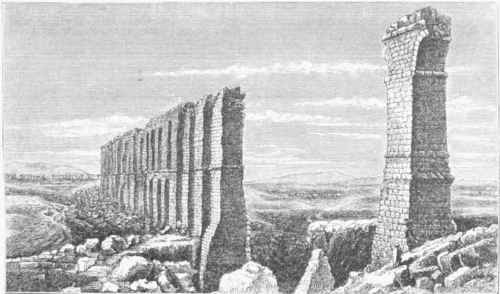
Ruins of the Aqueduct of Carthage.

Ruins of the Aqua Claudia.
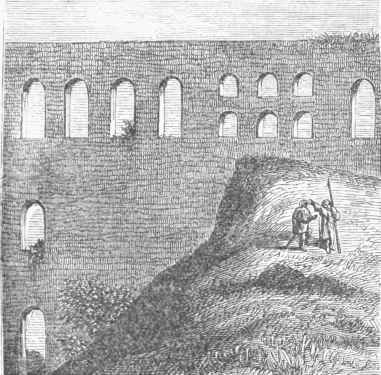
Aqueduct of Antioch.
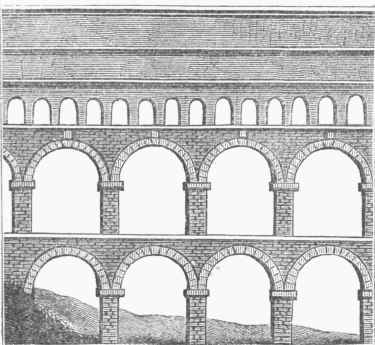
Pont du Gard, Nimes.
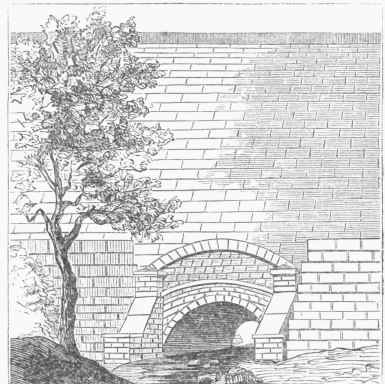
Croton Aqueduct, crossing Mill River.
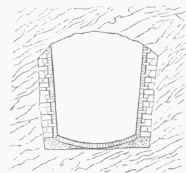
Rock Tunnel.
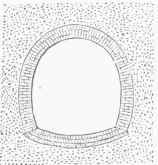
Main Aqueduct.
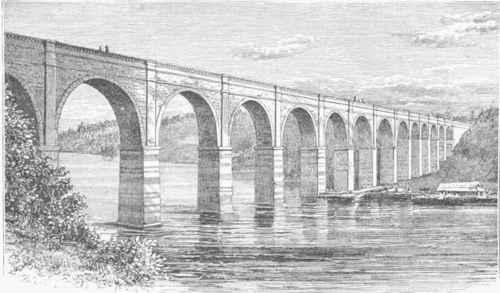
High Bridge, Harlem River.
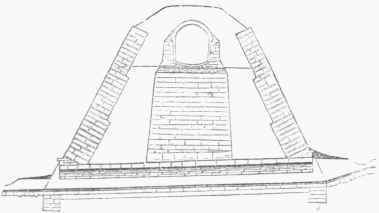
Cochituate Aqueduct.
Continue to:


My Books

