


Bohemia. Part 8
Description
This section is from the book "Bohemia - John L. Stoddard's Lectures", by John L. Stoddard. Also available from Amazon: John L. Stoddard's Lectures 13 Volume Set.
Bohemia. Part 8
A reward of sixty shillings was offered for the capture of a Hussite layman; three hundred for a Hussite priest. Prisoners were buried alive, or burned. Another mode of massacre was driving them over the brink of a mine three hundred feet in depth. For years these fierce forerunners of the Puritans were invincible. Yet their crude weapons were for the most part spiked flails, spears, and loaded clubs! Their ramparts were their wagons, linked together in a circle by strong chains. These they could use by day for transportation, and form a wall with them at night around the camp. There was, however, in this revolution, -as in all others which the world has seen,-a tendency for those conducting it to separate into two antagonistic wings. Thus, the conservative Hussites had insisted principally on permission to receive both elements in the Sacrament - the wine as well as the bread. On this account they were called Utra-quists, from the Latin word utraque (both), and frequently also Chalicists, because of their demand to use the consecrated cup. So precious did they deem this privilege, that finally the Chalice, as an emblem in their churches, actually replaced the Cross. It also figured on their battle flags, and often waved triumphantly above most dreadful scenes of carnage! They, too, denounced the sale of indulgences, and questioned the validity of any spiritual function performed by an immoral priest. But all were not content with this position. Intensity, unchecked by reason, quickly grows into fanaticism. "Nothing is more terrible," says Goethe, "than energetic ignorance." When an enthusiast, quoting texts of scripture as authority, really believes that he is called by God to deeds of violence, he is, next to a madman, the most dangerous being on our planet. The radical Hussites, quoting the example of the early Church, demanded a community of goods. Denouncing the existing forms of government, they wished to establish a republic, with absolute equality, and even with no distinction between priests and laity. Whatever we may think of these things in the abstract, the world was hardly ripe for them five hundred years ago. In fact, if one or two million Doukho-bors in Canada began tomorrow to insist on the adoption of their views, supporting their demands with iron-shotted clubs, there would undoubtedly be trouble. If the religious side of the question had been the only one, the efforts of the government to suppress it would have probably been paralyzed, and much religious liberty and great ecclesiastical reforms would have been gained. But communism, although very popular among the thousands who can furnish nothing to the common fund, can never long prevail. It is easy to share the property of others, but the "others" sooner or later make objection. No sooner did the Hussites violently disagree upon these points, and come to blows among themselves, than the result was certain. The government party had simply to adopt the policy of "divide and conquer." In 1433 the Council of Bale made many concessions to the Moderates, and within a year the Radicals were defeated hopelessly, though fighting to the last.
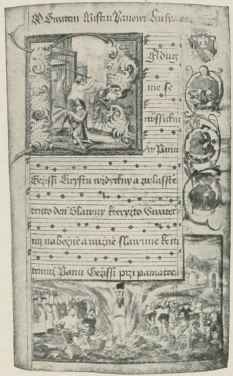
Ancient Hymn In Honor Of Hus.

A Descendant Of The Hussites.
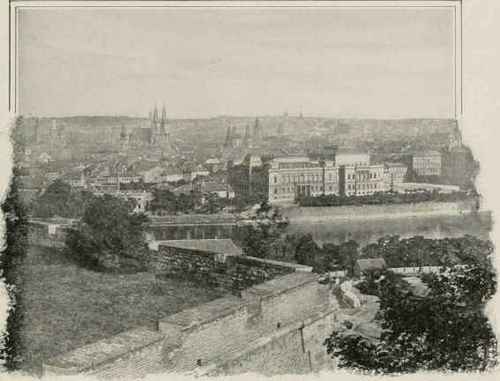
Prague, From The Old Fortifications.

The Old Hussite Church Of St. Nicholas, Prague.

The Schwarzenberg Palace, Prague.
I have laid special stress upon this frightful epoch in Bohemian history, not only from its own immense significance, but also from the fact that it is often wiser to direct attention to one characteristic period in a nation's annals, than - on account of limited space - to deal with many superficially. The Hussite wars are thoroughly representative of the religious zeal, fanaticism, bravery, and patriotism of the Czechs; and practically all Bohemia's history is explained by studying its two supremely popular movements: the Hussites' sanguinary struggle for reform four centuries ago, and the great national renaissance which we are witnessing to-day. Yet no one must conclude that, during the long interval between those epochs, this unhappy country was at peace. Repeated wars of almost inconceivable barbarity swept through Bohemia for centuries, like tidal waves, leaving behind them hideous trails of massacre and ruin. The aftermath of the fierce Hussite conflict was a still more terrible calamity, - the Thirty Years' War. Can we conceive what thirty years of uninterrupted warfare meant in those dark days of bigotry and savagery?
Continue to:


My Books

