


South Tyrol. Part 12
Description
This section is from the book "South Tyrol - John L. Stoddard's Lectures", by John L. Stoddard. Also available from Amazon: John L. Stoddard's Lectures 13 Volume Set.
South Tyrol. Part 12
Such actions, too, like all which spring from individual volition, free from superior orders or suggestions, are almost always natural and picturesque. Thus the Mohammedan, kneeling on the desert, and - all unconscious of observers - praying to the Infinite beneath the boundless dome of space, is one of the most impressive of religious sights. It is a genuine act of worship, as natural as breathing, as unobtrusive as a sigh. Not less sincere and touching are some of the popular expressions of religious faith among the Tyrolese.
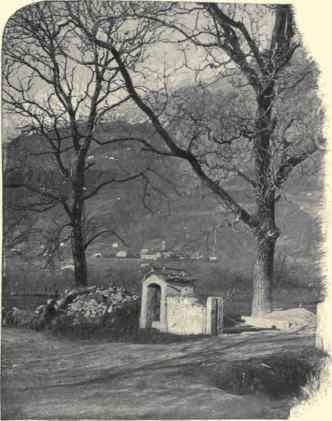
"Each path its wayside shrine".
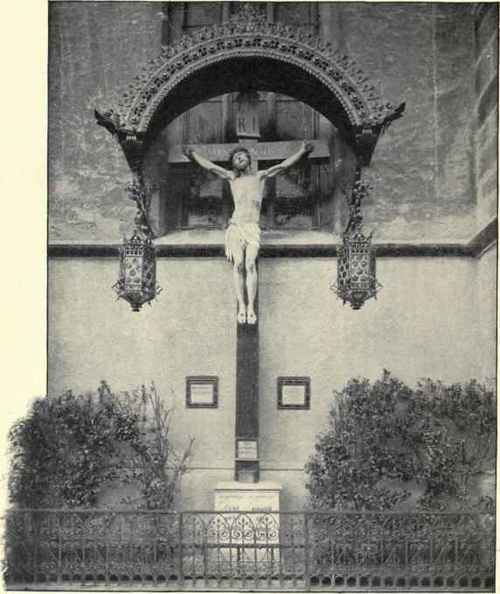
Crucifix On The Parish Church, Meran.
At midday and at sunset, when through the crystal air The tones of silver-throated bells are calling men to prayer, They halt at once, bareheaded, with quiet, reverent mien, Each figure adding interest and pathos to the scene.
Each vineyard has its crucifix, each path its wayside shrine, Where flowers adorn the Virgin's brow, and crown the Child divine; And few will pass those sacred spots without a lifted eye, A crossing of the weary breast, a prayer, - at least a sigh.
The statement of these lines is literally true. One cannot walk or drive an hour in the Tyr5l, without encountering on the hills and in the valleys, along the highways and in narrow paths, a multitude of little shrines, ranging . from miniature chapels, bright with flowers, metal ornaments, and lace-fringed altars, to some poor picture of the Child and Virgin, placed above a gateway or hung beneath a gable of a peasant's roof. Equally numerous also, either fastened to the walls or gleaming white among the foliage of the vineyards, are the crucifixes of this land. A few of them are admirable specimens of the art of wood-carving, in which the Ty-rolese excel; but oftener the representation of the scene of Calvary is primitive and painful. In almost every case, however, the crucifix is sheltered by a wooden frame resembling a diamond-shaped box, from which the cover has been removed. Some of these frames are painted; but most of them are wisely left in the natural wood, which gradually assumes the quiet browns and grays of the dove's breast or the thrush's wings, such as no glistening paint can ever give. Over these often climb caressingly the tender fingers of the ivy, weaving around the figure of the Man of Sorrows a delicate arabesque of green. Before them, as before the rustic altars in Japan, one usually sees some offering. It may be only a single flower, or a bunch of wayside blossoms; but frequently one finds there potted plants and tiny lamps, kept burning by some faithful worshipers.
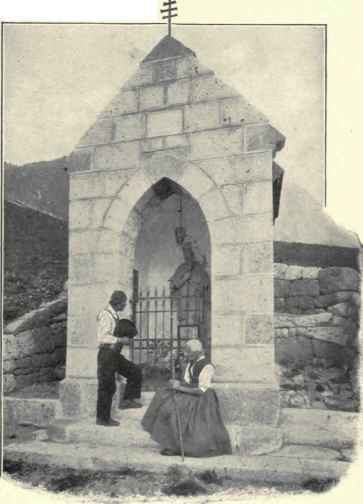
One Of Many.
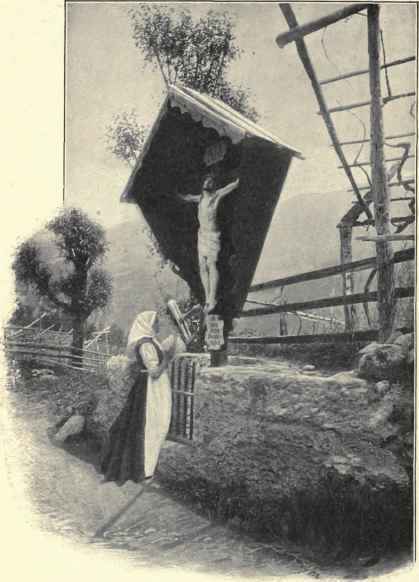
Piety And Faith.
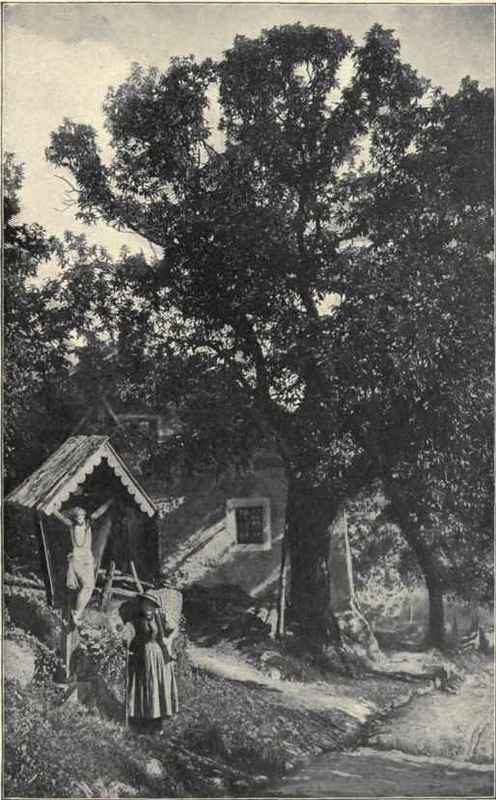
A Characteristic Scene In Tyrol.
Among a people so devout many religious customs still prevail, which had their origin centuries ago. Thus, on the night before Epiphany, in commemoration of the offerings of the Magi to the Child of Bethlehem, the master of a Tyrolese house goes into every room from attic to basement, followed by his family and servants, and fills the dwelling with the pungent smoke of burning incense, a little of the aromatic gum being furnished for this purpose by the church to every applicant, or brought from door to door by those who wish to sell it. While the proprietor carries thus the fragrant incense through the different rooms, his wife writes over every door, and even over the stalls of the cattle in the stable, the initials of the three kings of the Orient, - Meichior, Caspar, and Balthasar. On the Saturday before Easter, large olive branches from Italy, which have been blest by the priests, are brought into the houses, and hung up in the rooms, until their leaves fall off, when they are reverently burned. Upon the mountains the peasants cultivate certain flowers, which have medicinal properties, and are, on that account, brewed and given to the sick; but such is the reverence with which these are regarded, after they have been blessed by the church, that in a time of danger, such as a severe thunderstorm, the peasants will often rise in the night, and burn a few of them upon their broad, black hearths.
Continue to:


My Books

