


South Tyrol. Part 21
Description
This section is from the book "South Tyrol - John L. Stoddard's Lectures", by John L. Stoddard. Also available from Amazon: John L. Stoddard's Lectures 13 Volume Set.
South Tyrol. Part 21
Could we but understand the murmur of the silvery river, Etsch, which rushes musically by, what might we not discover of the wars, loves, joys, crimes, sorrows, and adventures of those who have been masters of this castle since its foundation stones were laid! For probably no other schloss in the Tyrol possesses such a number and variety of interesting legends. They range from one of the more ordinary type, in which two brothers fight a duel to the death in its old chapel, until the blood of the murdered man sprinkles the wall with stains still ineffaceable, though dimly seen, to the half-humorous, half-tragic story of a Capuchin monk, who, passing the castle one Good Friday night, was horrified to hear the sounds of revelry and dancing issuing from its banquet hall. Without an instant's hesitation he strode up to the gate, demanded and secured admission, and suddenly confronting the astonished chatelain and his guests, rebuked them for their shameless sacrilege. Not in the least abashed, the persons thus reproved unceremoniously grabbed him by his cowl and gown, and threw him over the balcony into the courtyard, whence he departed more dead than alive, not without making, however, the grewsome prediction that, ere the current year expired, all of the guilty revelers should die in punishment for their desecration of Good Friday and for their scandalous treatment of a man of God. Needless to say, according to the legend, the prophecy was fulfilled, and all participants in the debauch perished within the allotted time.
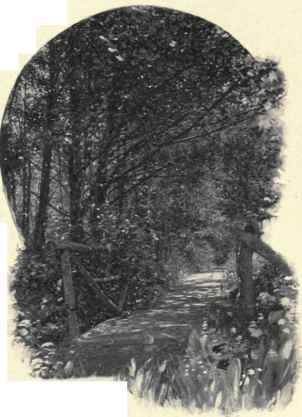
In The Castle Garden.
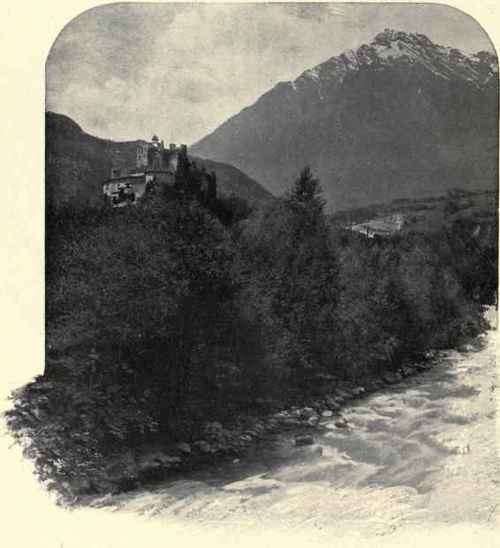
Schloss Forst, The River Etsch, And The Zielspitze.
But the most stirring story of Schloss Forst (which has, moreover, the immense advantage of being true) is that of the imprisonment here of Oswald von Wolkenstein, the Last of the Minnesingers, under conditions which would furnish fine material for poet, novelist, or playwright. Within the castle courtyard, partially hidden now by plants and flowers, a lowbrowed Gothic archway leads to a circular dungeon, which, with its two thin apertures that serve as windows, presents a startling contrast in its chilling, twilight gloom to the sweet air and sunshine of the outer world. Originally, however, it was worse; for, whereas now an accumulation of rubbish brings its floor to within six feet of the level of the court, it formerly had a depth of thirty. A comfortless abode, indeed, for one who had sung his poems to fair ladies in the light and luxury of stately palaces.
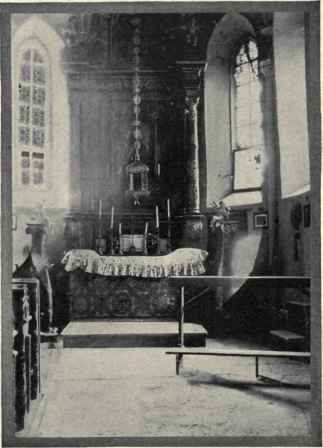
The Chapel, Schloss Forst.
The incidents connected with the incarceration of this gifted poet and musician are in the highest degree romantic. Oswald had loved a beautiful woman, named Sabina Jäger, who seems to have been as black in soul as she was fair in body. That she returned his passion for a time cannot be doubted, if we may judge from his enthusiastic songs of joy. Nor was he a man without good claims to any woman's love and admiration. Although still young, he was already renowned both as a poet and a warrior, and had not only traveled through Russia, England, France, and Spain, but had explored the Orient as far as Persia. He was, moreover, fascinating as a singer and player on the harp. Nevertheless Sabina quickly tired of him; and, having more ambitious schemes, got rid of him temporarily in a very original way. Under the pretense of exacting from him a final proof of his love for her, she demanded that he should go on a pilgrimage to the Holy Land, promising him that if he would bring her water from the river Jordan, straw from the manger at Bethlehem, and sand from the desert of Sahara, she would marry him. To please her and, as he supposed, to win her as his wife, the unsuspecting Oswald went to Palestine, wearing around his neck a small gold chain, which she had given him as a talisman and token of her love. Scarcely was he gone, however, when the fair Sabina married a much older, and of course much wealthier, man. In those days news traveled slowly, and the ill-fated poet made his pilgrimage and returned, without an inkling of her faithlessness. His grief at learning of her conduct was moreover intensified by the fact that on his fruitless journey he had lost an eye, and was disfigured by a wound. Sabina, however, merely laughed at his distress and mocked at his misfortune. Oswald avenged himself by writing poems on her treachery and heartless-ness, and singing them in courts and castles. Years passed. Sabina, stung to fury, left that part of the country, and became the favorite, at Meran, of the Tyrolese ruler, known as "Frederick of the Empty Pocket." Oswald, meantime, had married and was the father of two children.
Continue to:


My Books

