


The Rauchfuss System Of Selective Breeding And Queen Rearing
Description
This section is from the book "Honey Getting", by Edward Lloyd Sechrist. Also available from Amazon: Honey Getting.
The Rauchfuss System Of Selective Breeding And Queen Rearing
This system combines well with the clear brood nest method of management, and provides-swarm control and increase as well as queen rearing.
In the spring, go over the apiaries quickly and mark about one-third of the best colonies for rearing queens. At the beginning of the honeyflow, split or divide all two-story colonies, marked or unmarked, having eight frames, or more, of brood. If brood is not about equally divided in the two brood chambers, equalize, with eggs and young brood in both. Pay no attention to where the queen is but cut out any cells that may have been started.
Split the double brood nest by placing a super over the lower one and putting the upper one above the super over an excluder. An inch auger hole in the rear of the top brood chamber provides an additional entrance.
In eight days locate the queenright portion of the hive and set it off on a new stand next to the parent colony. The field bees will be with the parent colony or will return to it.
The queen cells in all colonies which have not been marked for breeding are cut out and cells introduced from the marked breeder colonies. Thus the poorer colonies are gradually eliminated.
In two weeks the queenless colonies are examined for queenrightness. If any colonies have failed, the colony with the old queen is set back on top of the parent colony. This is selective breeding and also eliminates swarming.
It is well to save some of the cells from the selected colonies and make up nuclei for them, thus securing a stock of young mated queens for use throughout the season.
Queen Rearing and Mating in Nuclei
I know of no better means of saving good cells and of having queens mated than to use the Rauchfuss nucleus bottom board. Briefly, the system is this: Regular ten-frame shallow supers are divided into four parts by three removable, closely fitting partitions, each division having a separate entrance through the cleat around the edge of the special bottom board, or an auger hole in each division of the super may be used. Eight frame supers may be divided into three parts.
The special bottom board is merely an inner cover with one or more slots cut across it, which are covered on both sides with a strip of queen excluder zinc. These slots should not be too large or the bees may not realize their queenlessness when placed in separate nuclei. One slot an inch or so wide should be enough, or several narrower slots may be used.
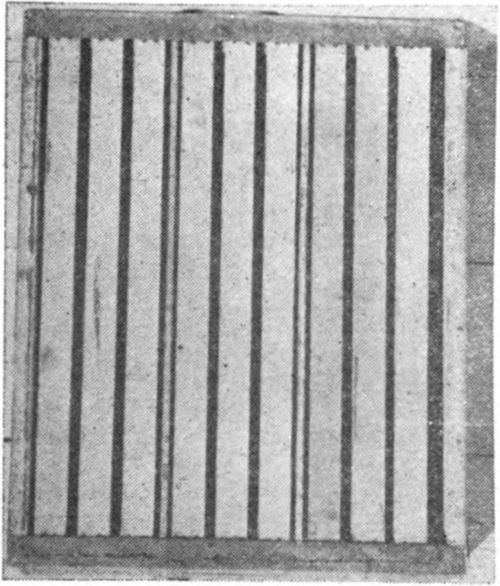
Left, the bottomside of a shallow super for three 3-frame nuclei (instead of four 2-frame as suggested in text). Either is satisfactory, although 2-frame divisions give four queens to the hive body, instead of three. In this super the frames rest on tin strips as in the T-super.
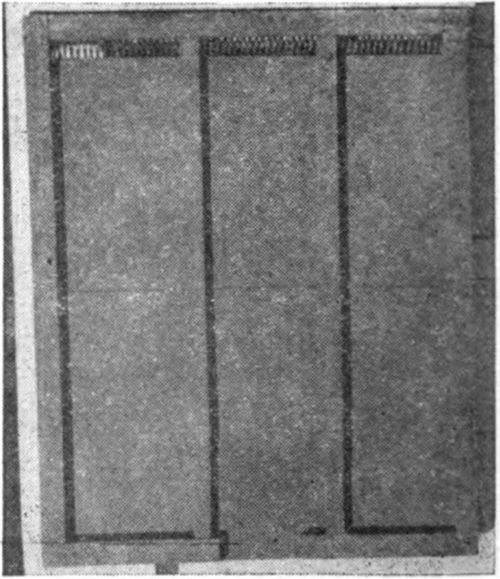
Right, special bottom board that may be used with the nucleus box. One entrance is cut through cleat, other two are auger holes in sides of box. Note coiled spring used instead of excluder. Strips of queen excluding wires or zinc may be used.
On this bottom board are dividing strips or cleats, one under each division board of the super, so that when one of these special boards is placed under a super and another on top of it, four queen tight compartments will be formed. For the entrances, a half inch may be cut out of the cleat around the edge of this special board, one entrance for each nucleus. It is well to provide, over each entrance, a wooden button and a bit of excluder zinc, either of which, as desired, may be turned to close the entrance.
Nuclei are made up in the middle of the day when field bees are out of the hive. Take one frame of all sealed brood, with adhering bees, from the strong colony on which the nuclei are to be placed (brood from other hives will do). This colony may be queen-right, may have a virgin, or may be given a cell. The other frame in each nucleus may have only a foundation starter or may be a comb containing some pollen and unsealed honey, but no unsealed brood.
These nuclei may best be stocked from colonies housed entirely in shallow supers although strong colonies with young queens may be made to furnish brood in shallow supers above a standard Langstroth brood chamber.
Although it is well to have some bees in each small nucleus, it is not necessary to bother about even distribution of bees, because, when five of these supers with four nuclei in each, are piled on top of a gloriously strong colony in one shallow brood chamber with a special bottom board between each two supers and a regular cover on top of all, the bees distribute themselves all through the hive, populating the 20 nuclei automatically with just the right number of bees. The number of nuclei automatically placed on a colony must be regulated by its strength and the seasonal condition. There should be a fairly good honeyflow on.
The lower story, which contains the original brood chamber, may be two shallow supers or a deep super; and may, if desired, also be given a queen cell. Sometimes matings seem to be better with a cell or virgin below; sometimes a queenright colony seems best.
If any cell fails to hatch or a queen is lost, the bees and brood in that compartment are not useless. There is no weak or unprotected nucleus to be robbed out; no moth in weak ones, indeed, no trouble at all, because the shallow frames with starters are merely built full of worker comb; and, if plenty of nectar is coming in, honey is stored, particularly in any nuclei which may miss mating a queen. No bees are used wastefully.
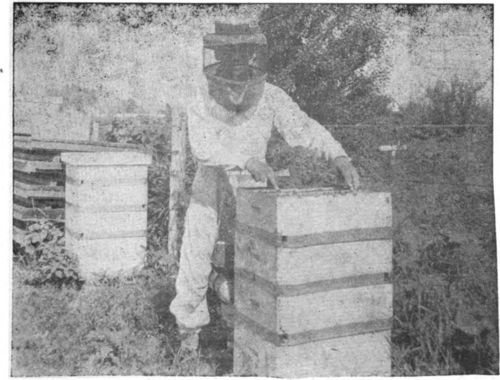
Rauchfuss nuclei, on the boards, above colony. (Harry Pease, in Iowa).
When the young queens have mated, the stack is torn down, queens are caged or used where wanted, and the stack rebuilt, using brood from the parent hive or from others, as before. Ripe cells may be given or, if selected brood is used, the little colonies may be allowed to build their own cells, for good cells will be built in nuclei of this kind.
If the young queens are not used soon after mating, it is well to turn the bit of queen excluder so that it will cover the entrance, because, sometimes, when a nucleus becomes full of brood, it will swarm out. A comb full of brood may be removed when necessary and replaced by a frame having a foundation starter.
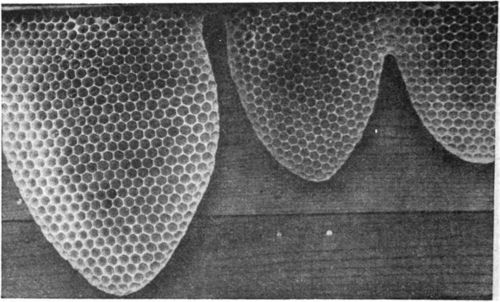
Three pieces of foundation, partly drawn out, eggs laid, ready for the bees to build queen cells.
When the queen mating season is over, the division boards are pulled out of the supers, the special bottom boards removed, the frames arranged in proper colony order, and the mother colony is ready for winter.
For the beekeeper who is not producing queens as a specialty, this method of mating, together with the simple Miller method of getting cells, solves the queen problem easily.
Continue to:


My Books

