


432. - Perpendicular, In Triangle Of Known Sides. Part 3
Description
This section is from the book "The American House Carpenter", by R. G. Hatfield. Also available from Amazon: The American House Carpenter.
432. - Perpendicular, In Triangle Of Known Sides. Part 3
Fig. 290.
436.- - Octagon: Radius of Circumscribed and Inscribed Circles: Area. - Let CEDBF(Fig. 290) represent a quarter of a regular octagon, in which F is the centre, ED a side, and CE and D B each half a side, while CF and BF are radii of the inscribed circle, and EF and DF are radii of the circumscribed circle.
Let R represent the latter, and r the former; also let b represent ED, one of the sides, and n be put for A D, and for A E. Then we have -
AD+DB=CF
n + b/2 = r,
or - n = r-b/2
Since A D E is a right-angled triangle (Art. 416), we have -
AE2 + AD2 = ED2 n2+n2 = b2,
2n2 = b2,
n2 = b2/2 2

Placing the value of n, equal to the value before found, we have -

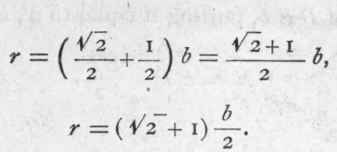
This coefficient may be reduced by multiplying the first fraction by

thus -

therefore -
(140.)
Or: The radius of the inscribed circle of a regular octagon equals half a side of the octagon multiplied by the sum of unity plus the square root of 2. In regard to the radius of the circumscribed circle, by Art. 416 we have -
DF2 = BF2+DB2,
R2 = r2 + (b/2)2
In this expression substituting for r2, its value as above, we have -

The square of the coefficient

by Art. 412 equals

then -

(141.)
Or: The radius of the circumscribed circle of a regular octagon equals half a side of the octagon multiplied by the square root of the sum of twice the square root of 2 plus 4.
In regard to the area of the octagon, the figure shows that one eighth of it is contained in the triangle D E F.
The area of D E F, putting it equal to N, is -
N=EDxBF/2,
N=bxr/2,


This is the area of one eighth of the octagon; the whole area, therefore, is -


(142.)
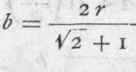
Or: The area of a regular octagon equals twice the square of a side, multiplied by the sum of the square root of 2 added to unity. When a side of the enclosing square, or diameter of the inscribed circle, is given, a side of the octagon may be found; for from equation (140.), multiplying by two, we have -

Dividing by

+ 1, gives -
(143)
The numerator, 2 r, equals the diameter of the inscribed circle, or a side of the enclosing square; therefore:
The side of a regular octagon, equals a side of the enclosing square divided by the sum of the square root of 2 added to unity.
437. - Dodecagon: Radius of Circumscribed and Inscribed Circles: Area. - Let A B C (Fig. 291) be an equilateral triangle. Bisect A B in F; draw CFD; with radius A C describe the arc ABB. Join A and D, also D and B; bisect A D in E; with the radius E C describe the arc E G. Then A D and D B are sides of a regular dodecagon, or twelve-sided polygon; of which A C, D C, and B C are radii of the circumscribing circle, while E C is a radius of the inscribed circle.
Side And Area Of Dodecagon
The line A B is the side of a regular hexagon (Art. 435). Putting R equal to A C the radius of the circumscribing circle; r, = E C, the radius of the inscribed circle; b, = AD, a. side of the dodecagon, and n = D F. Then comparing the homologous triangles, A DF and A EC (the angle ADF equals the angle E A C, and the angles D F A and A E C are right angles); therefore, the two remaining angles DAF and A CE must be equal, and the two triangles homologous (Art. 345). Thus we have -

Fig. 291.
Df: Da :: Ae: A C,
n: b:: b/2: R,
R = b2/2 n
In Art. 435 it was shown that FC (Fig. 291), or GH of Fig. 289, the radius of the inscribed hexagon, equals

and in which its b == R; Fc =

Continue to:


My Books

