


432. - Perpendicular, In Triangle Of Known Sides. Part 4
Description
This section is from the book "The American House Carpenter", by R. G. Hatfield. Also available from Amazon: The American House Carpenter.
432. - Perpendicular, In Triangle Of Known Sides. Part 4
Now ( Fig. 291) -
DF=DC-FC, or -

Substituting this value of n, in the above expression, we have -
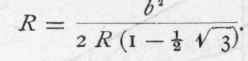
Multiplying by R and reducing, we have -
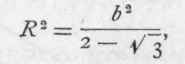
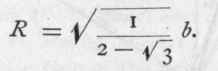
(144.)
Or: The radius of the circumscribed circle of a regular dodecagon, equals. a side of the dodecagon multiplied by the square root of a fraction, having unity for its numerator and for its denominator 2 minus the square root of 3.
Comparing the same triangles, as above, we have -
Fd; Fa :: Ea; Ec,
or -
n:R/2::b/2: r,
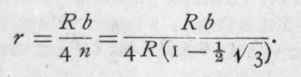
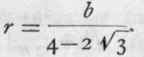
(145.)
Rule For Dodecagon
Or: The radius of the inscribed circle of a regular dodecagon equals a side of the dodecagon divided by the difference between 4 and the square root of 3.
The area of a dodecagon is equal to twelve times the area of the triangle ADC (Fig. 291). The area of this triangle is equal to half the base by its perpendicular; or, A E x EC; or -
b/2 x r, or, where N equals the area -
N = 1/2 b r.
Or, for the area of the whole dodecagon -
12 N - 6 br, A =6br.
Substituting for r its value as above, we have -
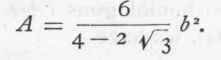
(146.)
Or: The area of a regular dodecagon equals the square of a side of the dodecagon, multiplied by a fraction having 6 for its numerator, and for its denominator, 4 minus twice the square root of 3.
438 - Hecadecagon: Radius of Circumscribed and Inscribed Circles: Area. - Let A B CD (Fig. 292) be a square enclosing a quarter of a regular octagon CE FB, E F being one of its sides, and CE and FB each half a side, while FD is the radius of the circumscribed circle, and FD the radius of the inscribed circle of the octagon. Draw the diagonal A D; with DF for radius, describe the circumscribed circle EGF; join G with F and with E; then EG and GF will each be a side of a regular hecadecagon, or polygon of sixteen sides.
An expression for FD, the radius of the circumscribed circle, may be obtained thus: Putting FD = R; HD = r; GF = b; GJ - n and JF = s/2 (Art. 416), we have -
GJ2 = GF2 - JF2
n2=b2-(s/2)2.
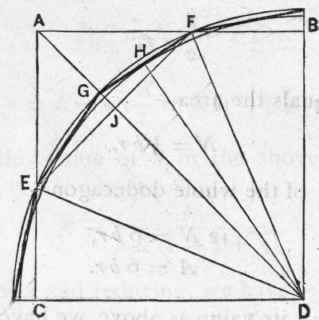
Fig. 292.
Comparing the two homologous (Art. 361) triangles, GJF and FHD (Art. 374), we have -
Gj: Gf:: Hf: Fd,
n: b :: b/2 : R,
n = b2/2R'
n2=b4/4R2
Putting this value of n2 in an equation against the former value, we have -
b4/4R2 = b2 - (s/2)2.
In Art. 436, the value of F D, as the radius of the circumscribed circle of a regular octagon, is given in equation (141.) as -
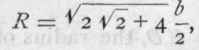
in which b represents a side of the octagon, or EF, for which we have put s. Substituting s for b and putting the numerical coefficient under the radical, equal to B, we have -

Squaring each member gives -
R2 = B(s/2)2
From which, by transposition, we have -
R2/B = (s/2)2.
Substituting in the above expression for (s/2)2 , this value of it, gives -
b4/4R2 = b2-R2/B
Transposing, we have -
b4/4R2 + R2/B = b2.
Multiplying the first term by B, and the second by 4R2, we have -
Bb4/4BR2+4R4/4BR2=b2,
Bb2 + 4R4 /4BR2 = b2
Bb4 + 4R4 = 4BR2b2.
Transposing, we have -
4R4-4BR2b2= -Bb4.
To complete the square (Art, 428) we proceed thus -
R4 - BR2b2 = -1/4Bb4,
R4-BR2b2+(1/2Bb2)2 = (1/2Bb2)2-1/4Bb4.
Taking the square root, we have -

Restoring B to its value,

as above, we have -
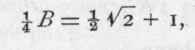

multiply these -
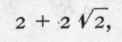


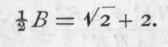
Therefore -
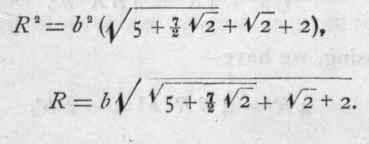
(147)
Or: The radius of the circumscribed circle of a regular hecadecagon equals a side of the hecadecagon multiplied by the square root of the sum of two quantities, one of which is the square root of 2 added to 2, and the other is the square root of the sum of seven halves of the square root of 2 added to 5.
To obtain the radius of the inscribed circle we have (Fig. 292) -
HD2 = FD2 - HF2
r2 = R2 - (b/2)2
Substituting for R2 its value as above, we have -
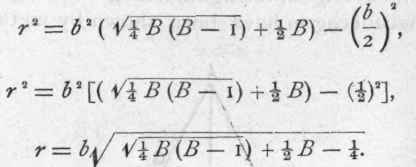
The coefficient of b is the same as in the case above, except the - 1/4; therefore its numerical value will be 1/4 less, or -

Continue to:


My Books

