


Dry Rot
Description
This section is from the book "The Engineer's And Mechanic's Encyclopaedia", by Luke Hebert. Also available from Amazon: Engineer's And Mechanic's Encyclopaedia.
Dry Rot
A term applied to that rapid decay of timber by which its substance is converted into a dry powder, which issues from minute tubular cavities resembling the borings of worms. On the causes of this decay numerous volumes have been written, and nostrums for its prevention or " cure" have been proposed without number, yet the dry rot continues to ravage our houses, and to destroy our ships. It has been said that moist and warm situations, where the circulation of the air is impeded, is the generating cause of this disease, and that the effluvia from timber so diseased will carry its effects to the circumjacent timber; and that any sort of wood, dry as well as damp, so exposed, will be soon destroyed. Timber once infected cannot be restored, and the only remedy lies in cutting away the diseased parts, to prevent the extension of the evil to the remainder; and to effect even the latter a free circulation of air must be admitted, and the parts be washed over with a strong solution of iron, copper, or zinc.
Patents have been granted for various applications of the latter, as preventives of the dry rot, the distinguishing features of the processes therein employed consisting in first preparing the timber by a good steaming, or drying out of the sap, and afterwards injecting, soaking, or boiling the timber in a solution of copperas, or other metallic salt. The following observations on this important subject were some time since addressed to the editor by Mr. John Gregory, who is an experienced and observant shipwright; and as they appear to mark out clearly the true cause of, and to suggest a very simple remedy for, the evil, it is right to give them a place in this work. Mr. Gregory says, "Instead of squaring a piece of timber according to the usual method, by leaving the heart of the tree in the centre.
my plan is to saw it light down the middle, through the heart, into two equal parts, immediately after the tree is felled; and my reasons for this l will now endeavour to explain to the best of my ability. It is, l believe, a well-known fact, that a tree does not, literally speaking, die on receiving the final stroke of the axe, but that it continues for a long period afterwards to vegetate, though less vigorously. At length, however, the sap ceases to circulate, the pores become closed, and the juices of the tree thus shut up undergo decomposition, and lay the foundation of dry rot. It is well known that a man who dies in a full habit of body soon decays; the same effect takes place in a tree full of sap, unless we adopt the same method with respect to it as the Egyptians practised with the human body, viz. that of depriving it of all moisture, which process would give to our timber a durability almost everlasting. My mind has been long impressed with this idea, which has been confirmed by my having recently noticed that several of the timbers in a very ancient public building, which had been sawn originally in the manner l have proposed, were perfectly sound, although they had withstood the dilapidating hand of time for seven hundred years; while other timbers in the same building, which had not been so cut, but apparently squared out with the heart in the centre, were perfectly rotten.
That the dry rot is certainly caused by the juices being enclosed in the heart of the timber, l have had frequent opportunities of observing during my long practical experience in the repairing of ships. In the frame of a ship in which such large quantities of timber are employed, l have uniformly noticed, First, that the decay commences in the run fore and aft, which is owing to the timbers being fitted so close together at the heels or lower ends. The evil being thus enclosed in the hearts of the timbers, and the air having no access to the exterior of them to carry off the moisture by evaporation, internal decay is the necessary consequence. l have sometimes witnessed these parts of the frame of a ship in such a rotten state as to have been justly compared by the workmen to a heap of manure. Secondly, those timbers in the midships that have been bored off with the outside planks are not so affected, which l attribute to the circumstance of the holes admitting a current of air through them, the destructive juices being thereby carried off. Thirdly, it frequently happens that the floor timbers of an old ship are found, on breaking up, to be nearly as sound as they were when first put in.
Their preservation seems to be owing to the effect of the salt water which constantly laves over them, causing them to become in a manner pickled; or it may be, that the salt entering into the composition of the wood, the destructive effects of its natural juices are thereby prevented. Fourthly, the planks in the bottom, nearest to the timbers, take the infection first; and where the tree-nails are not close, the disease rapidly extends endways of the grain. Fifthly, those parts of the deck planks that lie upon the beams are those which are first infected with the rot, the cause of which is evident, as those parts that are between the beams are generally quite sound. Sixthly, in the beams of ships the decay usually commences in the internal parts, which is decidedly owing, in my opinion, to the erroneous method of preparing the timber, as before mentioned; but when timber, so prepared, is used, l would recommend, as the best preventive of the rot, that a few holes be bored through the beam fore and aft, and, what would still add to the benefit, to bore another hole lengthways of the grain, to meet those which are bored crossways.
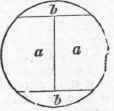
But the best preventive, l am confident, would be the adoption of my mode of preparing the timber, namely, to saw it lengthways right through the heart, by which not only much greater durability would be obtained, but great economy in the consumption of the timber, as well as a great increase of strength, which l will proceed to explain by reference to the annexed figure, which exhibits an end view or section of a piece of timber. Having procured a log of the shape required, first cut off the two slabs b b, and then divide the remainder a a into two equal parts. Being thus sawn through the heart, the air will rapidly absorb the juices, and such a seasoning may be soon effected as will, l have no doubt, completely prevent the dry rot. But my object in this place is to show the economy of the plan in a mechanical point of view. By thus sawing a log through the middle, two timbers are immediately provided instead of one, and both of one precise mould. Thus when the pieces a a in the above figure are placed end to end, they will form two timbers exactly similar, as appears by the annexed figure.
The expedition gained by this method of converting timber is . obvious; every ship-builder is fully sensible of the difficulty he is often put to, and of the sad waste of time and labour often incurred in preparing two such timbers to match one another. It not unfrequently happens that the framing of a ship stands still for several days owing to this circumstance. The saving of time and labour is in consequence an important saving in the expense of building. l have also proved by experiment that this mode of sawing the timber down the middle confers great additional strength. From the same bough l cut two pieces of the same length and thickness; one of them l squared according to the usual plan, which l condemn, the other, according to my proposed method, leaving the circular sides, as shown at a a in the foregoing figures. The proportional strength of only one of the pieces l found to be as 25 compared to 27, the strength of the whole square timber; the strength of the two pieces, therefore, makes the difference of 50 to 27, or nearly double; in addition to which advantage, far greater durability will be obtained by the prevention of the dry rot.
For the timbers of a 74-gun ship, logs of 22 inches diameter are usually employed; if these, instead of being squared, are divided according to my method, their strength and width of bearings for the planks will be fully adequate, and the little difference of strength may be easily compensated by two or three more timbers, for which there will be plenty of room, and the saving of expense will thereby be immense. By the most accurate calculations that l have been enabled to make, l find the saving in timber only to be full one-third. The annexed sketch represents a horizontal section of a small portion of a ship's side, with the arrangement of the timbers according to my plan, a a a, three of the ship's timbers; b b b b, the fittings made from the slabs before mentioned, which are uniformly of a suitable shape; c c are air passages, which serve effectually to carry off whatever moisture may remain in the timber, the hearts of the trees being exposed to the air. It will likewise be perceived that the circular form of the grain being retained, the strength of the timber is better preserved than if the logs were squared, as l have proved by the before-mentioned experiment.
From long observation and repeated investigation l am indeed convinced that the outside, or younger part of a tree, is stronger, more durable, and more seaworthy, than the heart, notwithstanding l have daily witnessed the preference given to the latter, while the former has been used for fuel. In the repairing and breaking up of ships, it will be almost invariably found that the decayed planks have the heart of the tree, and the sound ones, not; it follows, therefore, that the present system of lining is very defective. To lessen the charge of carriage, it is not unusual to side the logs where the trees are felled. Now, if the trees were also sawn down the middle in the forest, an increased facility of removal would be acquired, and the timber would be seasoning, and probably be fit for use, ere it came into the dock-yard. The longer a tree remains whole after it is felled, the more sap it will contain, and the more rapid will be its decay. l have seen many trees that were sound when felled, decay from the heart outwards, owing to their lying a long time with their juices shut up in them.
The dividing of the trees would have preserved them."
Continue to:


My Books

